SpaceX will need suppliers for Mars settlement

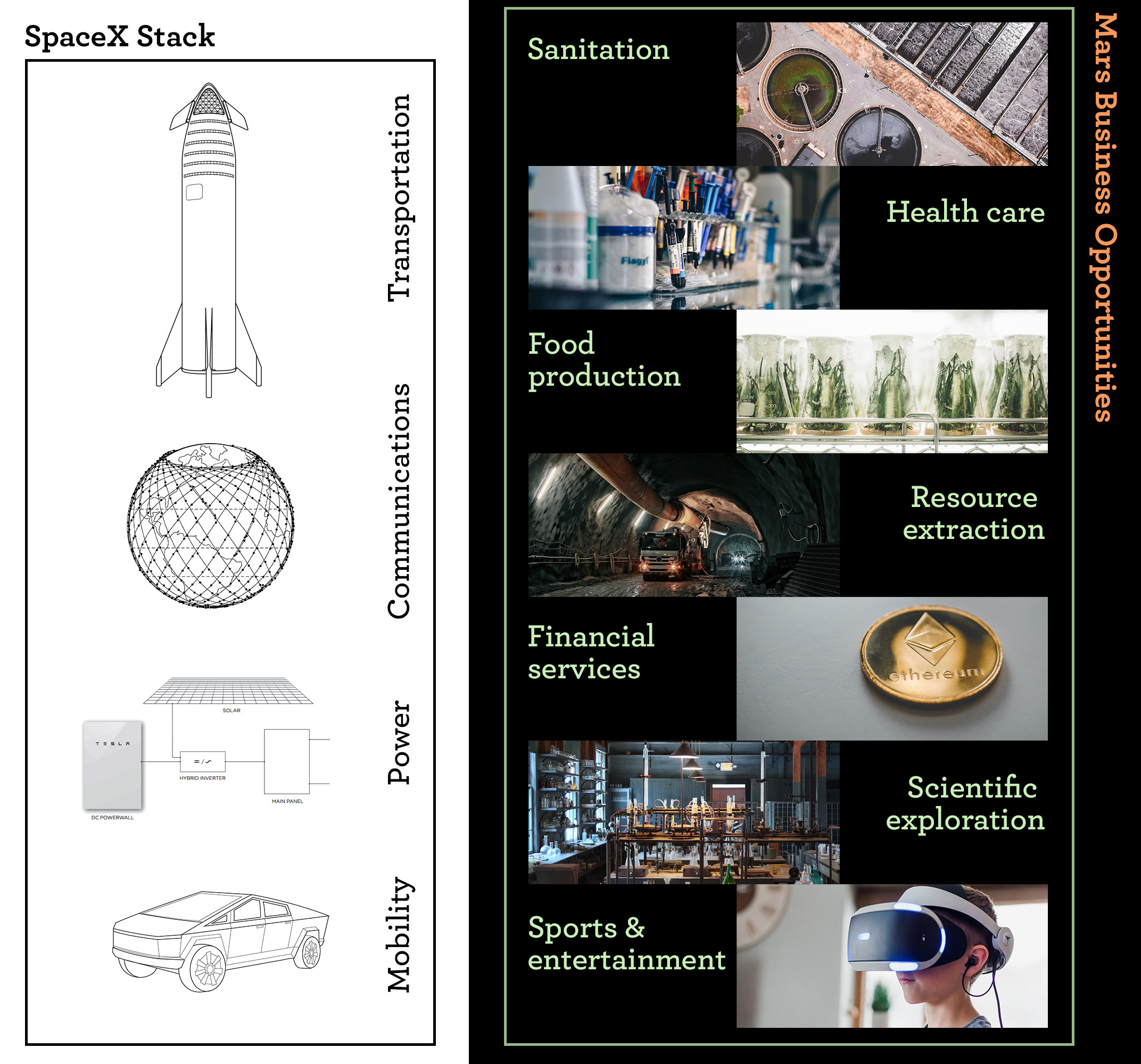
In a thread on Twitter, Kevin Cannon suggests that suppliers for services that SpaceX will need to settle Mars such as sanitation, medical supplies, entertainment, finance and others, get started sooner rather then later laying out their plans if they want to be selected to help settle a new world.

Image
Image credit: Kevin Cannon

Accessibility of lunar ice

In a recent thread on Twitter referring to a forthcoming paper, Kevin M. Cannon calculates the optimum path for rover access down into the cold traps in lunar craters at the Moon’s poles. The entire dataset including an ice prospecting guide is available on Cannon’s website which is now linked on our In Situ Resource Utilization page

Lowest-energy, lowest-distance and lowest-slope paths from illuminated, flat staging areas outside the cold trap to a target within it. Image and text credits: Kevin Cannon via Twitter

Spinning fiber from lunar regolith

A European student team call Ampex 20 is working on a project called MoonFiber which aims to automate production of glass fibers on the Moon. Applications include fabrication of composites, thermal insulation, fabrics and other products requiring woven material. Products made in-situ from local materials significantly reduce costs by not having to transport them from Earth.

Spinning unit capable to withstand the Moon environmental conditions. Image credit: Ampex 20

The MoonFiber project is being conducted by RWTH Aachen University in Germany. A teaser video is available here.

Making Mars soil fertile

A just released study published in the journal Plants documented the results of experiments to find the best ratio of compost to Martial soil simulant to effectively grow nutritious butter lettuce with the least amount of water while optimizing crop performance. Such findings will enable in situ resource utilization and reduce the mass of supplies needed to be transported to Mars to support farming in human settlements.

Living off the land (and air) on Mars

If we ever settle Mars, in-situ resource utilization (ISRU) is essential for sustainability of a Martian colony as dependence on Earth for resupply would be too expensive. UC Berkeley and Lawrence Berkeley National Lab chemists are developing a biohybrid system which attaches bacteria to nanowires that when exposed to sunlight and locally available carbon dioxide and water, produce a useful organic compound called acetate. Acetate is a building block for a range of products including fuels, plastics, drugs or even yeast. A byproduct of the chemical reaction is oxygen, which could be used for breathable air. There is even a dual use on Earth for carbon capture.

A device to capture carbon dioxide from the air and convert it to useful organic products. On left is the chamber containing the nanowire/bacteria hybrid that reduces CO2 to form acetate. On the right is the chamber where oxygen is produced. (UC Berkeley photo by Peidong Yang)

Let there be Lunar Flashlight

NASA’s Jet Propulsion Laboratory is developing a CubeSat that will utilize near-infrared lasers and an onboard spectrometer to prospect for ice in the permanently shadowed craters at the Moon’s south pole. The suitcase size spacecraft will inform future Artemis missions on where to begin in-situ resource utilization of this valuable commodity for space settlement

This artist’s concept shows the Lunar Flashlight spacecraft, a six-unit CubeSat designed to search for ice on the Moon’s surface using special lasers. The spacecraft will use its near-infrared lasers to shine light into shaded polar regions on the Moon, while an onboard reflectometer will measure surface reflection and composition. Image credit: NASA/JPL-Caltech

Easy extraction of lunar water with Aqua Factorem

Philip Metzger of the University of Central Florida (UCF) has just been awarded a Phase I NIAC grant to investigate an innovative water harvesting process that will be cheaper then conventional methods.

“This simple architecture requires the minimum number of in-space elements, and notably does not require an in-space propellant depot, so it provides the lowest cost and lowest risk startup for a commercial operation. The study will also test the innovative Aqua Factorem process through laboratory experiments, and this will produce basic insights into the handling of lunar resources”

Revised 6 May 2020: UCF/Today has an update on this story.

An illustration of what the UCF developed process could look like on the moon. Credit: NASA and Jessica Woodward/UCF

MAXIM – Maximum Impact Moon Mission

The University of Southern California’s Department of Astronautical Engineering has just published the final report of Dr. Madhu Thangavelu’s, course ASTE 527 Space Concepts Studio, the theme of which features the MAXIM architecture proposed for NASA’s Artemis program for return of humans to the moon. Be sure and watch the recorded presentation of the report which features the classic video “Wanderers” with commentary written and narrated by Carl Sagan. The class is held each fall and has an archive of each year’s reports, an excellent repository of creative concepts for space development.