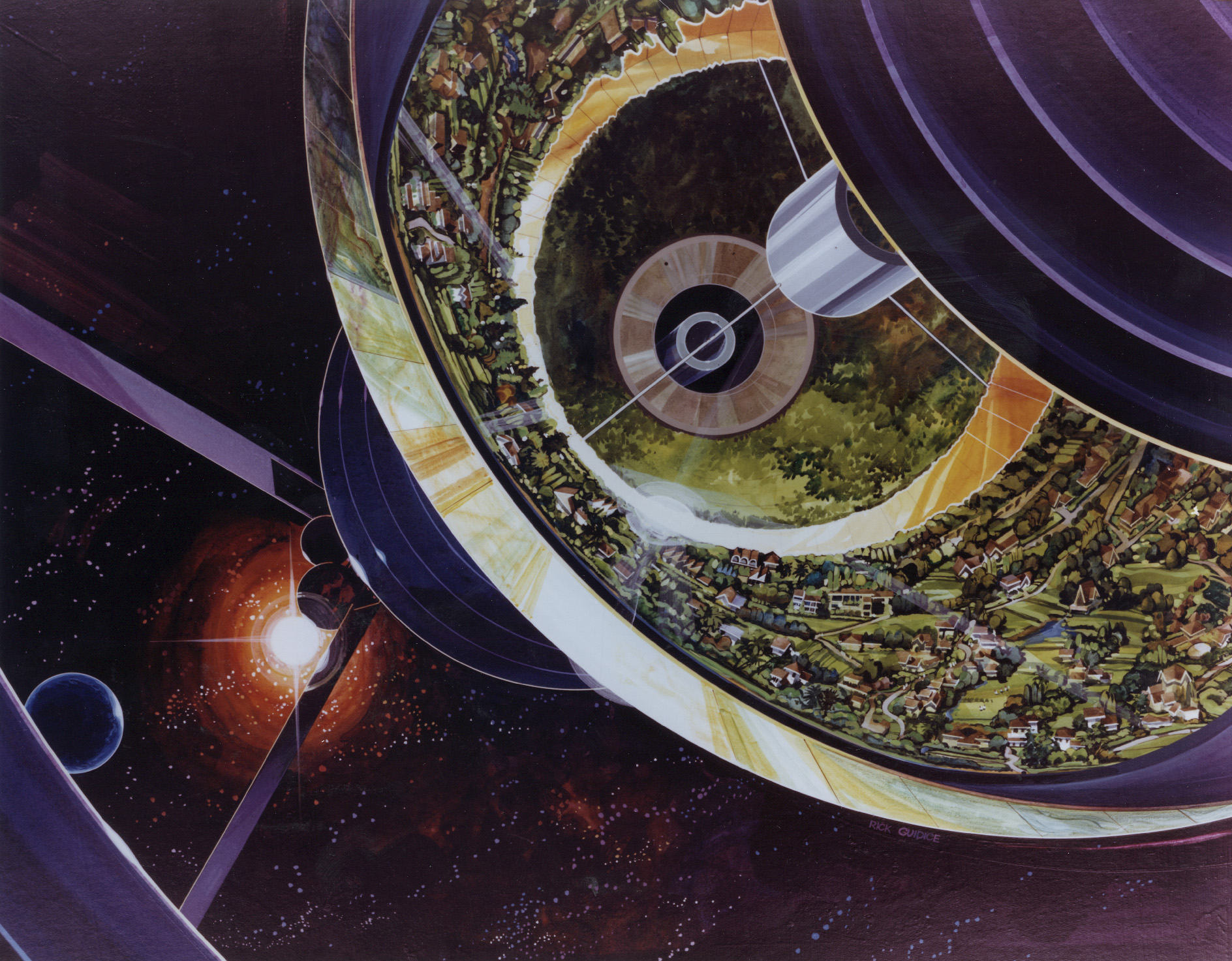

Erasmo Acosta thinks we might be headed in the wrong direction, that we may be suffering from planetary chauvinism and the better way may be to colonize space with O’Neill cylinders. He makes his case in a post on the Predict section of Medium. SSP has long been a strong proponent of free space O’Neill-type settlements, the advantages of which are numerous, not the least of which is 1G artificial gravity to prevent detrimental human health issues that may arise for occupants of colonies with lower gravity on the Moon or Mars. Such space settlements would house millions of people in perfect 70 degree controlled weather without the threat of natural disasters.
Jeff Bezos has advocated for this philosophy with the aim of moving heavy industry off world and preserving Earth’s environment for “residential zoning”. Recent developments seem to indicate he may be spending more of his time focusing on the realization of that vision.
Acosta, a retired software engineer, feels so strongly that O’Neill cylinders will be the preferred mode of space settlement he wrote a novel called K3+ which depicts a future in the next century where humans will be living in thousands of O’Neill cylinders in a “post-scarcity” civilization of virtually unlimited resources. Acosta envisions Mercury as a source of raw materials:
“The planet’s proximity to the sun, its low gravity, and metal-rich concentration make it the ideal source of raw materials for constructing thousands of O’Neill cylinders.”
In a previous post on Predict, he explains how to kickstart a program for harnessing space resources to fabricate these colonies.
After many years of construction, multiple rings of rotating habitats would eventually encircle the sun harnessing a vast amount of the energy output of our star approaching the configuration of a Dyson sphere.

Finally, as a tribute to the father of free space colonies and an inspiration for a generation of space settlement advocates, I’d like to close out this post with a link to the just released trailer for the much anticipated documentary: The High Frontier, The Untold Story of Gerard K. O’Neill.


