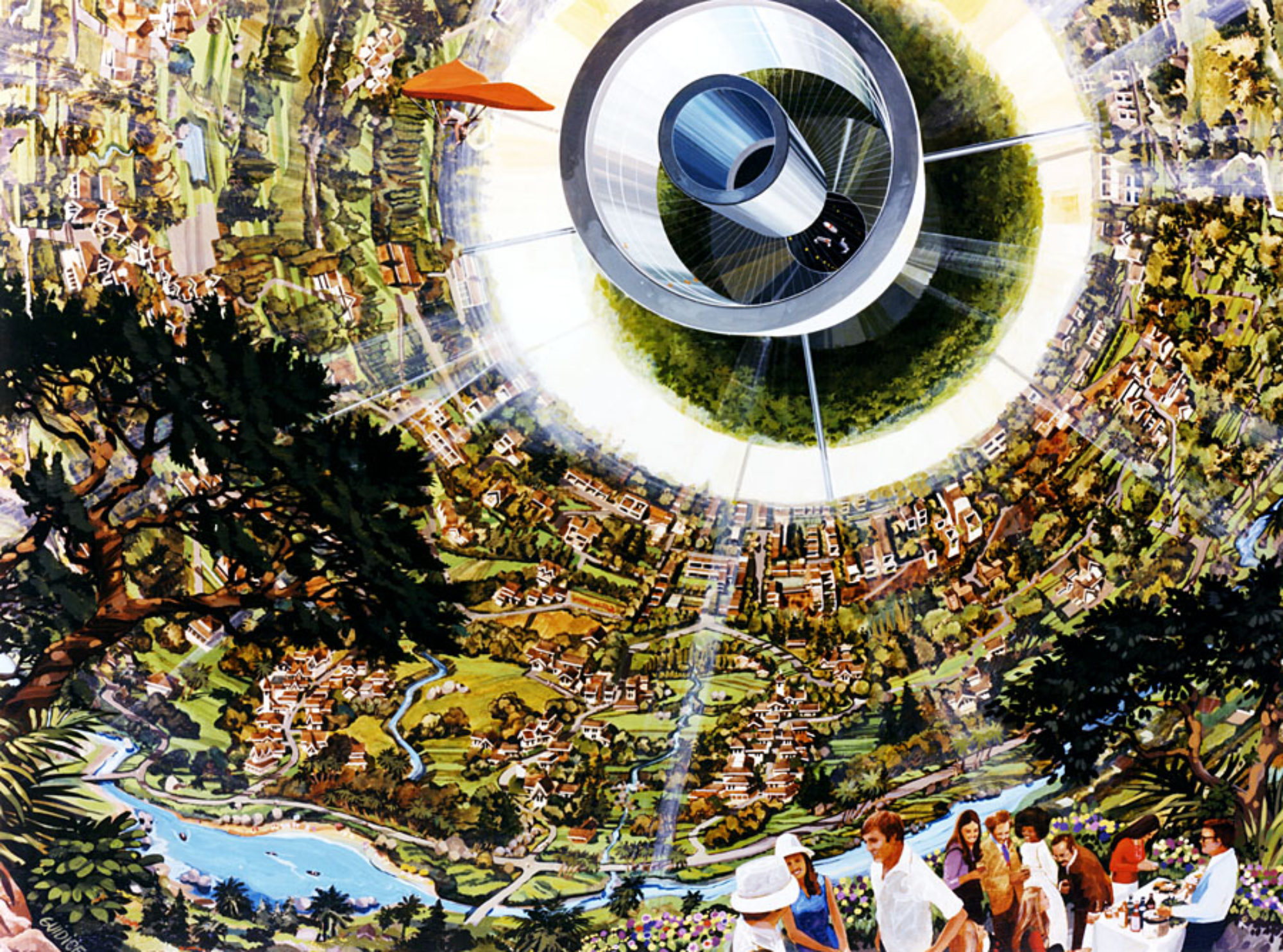
It’s time once again for the National Space Society’s annual Space Settlement Contest open to students from anywhere in the world up to grade 12. If you are a budding space settlement designer or have kids that are excited about creating communities in space, now is your chance to share your family’s vision in friendly competition with other space enthusiasts. Details can be found at the NSS Space Settlement Contest website curated by Al Globus.
Image of ASM Corporis, winner of 2019 NSS Space Settlement Contest. Credits: Aerospace Meridian / Illustration by Austin Pham. Corporis logo by Jayde Whiting / The Aerospace Meridian
The Space Show – the nation’s first talk radio show focusing on increasing space commerce, advancing space science and economic development, facilitating our move to a space-faring economy which will benefit everyone on Earth – needs your help. The Space Show is hosted by Dr. David Livingston, who completed his doctoral dissertation in 2001 on the commercialization and expansion of space development. Take a moment to visit The Space Show website and read Dr. Livingston’s end of year message. Please give generously to ensure this valuable resource continues to promote, encourage, and support future global economic opportunities, scientific discoveries, and medical advances for all humankind through peaceful and cooperative ventures in outer space.
Space is Open for Business by Robert Jacobson is a must-read for all potential “astropreneurs” (entrepreneurs involved the NewSpace economy), space advocates, investors or anyone who wants to keep current on space commerce and its impact on the future of humanity. This book is a refreshingly positive view of our future in space, a welcome alternative outlook in stark contrast to many dystopian and negative predictions of where we’re headed in today’s media.
Jacobson covers all aspects of the nascent space economy which has already begun to grow in leaps and bounds, and is headed for explosive growth in the near future. No stone is left unturned by his deep research of all aspects of space commerce, with scores of interviews of executives from both established and small startup space companies.
I especially liked the Sci-Fi and Society chapter in which Jacobson talks about science fiction “illuminating the possibility of the space frontier”. Much of what is now happening in space was predicted in science fiction in the last century. Many CEOs and executives of NewSpace companies were inspired to pursue careers in science or engineering through science fiction books, televisions shows and movies.
Eventually, humanity will evolve to migrate off Earth and establish space settlements throughout the solar system and eventually among the stars. Development of the technologies and commercial activities for space settlement have the potential to create vast wealth, bring billions of people out of poverty and preserve Earth’s natural environment. Jacobson has provided a hopeful glimpse of how the space businesses supporting this effort will manifest this destiny.
Solar Power Satellite delivering wireless power to the UK during daylight hours. (NOTE: power would be delivered 24/7). Credits: Frazer-Nash Consultancy
The United Kingdom’s Department of Business, Energy and Industrial Strategy (BEIS) is commissioning a study by the engineering consultancy Frazer-Nash on the feasibility of space-based solar power for delivery of clean, emission free energy to the country’s electrical power grid 24 hours a day. The study, announced on the Frazer-Nash website, will provide an impartial assessment for the government of the engineering viability, budget and economic benefits of space-based solar power for the UK. Frazer-Nash will partner with Oxford Economics, a global forecasting and quantitative analysis company.
Some key challenges expected from the investigation include: a realistic analysis of the scale of the engineering undertaking to build a satellite of such magnitude in space; can the economics justify the effort to be competitive with other sources of power generation; and finally, what are the international regulatory implications of radio frequency spectrum allocation?
Solar Power Satellite delivering wireless power to the UK at night. (NOTE: power would be delivered 24/7). Credits: Frazer-Nash Consultancy
Artist’s concept of a rectenna, a ground site that receives the microwave power transmission from a solar power satellite and converts it into electricity for a utility grid or other users. Credits: James A. Vedda and Karen L. Jones, The Aerospace Corporation
Space enthusiasts have been dreaming of the promise of space-based solar power ever since Peter Glaser first conceived of the idea in the 1960s and Gerald K. O’Neill leveraged the concept to popularize space settlements in his ground breaking book The High Frontier. But the costs have been preventatively high for many years and the technology has been stubbornly out of reach. Recent events and scientific advances have begun to change this situation. For example, launch providers are becoming more widely available and costs are coming down. Photovoltaic cell efficiency has dramatically improved since solar power satellites (SPS) were first conceived. On orbit robotic assembly, additive manufacturing and mass production is within reach. Finally, ISRU on the moon could provide access to materials outside the Earth’s gravity well dramatically reducing the cost of materials needed to build SPSs in space.
In a position paper released last month by The Aerospace Corporation’s Center for Space Policy and Strategy, recommendations are made for policy decisions by the U.S. government to make strategic investments in development of this space infrastructure, lest other countries beat us to the punch.
The authors of the paper, James A. Vedda and Karen L. Jones, say that “U.S. decisionmakers will have an opportunity during the next presidential term to establish the role of the United States in this potentially disruptive technology. If SPS can develop into a major component of orbital infrastructure, and someday contribute an additional source of renewable energy to users on Earth, the United States will want to be at the forefront of high-capacity power beaming in all its applications rather than become dependent on others for the technology and services they provide.”
Artist’s rendering of settlements on the Moon. Credits: Taylor Herring/Samsung via Futurism.com
A melding of multiple disciplines is required for creating a positive human space future that will enable space settlement. In addition to aerospace engineering, architecture and the traditional physical sciences we associate with space exploration, the fields of sociology, philosophy, art, space law and may others will be needed. A method for integrating these fields and coordinating them across the private sector, universities and government has been developed in The Interplanetary Initiative, a pan-university venture created at Arizona State University. The innovative research model is described in a paper in the September 2020 issue of New Space. The program turns students into team leaders and collaborators, equipping them with the skills and knowledge to solve problems anticipated to be encountered as humans expand out into the solar system.
Artist’s concept of an O’Neill space colony. Credit: Rachel Silverman / Blue Origin
J. N. Nielsen has a theory…or four. Picking up where he left off in his previous Bound in the Shallows post on Centauri Dreams about the origins of a spacefaring civilization, Nielsen explores the possibility that the nuclear rocket or fusion power may be the indispensable transformative technology that will enable breakout of a spacefaring future. But even if we develop the capability of nuclear propulsion, it may not be sufficient. We need a “mythology” to enable humanity’s next central project. As Nielson defines it, a mythology “… is a kind of recapitulation in which the contributions of ages past—whether biological, psychological, social, or cultural—are each given their due, and these antecedents serve as a springboard to something authentically novel, something unprecedented that facilitates human beings to transcend their past and to accomplish something unprecedented.”
As happens every time, whenever I dig into Nielson’s rich writings I loose myself in a beautiful philosophical landscape of culture. Give yourself some time to ponder and absorb these insightful hypotheses on what is needed to settle the solar system and beyond…and visit his Grand Strategy: View from Oregon site for more politics, economics, warfare, religion, and philosophy with a focus on civilization which often leads to consideration of the future and space exploration.
Artist’s concept of an O’Neill space colony. Credits: Blue Origin
In a thread on Twitter Philip Metzger, a planetary physicist at the University of Central Florida, updates his bootstrapping vision from a few years back in which he and colleagues at NASA published a paper on how robotics, 3D printing and in situ resource utilization could be leveraged to accelerate a solar system civilization. In a series of 9 Tweets, Metzger makes the case for his “Rapid Bootstrapping Scenario” as the preferred course out of three possible alternatives to get us there faster.
Many space enthusiasts, including Blue Origin CEO Jeff Bezos, advocate for what Metzger calls a solar system “Civilization Fully Revolutionized”. This is a future where most industrial manufacturing is done sustainably in space and Earth is preserved as a beautiful natural environment.
If we continue on the current path, down what Metzger calls “The Slow Growth Scenario”, space agencies like NASA will continue paving the technological highway for private entities to slowly develop their profitable enterprises. But because space exploration and development is difficult, a different approach is needed to prime the pump. Metzger suggests the preferred course of action is intentional pre-economic bootstrapping in which “…visionary individuals with means, citizen-led movements, or governments that see the long-term benefit of getting beyond our planetary limit…create a coalition of likeminded citizen movements and enlightened governments committed to a good future so we reach the ‘ignition’ point first by being fast”.
Source: Philip Metzger/UCF. @DrPhiltill. www.philipmetzger.com
One of the biggest challenges of space settlement facing humanity is procreation off world. We simply don’t know if its possible for a baby to be carried to term in less then one gravity. There are obvious ethical considerations of simply going there and trying it out. NASA is studying the problem but until we have a variable gravity centrifuge facility in space that will enable us to determine the “gravity prescription”, it will be a while before we have an answer.
In an article in The Space Review, Fred Nadis discusses some of the medical challenges of human reproduction in space and why one company, SpaceLife Origin, who’s mission was to enable human reproduction in space decided to suspend its planned missions for “Serious ethical, safety and medical concerns …”
These medical unknowns about reproduction in any gravitational field less then 1g is the obvious attraction of O’Neill type free space settlements which provide Earth normal gravity. But the huge scale and investment necessary to build such large scale settlements puts this approach far in the future. Al Globus thinks a better way might be to start with smaller spinning habitats in low earth orbit.
Asgardia’s has a key scientific goal of facilitating the first human childbirth in space which they believe is a crucial step on humanity’s “path to immortality as a species”. In preparation for that goal, the organization is creating the first sovereign nation in space. A good introduction to their plans can be found in an interview with Dr. Lena De Winne, the Head of Administration to the Head of Nation of Asgardia, who appeared on the Space Show recently.
Artist’s impression of the first human born in space. Credits: Asgardia
The Pathfinders’ Guide to the Space Enterprise. Credits: The Aerospace Corporation.
The Aerospace Corporation has created a visually stunning chart called “Pathfinders’ Guide to the Space Enterprise” in which they provide a glimpse into the nascent space economy based on hundreds of ideas from over 70 world-class space experts condensed into seven core themes about how the future could unfold. The analysis, which is both deep and thought provoking, identified two critical uncertainties shaping the the future of space development:
1. The degree in which space will be “commercialized.” How much will space exploration and exploitation be designed to seed the commercial ecosystem?
2. The evolution and potential transformation of global power states. What space-based leverage points could change the terrestrial power balance?
Their hope is to “…inspire your internal adventurer to think about how space can and will play a role in the future and how we get there.”