Caelus publishes study on terminology of commercial space activities, completes Sino-US Space Commercialization Perspectives Workshop

Credits: Caelus Foundation

The Caelus Foundation, a nonprofit who’s mission is to advocate for broad participation in the space domain and to engage and empower people around the world to build a space-centric community through their decisions and actions, has just published a research paper providing an understanding of common terms important for achieving positive benefits from commercial space activities, and in establishing supportive and appropriate regulatory frameworks.

The authors summarize their findings with this conclusion: “This research has revealed that there are significant challenges with communicating the value of space enterprises, given the common terminology used today. This is largely due to the root word for the industry, ‘space,’ being a term that does not naturally convey any specific type of value. Terms such as ‘commercial space’ and ‘newspace’ attempt to compensate for this issue. Yet, as our interviews showed, the lack of clear and universal understanding of these words creates new challenges, while not fully addressing the obstacle of communicating the idea of space as a domain of economic and strategic value.”

On September 19th, Caelus participated in the Sino-US Space Commercialization Perspectives Workshop co-hosted by the Secure World Foundation and the Chinese Society of Astronautics. The purpose of the workshop was to create a dialogue “… to share and understand perspectives from both US and Chinese stakeholders on how space commercialization is happening in both countries, and what can be done to increase transparency between both commercial contexts.” A full debrief is being prepared in partnership with Secure World and will be made available to the public when completed in the near future.

Rob Ronci, Caelus Executive Director and co-author of the research paper appeared on The Space Show November 22 hosted by Dr. David Livingston on which I called in and discussed the above topics with him. You can listen to the show by downloading the recording on the The Space Show website.

Design solutions for safe lunar habitats

Artist’s impression of an inflatable habitat on the Moon. Credits / NASA, Gary Kitmacher

Haym Benroya, Distinguished Professor of Mechanical and Aerospace Engineering at Rutgers University and author of Turning Dust to Gold, Building a Future on the Moon and Mars gave a presentation recently at a workshop of the Engineering and Physical Sciences Research Council. EPSRC is the main funding body for engineering and physical sciences research in the UK. The event kicked of a project sponsored by the EPSRC called Designing for the Future: Optimizing the structural form of regolith-based monolithic vaults in low-gravity conditions. Benroya shared his presentation with me in which he discusses the design challenges and solutions to optimize a reliable and safe lunar habitat.

The design of space settlements on the Moon will have an array of engineering challenges including protection from radiation, meteoroids, temperature extremes and Moonquakes. In addition, human factors such as psychological and physiological aspects associated with isolation and the lower gravity conditions need to be taken into consideration. This presentation summarizes all the key design constraints, especially those surrounding the thermal and seismic conditions, laying the engineering groundwork for safe dwellings that will be erected when we return to the Moon, hopefully this time to stay and thrive.

For the technically inclined who want more information on lunar settlement design methodology be sure and check out Benroya’s excellent book Building Habitats on the Moon: Engineering Approaches to Lunar Settlements.

And don’t miss our appearance along with Dr. David Livingston of The Space Show and Moonwards‘ Kim Holder at the Icarus Interstellar 2017 Starship Congress.

When will the first human be born off Earth?

Space baby. Credits: scienceabc.com

One of the biggest challenges of space settlement facing humanity is procreation off world. We simply don’t know if its possible for a baby to be carried to term in less then one gravity. There are obvious ethical considerations of simply going there and trying it out. NASA is studying the problem but until we have a variable gravity centrifuge facility in space that will enable us to determine the “gravity prescription”, it will be a while before we have an answer.

In an article in The Space Review, Fred Nadis discusses some of the medical challenges of human reproduction in space and why one company, SpaceLife Origin, who’s mission was to enable human reproduction in space decided to suspend its planned missions for “Serious ethical, safety and medical concerns …”

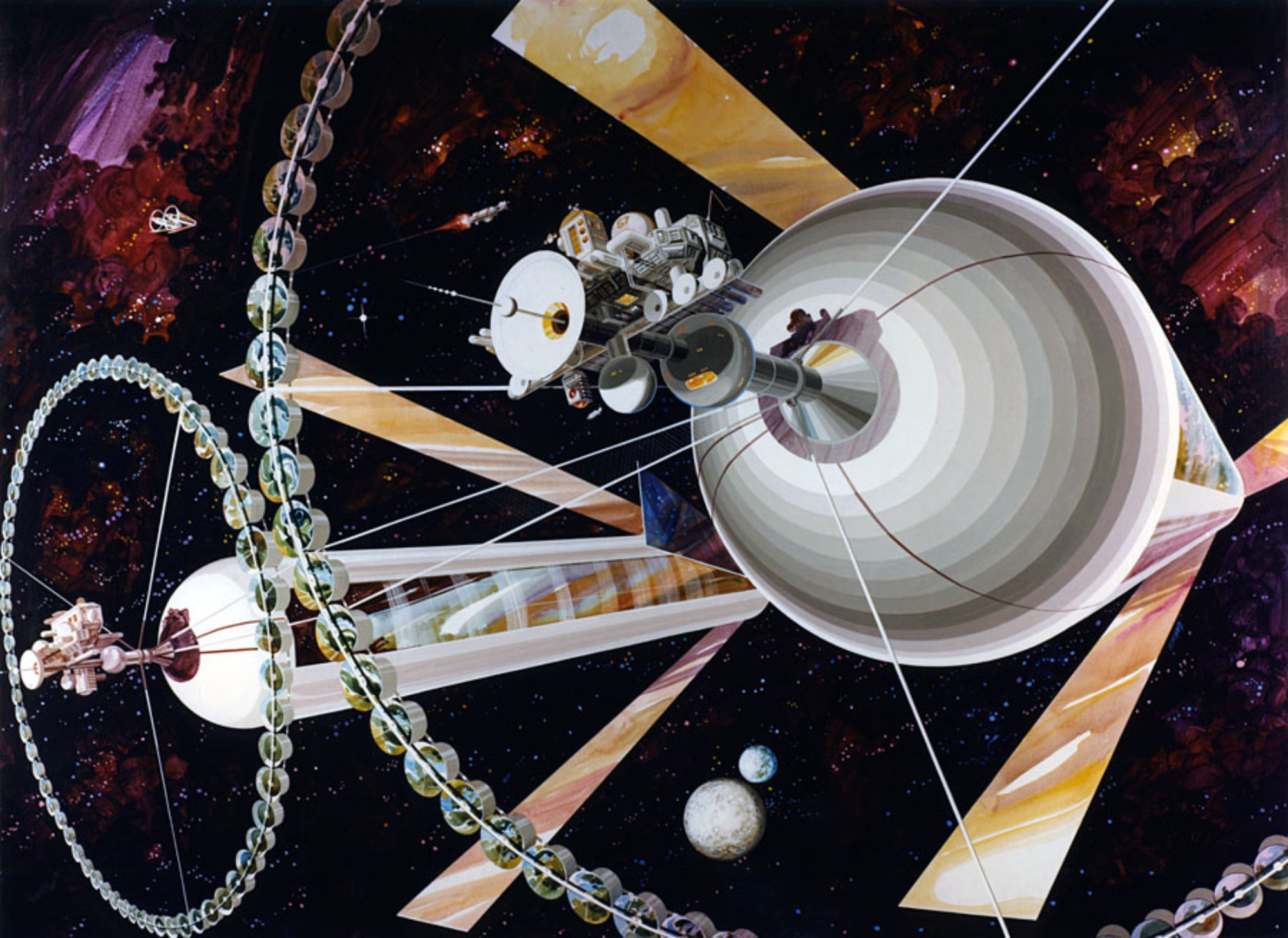
These medical unknowns about reproduction in any gravitational field less then 1g is the obvious attraction of O’Neill type free space settlements which provide Earth normal gravity. But the huge scale and investment necessary to build such large scale settlements puts this approach far in the future. Al Globus thinks a better way might be to start with smaller spinning habitats in low earth orbit.

Asgardia’s has a key scientific goal of facilitating the first human childbirth in space which they believe is a crucial step on humanity’s “path to immortality as a species”. In preparation for that goal, the organization is creating the first sovereign nation in space. A good introduction to their plans can be found in an interview with Dr. Lena De Winne, the Head of Administration to the Head of Nation of Asgardia, who appeared on the Space Show recently.

Artist’s impression of the first human born in space. Credits: Asgardia