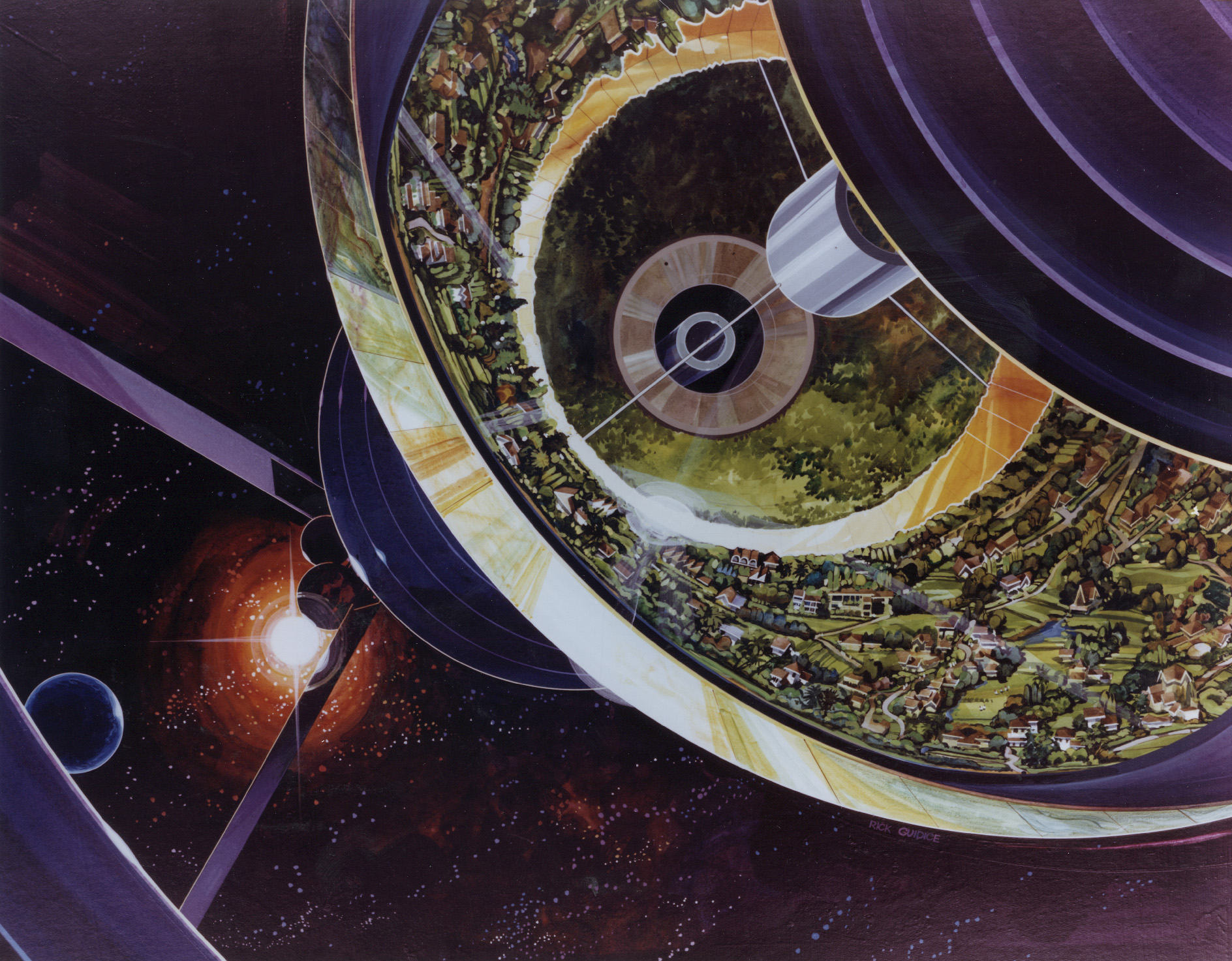

At a presentation at ISDC 2026, Orbital Construction Pioneers (OCP) introduced the First Step Manufacturing System (FSMS): an orbital additive manufacturing system that could potentially produce segments for very large structures (on the order of a few hundred meters long) using a bio-material derived from plants grown and processed in orbit.
Why is this important? Humanity’s long-term expansion into the solar system cannot be sustained by continuous resupply from Earth. The cost, complexity, and sheer mass penalties of launching every kilogram of food, water, oxygen, fuel, structures, and spare parts out of Earth’s gravity well become prohibitive as missions move farther out from low Earth orbit. In situ resource utilization (ISRU) has long been recognized as the only practical path to sustainability.
OCP has developed the FSMS as a promising architectural response to this challenge. FSMS is an orbital fabrication platform whose core innovation is biological additive manufacturing. Hydroponic and aquaponic farms operating inside a rotating space station would generate plant biomass that serves as both binder and filler for Stellamer, a bio-derived thermoset polymer. This material could enable continuous, large-scale additive manufacturing of structural components in an artificial-gravity environment. The system simultaneously produces life-support commodities and specialized mission components, creating a symbiotic industrial-ecological ecosystem.
George Tyson, CEO of OCP, came on The Space Show on July 28th to discuss the company’s plans and progress to date with David Livingston and me, along with several members of The Space Show Advisory Board. Tyson spoke with us from his lab in Colorado City, Texas, on the development of Stellamer and showed samples of the material he’s tested. When asked about the technology readiness level of flight-ready hardware and plans for orbital demonstration flights, Tyson indicated that it was still in the early research stages but as soon as they have optimized the Stellamer formulation and are satisfied with the performance of their prototype printer, the next milestone would be validation of the equipment under microgravity conditions on a parabolic flight platform.
Tyson also made an exclusive media announcement. In partnership with Hawaii-based Exo-Scientific, the companies are forming the Interplanetary Regen Network (IRN), a multi-party consortium focused on the collaborative development of bioregenerative systems, advanced in-space construction techniques, and ISRU technologies to sustain human presence beyond Earth. Exo-Scientific provides integrated solutions in engineered aquatic life systems for closed-cycle cultivation, ISRU management, and the practical application and adaptation of Earth-proven sustainability principles to offworld environments. I asked Tyson if Exo-Scientific would provide the life support systems for OCP’s space stations via their aquaponic ecosystems, but he was under an NDA at this juncture, so could not comment on the question. Exo-Scientific was also a presenter at ISDC2026 on their Coral Wetlab concept. Clearly, the company’s systems could be synergistic and complementary to OCP’s technology and plans.
The IRN is soliciting discussions with potential consortium members, government partners, research institutions, and commercial clients interested in advancing bioregenerative systems, in-space construction, and ISRU capabilities for cislunar, lunar, and Mars applications.
OCP’s long-term plan for full-scale implementation of FSMS is to start with the construction of Station 520 in medium Earth orbit (MEO), a 320-meter-diameter rotating habitat that would generate lunar-level artificial gravity at one revolution per minute. The pressurized volume would be approximately 774,000 cubic meters, sufficient to house extensive farms, processing equipment, habitation quarters, and specialized manufacturing functions such as pharmaceutical production and thin-film fabrication. A large-format 3D printer would sit at the geometric center, capable of producing structural segments up to 50 meters across and 6 meters thick. These segments would clad the station’s primary truss frame and enable the fabrication of additional modules.
OCP envisions construction beginning with the launch of seven Version 3 Starship-sized vehicles (or equivalent) that would deliver the essential components for assembly. These vehicles would contain enough scaffolding for the station skeleton, hydroponics and aquaponics materials, the necessary items for the construction of the 3D printer located at the center, plant processing equipment, food, water, air, tools, and EVA suits used by the construction crew. A repair station for EVA suit and equipment maintenance would also be provided, including a small startup crew’s quarters and work area.
Once the vehicles reach MEO, the scaffolding would be employed to build the station skeleton while incorporating the seven vehicles themselves into the emerging framework. Appropriate items such as propulsion systems, electronics, pumps, and related equipment would be relocated from the vehicles to their permanent placement on the scaffolding. The tanks and cargo areas of the vehicles would then be connected to provide pressurized sections that serve as the initial farms. With these foundational elements in place, the station could be spun up to one-third rotation, allowing the hydroponic and aquaponic systems to be mounted and activated.
As plant material becomes available, the plant processing system would be assembled and activated. This system creates the material—thermoset epoxy and plant fibers—required for use in the printer. Using a mix of the station-produced thermoset and plant material, the outside skin and inside bulkheads would then be printed. As the outside of the station is skinned, additional sections would be enclosed and pressurized to accommodate new hydroponic and aquaponic farms. When the construction of the station is complete, rotation is increased to one rpm, and tenants could then be allowed to move in.
As stated previously, central to this entire sequence is the FSMS 3D printer, which would be integrated into the structure of the station. The printer will utilize materials grown and processed on the station. Printed items up to 50 meters across and 6 meters thick will be used to sheet the truss frame of the station. Beyond these large segments, the printer is also capable of printing other shaped parts of varying size, such as I-beams, triangles, tubes, tanks, and similar components, thereby creating various pressurized modules that will increase the size and volume of the station as well as support other applications. The printer will rely exclusively on station-derived thermoset bio-binder and plant-derived fillers, both of which would be hydroponically grown and processed on the station.

Once operational, Station 520 would become a self-sustaining ecosystem. Waste streams would be fully recycled; oxygen and water continuously regenerated; methane produced from biological waste; and plant fibers would become industrial feedstock. It is believed that outputs will exceed the station’s own needs and could be traded with visiting spacecraft, providing refueling, resupply, and waste-processing services. In this way, FSMS will transform Station 520 into a renewable manufacturing hub that could produce structural mass, life-support commodities, and mission-specific modules. It could become the first practical foundation for a non-Earth-centric orbital economy and simultaneously offer the United States a strategic industrial and defense platform in orbit. It is being positioned as a gateway to the Moon and Mars.
Tyson’s vision doesn’t stop in low Earth orbit. He shared with me a draft paper that he intends to submit for consideration as a presentation at ISDC 2027, of an economic model based on FSMS that lays the foundation for a space-based economy that could extend throughout the solar system. The rest of this post is based on his insights from that paper, with his generous permission.
Progression of Orbital Economic Development
Orbital economic development will follow a predictable sequence analogous to the terrestrial progression from subsistence agriculture to industry and then to commerce. The sequence will be shaped by mass constraints, the necessity of closed-loop life support, and the requirement for continuous production. FSMS will supply the architecture that will enable an orbital station to advance through each stage without reliance on Earth-supplied resources.
The initial stage will be biological sustainability. Hydroponic and aquaponic systems will generat food, oxygen, water, and biomass, forming the ecological base required for long-duration habitation. This stage mirrors early agricultural settlements in which reliable food production enabled population growth and the beginnings of specialization.
The second stage is industrial capability. FSMS converts biological output into structural mass, life-support commodities, and manufacturing feedstock. The transition is analogous to terrestrial industrialization, in which local production of steel, concrete, and machinery enabled large-scale construction and economic expansion. In orbit, manufacturing will break the launch vehicle fairing-size constraint and permit the creation of large rotating habitats, industrial modules, and specialized stations.
The third stage is economic expansion. Once primary and secondary outputs become established, tertiary services will emerge—logistics, crew support, data services, defense infrastructure, and interstation trade. These services will create economic gravity that attracts additional stations, missions, and commercial operators. Over time, specialized stations will form clusters, and clusters will form networks, producing a resilient orbital economy capable of supporting interplanetary operations. This progression will transform Station 520 from a single manufacturing node into a central hub of orbital commerce and will lay the foundation for sustained human presence in cislunar space and eventual expansion to Mars, the asteroid belt, and beyond.
Station 520 as the First Orbital Industrial Hub
Station 520 is designed from the outset to function as an industrial hub rather than a research outpost or mere logistics waypoint. Its scale, closed-loop ecology, and manufacturing capability will allow it to operate as a self-sustaining economic engine. The ability to produce more than it consumes is intentional. Visiting spacecraft will be able to offload waste, receive processed commodities, refuel, resupply, and acquire custom-fabricated components. These exchanges will create predictable traffic patterns and establish the station as a focal point for orbital logistics. Subsequent stations will rely on Station 520 for structural modules, life-support commodities, and specialized manufacturing services. The role is analogous to that of early industrial cities that anchored regional economies by supplying essential goods and services. Station 520 will perform the same function in orbit, serving as the first node in a network of infrastructure that will eventually support interstation trade, defense operations, scientific research, and interplanetary missions.
Cluster Formation and Interstation Trade
When Station 520 begins production, it will naturally attract additional stations seeking reliable supply, fabrication services, and ecological support. Orbital clusters will form through economic gravity rather than centralized planning. Stations will appear where production, logistics, and habitation needs intersect, creating dense regions of activity similar to terrestrial industrial districts. The first cluster will form around Station 520 because it will supply the essential goods required for orbital expansion. Research stations, agricultural modules, logistics depots, defense platforms, and specialized manufacturing nodes will locate nearby to minimize transit time and maximize access to FSMS outputs. As each station specializes, interstation trade will increase, strengthening the entire cluster.
Trade flows will follow predictable patterns. Structural modules will move outward from Station 520 to new construction sites. Life-support commodities will circulate among habitation stations. Waste streams will move inward for processing and conversion into fuel, fertilizer, and industrial feedstock. Data, navigation, and timing services will flow across the cluster, supporting operations and defense. Over time, these exchanges will create a resilient economic ecosystem capable of supporting large populations and complex industrial activity. Cluster formation will mark the transition from isolated stations to interconnected economies, enabling specialization, efficiency, and scalability. As clusters grow, they will become staging points for expansion to lunar orbit, Mars transit routes, and eventually the asteroid belt.
Expansion Beyond Earth Orbit
Once an orbital cluster becomes self-sustaining, expansion beyond Earth orbit will be economically viable. The historic limiting factor for deep-space missions has been mass: every kilogram launched from Earth carries a cost penalty that compounds with distance. By producing structural mass, life-support commodities, and fuel precursors in orbit, FSMS will eliminate much of this penalty and enable missions that would otherwise be infeasible.
The first stage is cislunar expansion. Stations positioned at Earth–Moon Lagrange points or in lunar orbit will rely on Station 520 for construction modules, ecological support, and resupply. These stations will specialize in mining, scientific research, logistics, or defense. Their proximity will permit efficient trade and form the first interorbital economic corridor.
The second stage is Mars transit. Large rotating habitats fabricated in orbit will provide artificial gravity, radiation protection, and closed-loop life support for long-duration missions. Instead of launching fully assembled transit vehicles from Earth, FSMS will enable modular construction in orbit, reducing launch mass while increasing mission size and flexibility. Transit vehicles will be refueled, repaired, and upgraded at Station 520 before departure.
The third stage is the asteroid belt. Resource extraction becomes economically viable only when processing and manufacturing occur near the source. FSMS-derived technologies such as large rotating habitats, closed-loop ecology, and modular fabrication will enable industrial operations in deep space. Stations built in orbit will become templates for asteroid-based manufacturing hubs capable of producing metals, volatiles, and industrial feedstock. Expansion beyond Earth orbit will therefore be the natural consequence of establishing a functional orbital economy. Once mass can be produced in space, the solar system will become accessible in a manner that Earth-launched missions alone cannot achieve.
Strategic Implications for the United States
A functional orbital economy will be both an industrial achievement and a strategic asset. Nations that control orbital manufacturing, logistics, and closed-loop ecological systems will shape the future of space commerce, defense, and exploration. Station 520 will provide the United States with the first platform capable of sustaining large-scale orbital operations without continuous Earth resupply, establishing a durable advantage in cislunar space.
Manufacturing in orbit will break the launch-vehicle constraint that currently limits the size and capability of U.S. orbital assets. Large rotating habitats, industrial modules, and defense platforms can be built and maintained without the limitations of Earth’s gravity well. This strengthens national security by enabling resilient infrastructure that cannot be easily disrupted by terrestrial launch bottlenecks or adversary interference. Closed-loop ecological systems will provide strategic endurance: stations that produce food, water, oxygen, and fuel locally can operate indefinitely, supporting long-duration missions, rapid response, and persistent presence in critical orbital regions. They also allow the United States to support allied missions, humanitarian operations, and scientific research without overburdening terrestrial logistics. Interstation trade and cluster formation will create strategic depth. A distributed network of specialized stations will support defense, commerce, and exploration while reducing vulnerability and increasing operational flexibility. The same capabilities extend beyond Earth orbit, enabling construction of Mars transit vehicles, asteroid-belt industrial hubs, and deep-space research stations. By establishing the first functional orbital economy, the United States positions itself to lead the next era of human expansion into the solar system.
The Economic Path to a Solar-System Civilization
The emergence of an orbital economy will mark a fundamental shift in humanity’s relationship with space. For six decades, orbital activity has been constrained by Earth’s gravity well, limited launch mass, and the absence of local production. FSMS will break these constraints by enabling continuous, renewable manufacturing in orbit. With Station 520 the United States could establish the first platform capable of producing structural mass, life-support commodities, and industrial feedstock without reliance on Earth-supplied resources.
This capability will transform orbital stations from isolated outposts into interconnected economic actors. Primary outputs will create the foundation for habitation and construction. Secondary outputs will expand industrial capability and ecological resilience. Tertiary outputs will generate logistics, services, and strategic infrastructure. Together, these layers will form a scalable economic architecture capable of supporting clusters, trade networks, and deep-space missions. Once mass can be produced in orbit, expansion beyond Earth will become economically inevitable. Cislunar stations, Mars transit vehicles, and asteroid-belt industrial hubs will follow naturally from the ability to fabricate large structures and sustain crews without continuous resupply. The solar system will become accessible not primarily through larger rockets but through the emergence of a functional orbital economy.
Station 520 is the first step in this transformation. It will supply the United States with a durable industrial foothold in orbit, generate economic gravity that attracts additional stations, and lay the foundation for a solar-system civilization built on renewable orbital manufacturing. The path forward is clear: build the economy first, and the civilization will follow. Orbital Construction Pioneers is blazing the trail with FSMS.