Worldships for interstellar space settlement

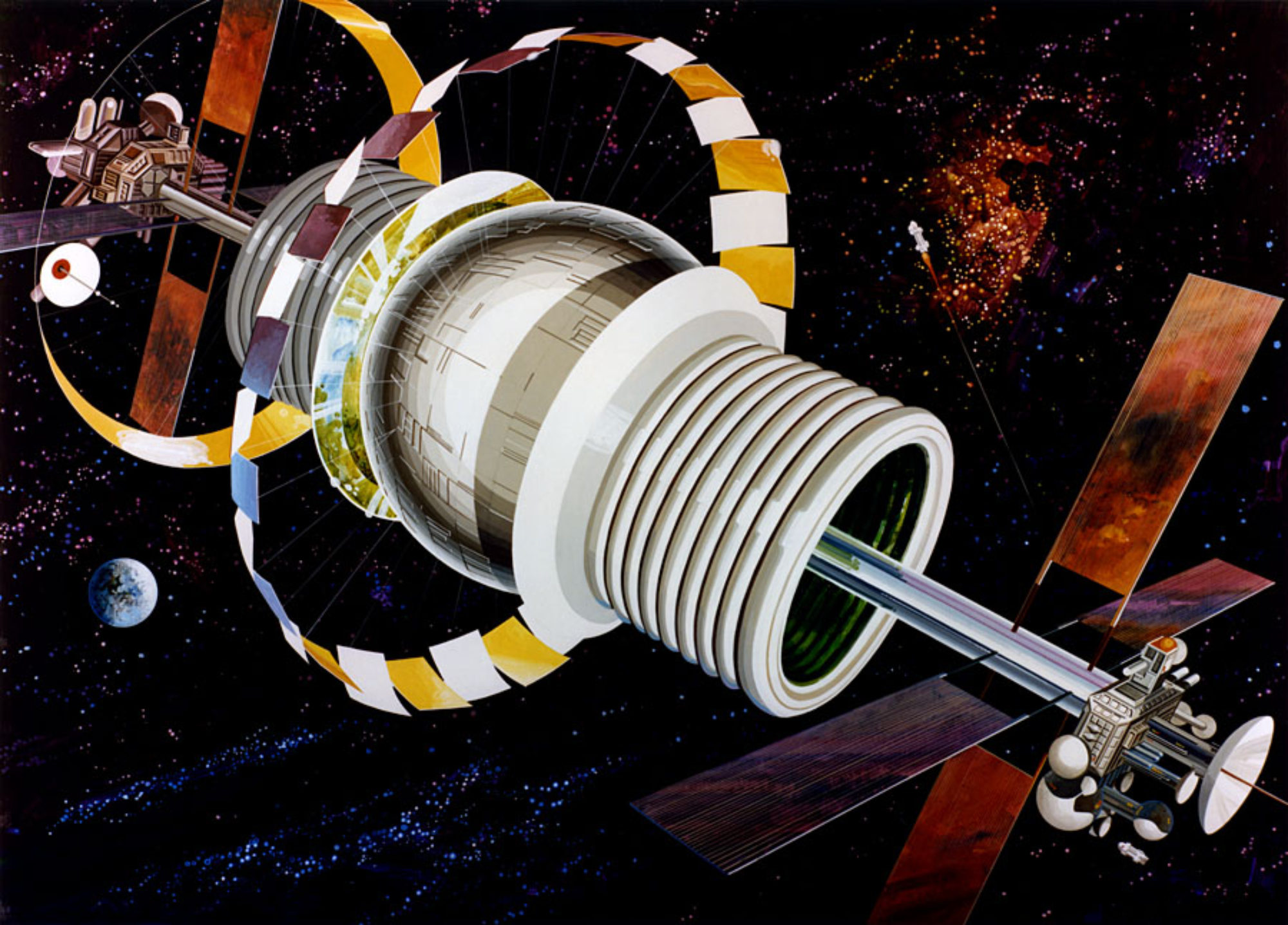
Image of an interstellar Worldship. Credits: Michel Lamontagne / Principium, Issue 32, February 2021

The feasibility of Worldships has been covered previously on SSP by The Initiative and Institute for Interstellar Studies via Principium. A new article by Michel Lamontagne on page 29 of the most recent issue examines the concept from a perspective of an interplanetary society which has harnessed fusion energy and life support systems for space settlements, while reducing costs through self replicating factories.

Such a starship is envisioned to use a deutrium/He3 fusion drive to accelerate to 1% of the speed of light completing a journey to Alpha Centauri in about 430 years. The author envisions a fleet of 3 or 4 (or more) Worldships housing about 1000 passengers each in rotating torus habitats 1,200m in diameter with artificial gravity.

Image of the interior of a worldship habitat. Credits: Michel Lamontagne / Principium, Issue 32, February 2021

Self replication is the key to this architecture. Lamontage explains: “If fully self replicating systems exist at the departure of the mission, Sprinter starships carrying self replicating machines can be sent at the same time as the Worldship flotilla departs. The Sprinters will arrive centuries before the Worldships, and the self replicating machines will have ample time to create multiple habitats, and perhaps begin to seed them with simple life forms.”

Lamontage cautions that the needed AI technology and practical self replicating machines may be more difficult to develop than predicted. The Worldship habitat ecosystems may encounter instabilities over centuries-long journeys leading to eventual breakdown of life support systems. Finally, rapid technological advances may lead to advanced propulsion schemes or other opportunities that would make a Worldship obsolete before getting started.

Propellant production on Mars

Schematic of a Mars settlement methane production system for a single SpaceX Starship over a period of two years. Electrolysis and hydrogen storage are off the shelf. Sabatier reactor needs to be developed. Credits: Michel Lamontagne / marspedia.org

Early missions to Mars such as Robert Zubrin’s Mars Direct architecture will require propellant production for the trip home. Methane can be produced in situ on the red planet’s surface through the basic chemical reaction CO2 + 4H2 → CH4 + 2H2O. A French chemist named Paul Sabatier discovered back in 1897 that this reaction could be facilitated by a nickel catalyst in the presence of hydrogen and carbon dioxide at elevated temperatures. Since water ice is present on Mars, hydrogen could be produced though electrolysis of water. Combining these two reactions into a methane production system, Michel Lamontagne has provided a schematic of the whole process on marspedia.org. By design, the SpaceX Starship uses methane for fuel. The company may want to prioritize development of a flight-ready Sabatier reactor for this system to enable the transportation infrastructure needed for supplying a settlement until it can become self sufficient.

Artist rendering of a SpaceX Starship lifting off near a Mars settlement. Credits: SpaceX / Flickr

Space settlement through private enterprise

Artist rendition of Starship exploring Saturn. Image credit SpaceX/Flickr

In an interview by Stuart Clark in BBC Science Focus Magazine, Vice President for North American operations for the International Space University Gary Martin answers questions on how private enterprise is changing space exploration. Companies like SpaceX and Blue Origin, through their own initiatives and public/private partnerships are opening up the final frontier, paving the way for space settlement.

SpaceX will need suppliers for Mars settlement

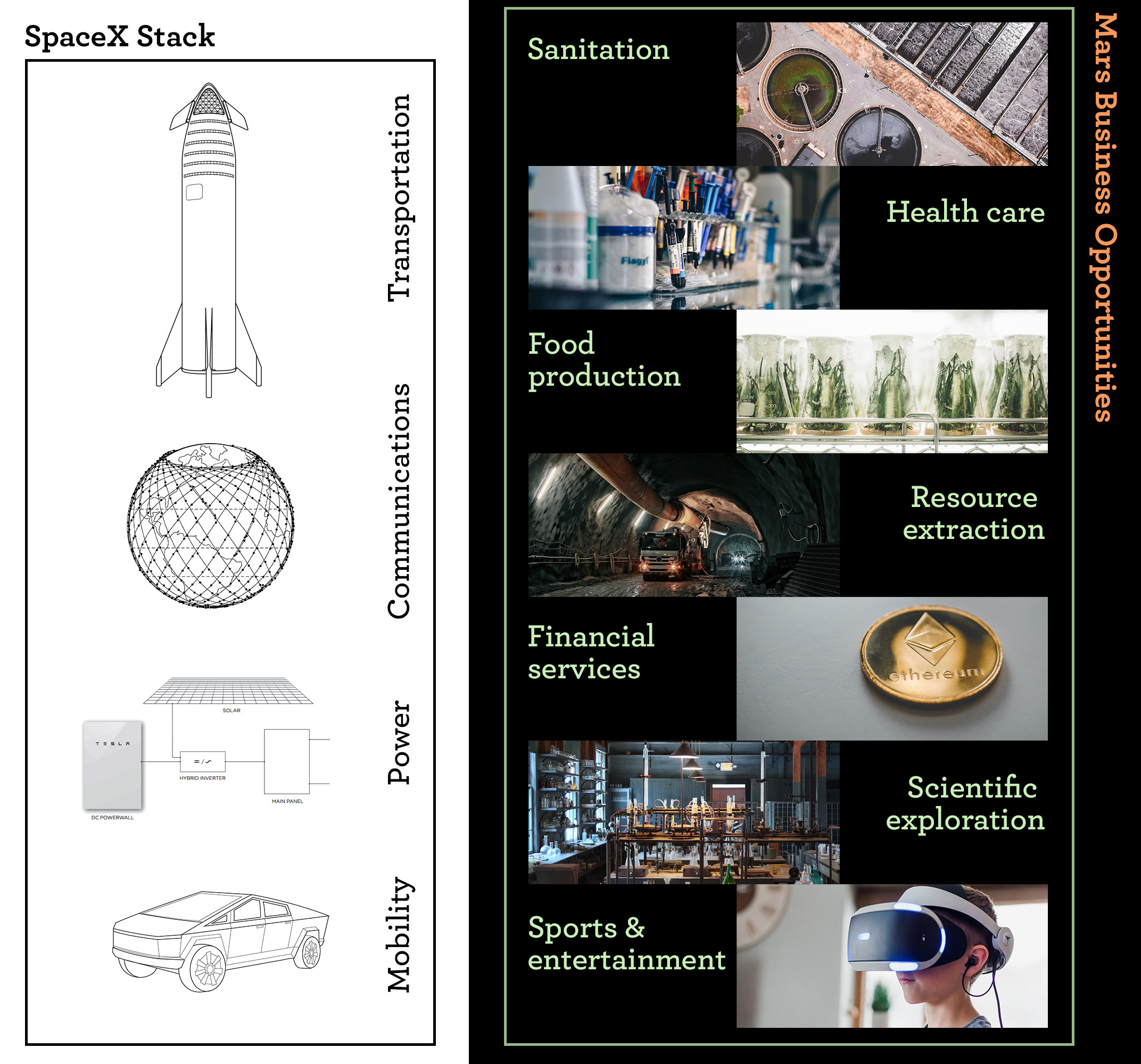
In a thread on Twitter, Kevin Cannon suggests that suppliers for services that SpaceX will need to settle Mars such as sanitation, medical supplies, entertainment, finance and others, get started sooner rather then later laying out their plans if they want to be selected to help settle a new world.

Image
Image credit: Kevin Cannon