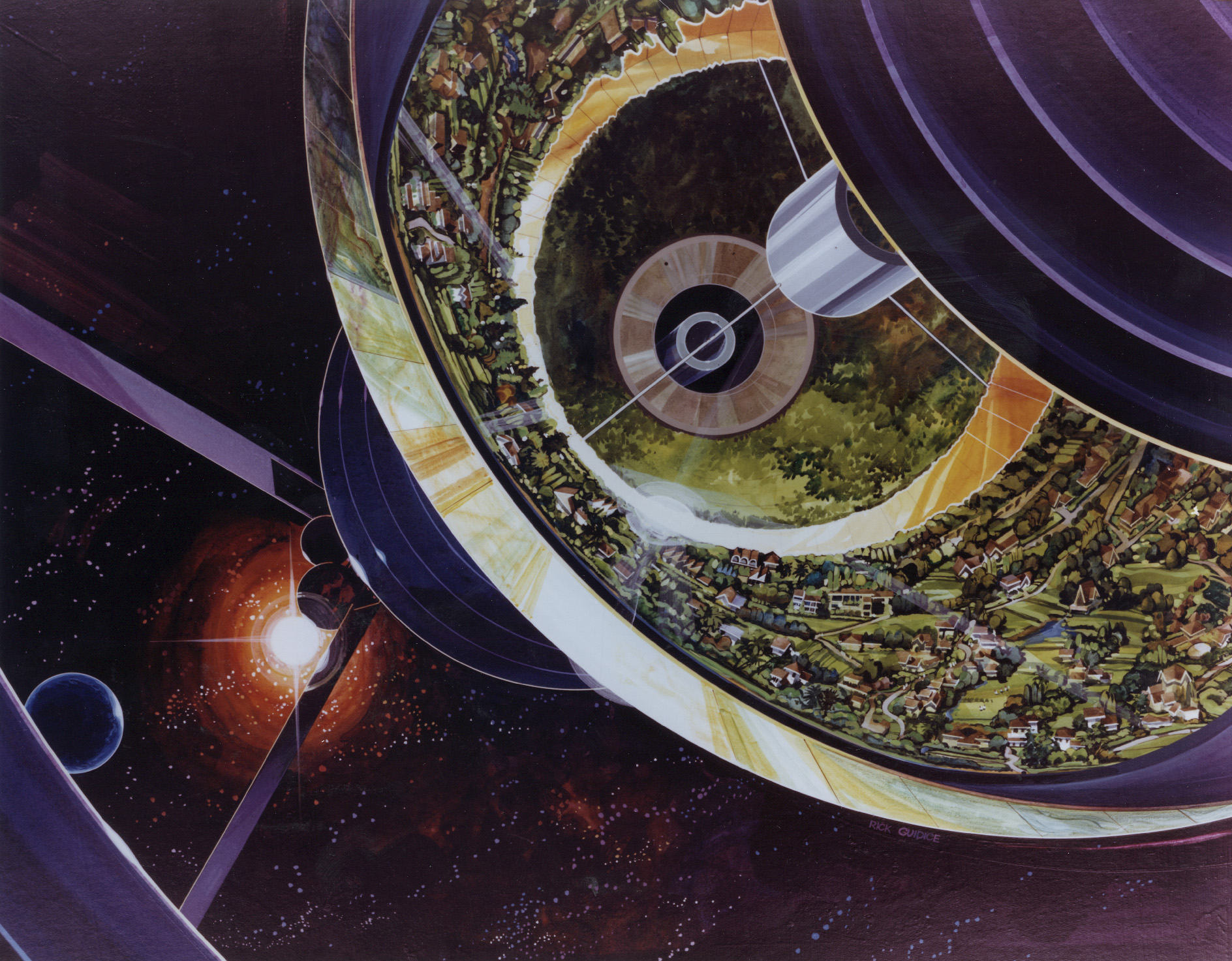
Novel design of a Mars Cycler

Above – Mars Cycler exploded section. Below – Cruise ship-sized Mars Cycler booster (left) and docking configuration (right). Credits: Offworld Industries Corp.

At the 54th International Conference on Environmental Systems held in Prague, Czechia, this past July, a paper was presented describing an innovative design of a large-scale Mars Cycler. The authors, A. Scott Howe, John Blincow, Theodore W. Hall, and Colin Leonard, make the assumption that a significant planetary migration to Mars will happen in the near future, citing Elon Musk’s often stated goal of establishing a one-million person colony on the Red Planet by 2050. The authors argue that Starship will not be a suitable transportation method for a large, non-professional clientele on what has historically been a six-month journey due to the physiological and psychological health risks of a long-duration mission (not withstanding a recent paper penned by University of Santa Barbara physics undergrad Jack Kingdon proposing two trajectories that reduce transit times to between 90 to 104 days each way).

Instead, they envision a “cruise ship” approach using a large, robotically constructed Mars Cycler that would continuously travel between Earth and Mars. The concept for a Mars Cycler was first conceived by Buzz Aldrin in a 1985 paper, and in recognition of his invention, is often referred to as an Aldrin cycler. This particular cycler design is advantageous because it would use minimal propellant to maintain its trajectory. The concept features a dual-torus structure, with a non-rotating outer torus for docking and a rotating inner torus to provide artificial gravity. The paper lays out in detail the specifications for a minimal-sized version with crew capacity of 52-61 people, and calculates the mass and equipment required for the vessel. The authors estimate that it would take 63 Starship launches (version 3) to deliver the construction materials and propellant to low Earth orbit (LEO). A scaled up larger cruise ship-sized version with a capacity of 1000 occupants would take 428 Starship version 3 launches, which is within the range of engineering possibility and certainly within the launch rate of thousands of Starships Elon Musk envisions as part of his Mars colonization plans.

The Mars Cycler would be assembled using Offworld Industries Corporation’s Sargon System, a family of new construction machines the company claims could build an entire space station in half a year (Blincow is CEO of Offworld Industries Corp). The novel construction technology autonomously assembles preformed hull panels loaded in a magazine, robotically dispensed, formed and welded into large toroidal (or other shaped) space stations ready to be pressurized.

The paper advocates for the cycler to provide artificial gravity to mitigate the deleterious health impacts of microgravity allowing occupants to maintain healthy muscle and bone density throughout the journey. The proposed design decouples an inner artificial gravity centrifuge from an outer non-rotating torus, which offers several operational benefits:

  • Distributed docking ports: The non-rotating outer torus can accommodate multiple visiting vehicles docking at various points around its perimeter.
  • Fixed systems: Solar panels and radiators can be mounted without the need for gimbals or motorized mounts, simplifying the design.
  • Seamless transfer: Crew and cargo can be transferred between visiting vehicles and the cycler without the need for spin-up or spin-down procedures.

The paper identifies several challenges to overcome in order to realize an operational Mars Cycler. The top five include:

  1. Large-scale space construction: The project requires the construction of very large orbital structures. A key challenge is maintaining tolerance control during assembly, ensuring panels fit together precisely and the torus closes properly.
  2. Attitude control and maneuvering: The paper assumes, but does not detail, that maneuvering large quarter-toroids in proximity to each other will be possible without “exotic solutions’. This is a significant challenge because each section would have its own center of mass and orbit, creating strain on connected elements.
  3. Artificial gravity implementation: A number of difficulties are discussed, including economic spin-up/spin-down, docking procedures while the structure is spinning, and performing extra-vehicular activities (EVAs) under rotation. The paper also notes that transferring power, control, information, and liquids between the rotating and non-rotating segments would be challenging.
  4. Mars surface infrastructure: The paper acknowledges that a major challenge is the “big elephant in the room of Mars surface infrastructure”. The entire concept is based on the assumption that the necessary infrastructure, such as propellant production facilities, will be in place on Mars by the time the cycler is ready.
  5. Life Support Systems: Sustaining human crews on a cycler for extended periods (e.g., months-long transits) requires robust life support systems for air, water, food, and waste management. The paper underscores the challenge of maintaining these systems with minimal resupply over multiple cycles.

Assuming these challenges could be solved, this interplanetary cruise ship design of a Mars Cycler is a new approach to deep-space travel, elegant in its simplicity. It offers a potential solution to the challenges of long-duration missions by providing artificial gravity via a rotating inner torus to ensure the health and well-being of future Mars colonists.

In addition to these cyclers providing a mode of safe space transportation, such large artificial gravity space stations could be permanently located in orbit around planets or moons that have surface communities in split life cycle space settlements which SSP covered recently. Such a facility could have duel use as an Earth-normal gravity crèche, providing birthing centers and early child development for families settling in the region. Colonists could choose to split their lives between rearing their young in healthy normal gravity settings until their offspring are young adults, then moving down to live out their lives in lower gravity surface settlements – or they may choose to live permanently in free space.

Split life cycle approach to settling the solar system

Left: Artist impression of the inside of Kalpana One, a free space settlement providing artificial gravity. Credits: Bryan Veerseeg / Spacehabs.com; Right: Conceptual illustration of a colony on the surface of Mars. Credits: SpaceX.

Until recently, space settlement advocates have typically split into two camps: those who favor building colonies on the surfaces of the Moon or Mars, and those who prefer constructing O’Neill cylinders in free space, spinning to provide artificial gravity outside of planetary gravity wells. Readers of this blog know I lean toward the latter, mainly because colonies on worlds with gravity lower than Earth’s could pose problems for human physiology, particularly reproduction. Truthfully, we won’t know if humans can reproduce in less than 1g until we conduct long-term mammalian reproduction experiments under those conditions. It would be far cheaper and quicker to perform these experiments in Low Earth Orbit (LEO) rather than waiting for sufficient infrastructure to be established on the Moon or Mars for biological research.

Another approach involves not sending humans into space at all, instead entrusting space colonization to human-level artificial general intelligence (HL-AGI) and conscious machines—a non-biological strategy. With recent advancements in AGI and automation, conscious HL-AGI robots may become feasible in the near future (though the exact timeline—whether decades or longer—remains a matter of debate). This prospect might disappoint many space advocates who view migration beyond Earth as the next phase of natural biological evolution hopefully starting within our lifetimes. Deploying sentient machines would effectively remove humanity from the equation altogether.

If you’ve been following space colonization in the press you’ve most likely heard of the book A City on Mars by Kelly and Matt Weinersmith. I have not purchased the book but I’ve read several reviews and heard the authors interviewed by Dr. David Livingston on The Space Show to get an understanding of the Wienersmith’s overall viewpoint, which is at the very least skeptical, and to some space advocates downright anti-settlement. The book is very pessimistic taking the position that the science and engineering of space settlements for large populations of people is too challenging to be realized in the near future.

Peter Hague, an astrophysicist in the UK, wrote an excellent three part review setting the record straight correcting some of the critical facts that the Wienersmith’s get wrong. But in my opinion the best critique by far was written by Dale Skran, Chief Operating Officer & Senior Vice President of the National Space Society (NSS). In a recent post on the NSS blog, he links to a 90 page Critique of “A City on Mars” and Other Writings Opposing Space Settlement in the Space Settlement Journal where he provides a chapter-by-chapter, section-by-section response to the entire book as well as rebuttals to a few other naysayer publications [“Dark Skies” (2021) by Daniel Deudney; “Why We’ll Never Live in Space” (2023) in Scientific American by Sarah Scholes; “The Case against Space” (1997) by Gary Westfahl].

However, Skran credits the Weinersmiths with an innovative idea he hadn’t encountered before, one that addresses the challenge of human reproduction in low gravity. They suggest establishing orbital spin-gravity birthing centers above surface colonies on the Moon or Mars, where children would be born and raised in an artificial gravity environment—essentially a cosmic crèche. Skran builds on this concept, proposing that the life cycle of Moon or Mars colonists could be divided into phases. The first phase would take place in space, aboard rotating settlements with Earth-normal gravity, where couples would conceive, bear children, and raise them to a level of physical maturity—likely early adulthood—determined by prior research. Afterward, some individuals might opt to relocate to the low-gravity surfaces of these worlds. There, surface settlements would focus on various activities, including operations to extract and process resources for building additional settlements.

Skran elaborated on this split life cycle concept and outlined a roadmap for implementing it to settle low-gravity worlds across the solar system during a presentation at the 2024 International Space Development Conference. He granted me permission to share his vision from that presentation and emphasized that the opinions expressed in his talk were his own and did not reflect an official position or statement from the NSS.

Taking a step back, the presentation summarized research that has been performed to date on mammalian physiology in lower gravity, e.g. studies SSP covered previously on mice by JAXA aboard the ISS in microgravity and in the Kibo centrifuge at 1/6g Moon levels. The bottom line is that studies show some level of gravity less then 1g (artificial or otherwise) may be beneficial to a certain degree but microgravity is a horrible show stopper and much more research is needed in lower gravity on the entire reproduction process, from conception through gestation, birth and early organism development to adulthood. The question of reproduction in less then 1g is the elephant in the space station living room. In my presentation at ISDC last year, I took the position that the artificial gravity prescription for reproduction could impact the long term strategy for where to establish biologically self-sustaining space settlements leading to a fork in the road: a choice between O’Neill’s vision of free space rotating settlements vs. lower gravity surface colonies (because outside of the Earth all other solar system worlds where it is practical to establish surface settlements have less then 1g – e.g. the Moon, Mars, Asteroids and the moons of the outer planets – I exclude cloud settlements in Venus’s atmosphere as not realistic). I’ve been swayed by Skran’s proposal and have come to the realization that we don’t need to be faced with a choice between surface settlements or free space artificial gravity habitats – we can and should do both with this split life cycle approach.

How would Skran’s plan for settling the solar system work? He suggests we start small with rotating space settlements in LEO like Kalpana Two, an approach first conceived by Al Globus and popularized in his book coauthored by Tom Marotta The High Frontier: an Easier Way. Locating the habitats in LEO leverages the Earth’s protective magnetic field, shielding the occupants from radiation caused by solar particle events. This significantly reduces their mass and therefore costs because heavy radiation shielding does not need to be launched into orbit. In addition, the smaller size simplifies construction and enables an incremental approach. Kasper Kubica came up with a real estate marketing plan for Kalpana in his Spacelife Direct scenario.

Skran promoted a different design which won the Grand Prize of the NSS O’Neill Space Settlement Contest, Project Nova 2. The novel space station, conceived by a team of high school students at Tudor Vianu National High School of Computer Science, Bucharest Romania, slightly resembles Space Station V from the film 2001: A Space Odyssey. Many other designs are possible.

Project Nova 2 rotating space settlement, one possible design of a rotating space settlement initially built in LEO then moved out to the Moon and beyond. Credit: Tudor Vianu National High School Research Centre Team / NSS O’Neill Space Settlement Contest 2024 Grand Prize Winner

But to get there from here, we have to start even smaller and begin to understand the physics of spin gravity in space. To get things rolling Kasper Kupica has priced out Platform 0, a $16M minimum viable product artificial gravity facility that could be an early starting point for basic research.

Conceptual illustration of Platform 0, a habitable artificial gravity minimum viable product. Credits: Platform 0 – Kasper Kubica / Earth image – Inspiration4

These designs for space habitats will evolve from efforts already underway by private space station companies like Vast, Above, Axiom Space, Blue Origin (with partner Sierra Space) and others. Vast, which has for years had AG space stations on its product roadmap, recently revealed plans to use its orbital space station Haven-1 to be launched in 2026 to study 1/6g Moon level AG in a few years, albeit without crew. And of course let’s not forget last month’s post which featured near term tests proposed by Joe Carroll that could be carried out now using a SpaceX Falcon 9 as an orbital laboratory where researchers could study human adaptation to AG.

Illustration depicting a SpaceX Crew Dragon spacecraft tethered to a Falcon 9 second stage which could be spun up (in direction of down arrow) to test centrifugal force artificial gravity. Credit: Joe Carroll

Back the plan – once the rotating space habitat technology has been proven in LEO, a second and third settlement would be built near the Moon where lunar materials can be utilized to add radiation shielding needed for deep space. The first of these facilities becomes a factory to build more settlements. The second one becomes a cycler, the brilliant idea invented by Buzz Aldrin, initially cycling back and forth in the Earth Moon system providing transportation in the burgeoning cislunar economy just around the corner. The next step would be to fabricate three more copies of the final design. Two would be designated as cyclers between the Earth and Mars. Building at least two makes sense to establish an interplanetary railroad that provides transportation back and forth on a more frequent basis then just building one unit.

Here’s the crown jewel: the third settlement will remain in orbit around Mars as an Earth normal gravity crèche, providing birthing centers and early child development for families settling in the region. Colonists can choose to split their lives between rearing their young in healthy 1g habitats until their offspring are young adults then moving down to live out their lives in settlements on the surface of Mars – or they may choose to live permanently in free space.

This approach enhances the likelihood that settlements on the Moon or Mars will succeed. The presence of an orbiting crèche significantly reduces the risks associated with establishing surface communities by providing an orbital station that can support ground settlements and offer a 1g safe haven to where colonists can retreat if something goes wrong. This alleviates the pressure on initial small crews on the surface, meaning they wouldn’t have to rely solely on themselves to ensure their survival. Finally, an incremental strategy, involving a series of gradual steps with technology readiness proven at each stage through increasingly larger iterations of orbital settlements, offers a greater chance of success.

The final step in this vision for humanity to become a truly spacefaring civilization is to rinse and repeat, i.e. cookie cutter duplication and dispersal of these space stations far and wide to the many worlds beyond Mars with abundant resources and settlement potential. There’s no need to choose between strategies focused solely on surface communities versus spin-gravity colonies in free space. We can pursue both, as they will complement each other, providing families with split life cycle settlement options to have and raise healthy children while tapping the vast resources of the solar system.

Images of resource rich lower gravity worlds beyond Mars with potential for split life cycle settlement (not to scale). Top: the asteroid Ceres. Middle: Jupiter’s Moons, from left to right, Io, Europa, Ganymede, and Callisto. Bottom left: Saturn’s moon Titan. Bottom right: Neptune’s moon Triton. Credits: NASA.