Interview with Mikhail Shubov: Guided self replicating factories, orbital fuel depots, hydrogen production on Mars and other visions for space settlement

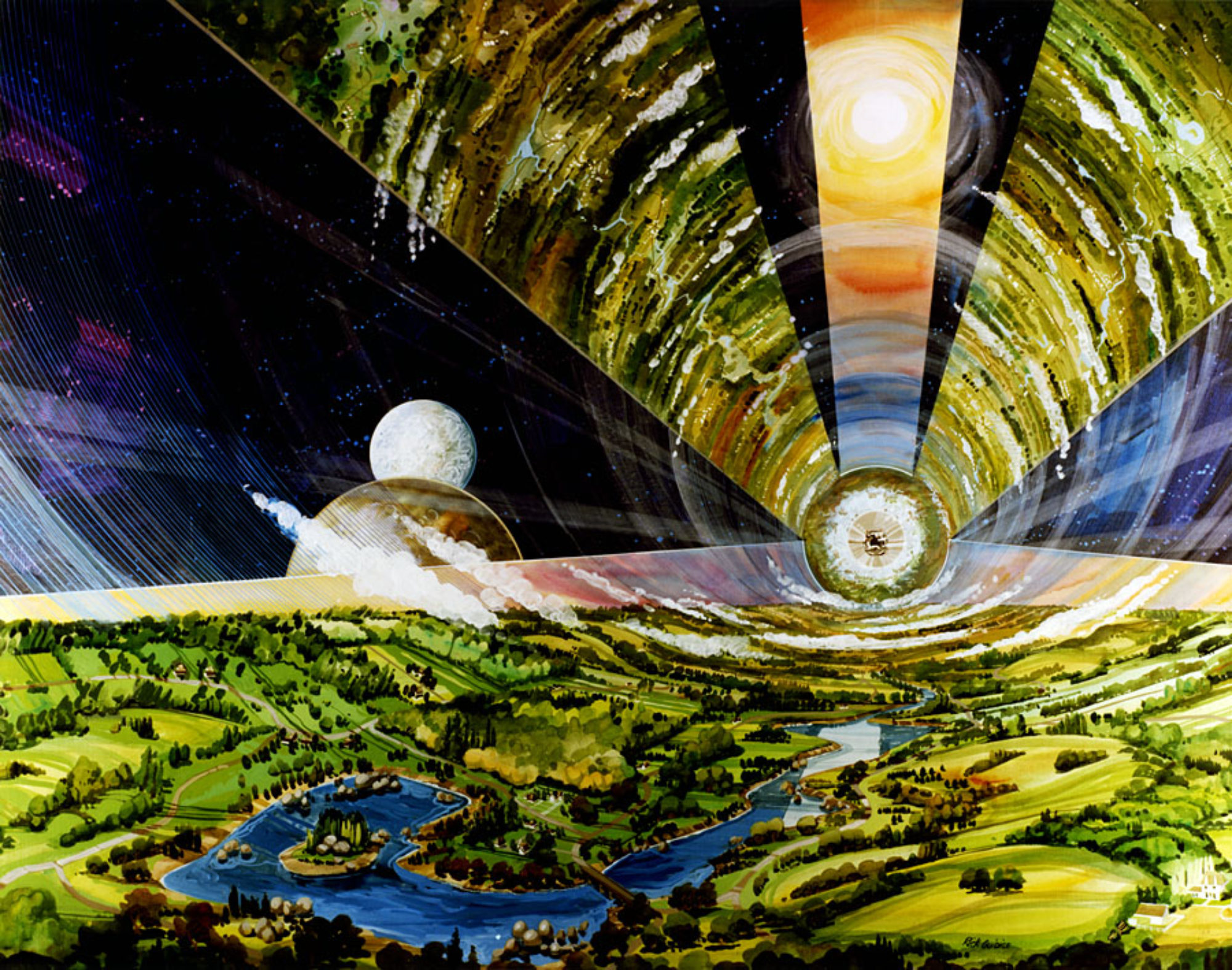
Vintage 1980 artist depiction of a self replicating factory on the Moon. Credits: NASA

Earlier this year SSP covered self replicating factories for space settlement. An innovative paper on this topic with a simpler approach was submitted by Mikhail Shubov to ArXiv.org in August that shows how to accelerate efforts in this area.

A fully autonomous self replicating factory in space requires significant advancements in artificial intelligence, robotics, and other fields. Such facilities are mainly theoretical at this point and may not be feasible for many decades. But if humans could “guide” the operation remotely via computer control, a colony on the Moon could be started relatively soon.  This could be the proving ground for establishing such facilities on other worlds which Shubov believes could be set up on Mercury, Mars and in the Asteroid Belt eventually leading to exponential growth allowing humanity to expand out into the solar system and beyond.  He suggests that rather then using the usual definition of self-replication in which a factory would make a duplicate copy of itself, until this capability is realized, a better figure of merit would be the “doubling time”. This is how long it takes to double the facility’s mass, energy production, and machine production.

I reached out to Dr. Shubov about this article and discovered that he has been busy with a variety of scholarly papers on several technologies needed for space settlement. He agreed to a wide ranging interview via email about these topics and his vision of our future in space.

SSP: Thank you Dr. Shubov for taking the time for this interview.  With respect to your work on Guided Self Replicating Factories (GSRF), there are already companies developing semiautonomous robots for in situ resource utilization on other worlds.   OffWorld, Inc. states that “We envision millions of smart robots working under human supervision on and offworld, turning the inner solar system into a better, gentler, greener place for life and civilization.”  Their business model is focused on developing a robotics platform for mining and construction on Earth, then leveraging the technology for use in space.  Do you think this is a good approach to get started?

MS: Thank you Mr. John Jossy for taking interest in my work!

In my opinion, remotely guided robots will be very effective for construction of a colony on the Moon. These robots could be guided by thousands of remote operators on Earth. They would be linked to Earth’s Internet via Starlink which is already being deployed by Elon Musk via SpaceX. Starlink will consist of thousands of satellites linked by lasers and providing broadband Internet on Earth. About 1,646 satellites are already orbiting the Earth.

Hopefully, it would be possible to produce [an] Earth-Moon Internet Connection of about a Terabit per second. That would enable people on Earth to remotely operate hundreds of thousands of robots.

Using these robots on Asteroids and other planets of Solar System will be much more difficult due to low bandwidth and high delay of communication. For example, latency of communication between Earth and Mars is 4 to 21 minutes.

SSP: Obviously, establishing outposts on other worlds where astronauts could teleoperate robots to build a GSRF would eliminate the latency problem, which you address in your paper.

You’ve envisioned four elements of a GSRF: an electric power plant, a material production system (ore mining, beneficiation, smelting), an assembly system in which factory parts are shaped and fabricated, and a space transportation system.  With respect to the space transportation system you cover both launch vehicles and in-space propulsion systems.  The space transportation element of a GSRF, although vital for its implementation, seems to be an external part of the system.  In fact, you stated that “Initially, spaceships will be built on Earth. Fuel for refueling spaceships will be produced in space colonies from the beginning.”  So, when calculating the doubling time of a GSRF, we are not including the production of space transportation systems, correct?

MS: In my opinion, [the] space transportation system may become part of GSRF at later stages of development. How soon space transportation becomes a part of GSRF depends on the speed of development of different technologies.

If inexpensive space launch from Earth becomes available, then there will be less reliance on self-replication and more reliance on transportation of materials from Earth. In this case, space transportation system will not be part of GSRF for a long time.

If rapid growth of a Space Colony by utilization of in situ resources is possible, then many elements of space transportation system would be produced at the colony. In this case, [the] space transportation system will become a part of GSRF relatively soon.

SSP: You suggest that an important product produced by a GSRF in the Asteroid Belt would be platinum group metals to be delivered to Earth, and that they would help finance expansion of space colonization.  Some space resource experts, including John C. Lewis, believe that “…there is so vast a supply of platinum-group elements in the NEA [Near Earth Asteroids] … that exploiting even a tiny fraction of them would cause the market value to crash, bringing to an end the economic incentive to mine and import them.”  Some suggest the market for these precious metals may be in space not on Earth.  When you say “delivered to Earth” what markets were you envisioning to generate the profits needed to finance the GSRF?

MS: In my opinion the main applications of platinum group metals would be in industry. First, PGM are very important as chemical reaction catalysts. In particular, platinum is used in hydrogen fuel cells and iridium is a catalyst in electrolytic cells. It is likely that demand for platinum, iridium and other PGM will grow along with hydrogen economy. Second, platinum and palladium is used in glass fiber production.

Third, Iridium-coated rhenium rocket thrusters have outstanding performance and reusability. Rhenium is also used in jet engines. These thrusters will also provide a market for iridium and rhenium metals.

SSP: As the need for PGM grows exponentially in the future, especially with energy and battery production needs on Earth in the near future, the environmental impacts of mining these materials on Earth may be another reason to source these materials off world.

Mining water to produce hydrogen for rocket fuel is a theme throughout your writings.  In a paper submitted to the arXix.org server last month entitled Feasibility Study For Hydrogen Producing Colony on Mars, you propose that a technologically mature Martian factory could produce and deliver at least 1 million tons of liquid hydrogen per year to Low Earth Orbit.  Does placing a hydrogen production facility on Mars for fuel used in near-Earth space make sense from a delta-v perspective?  You acknowledge that initially it will be cheaper and easier to access the Moon’s polar ice to produce hydrogen.  But in the long term, Near Earth Asteroids (NEA) or even the Asteroid Belt are easier to access and they include CI Group carbonaceous chondrites which contain a high percentage (22%) of water.  Can you reconcile the economics of sourcing hydrogen on Mars over NEAs?

MS: Delivery of Martian hydrogen into the vicinity of Earth may be necessary only when the space transportation technology is relatively mature. In particular, as I mention in my work, Lunar ice caps contain between 48 million and 73 million tons of easily accessible hydrogen. Until at least 16 million tons of Lunar hydrogen is used, hydrogen from other sources would not be needed.

As I calculate in my work, delta-v for transporting hydrogen from Low Mars Orbit to LEO is 3.5 km/s accomplished by rocket engines plus about 3.2 km/s accomplished by aerobreaking. This would be economic if vast amounts of electric energy will be produced on Mars easier than on asteroids. An important and renewable resource on Mars is the heat sink in the form of dry ice. This may enable production of vast amounts of electric energy by nuclear power plants.

Even if delivery of hydrogen from Low Mars Orbit to Earth turns out to be economically infeasible, hydrogen depots in near-Mars deep space would still play a very important role in transportation to and from Asteroid Belt as well as [the] Outer Solar System.

SSP: Your first choice of a power source for the colony on Mars is an innovative heat engine utilizing dry ice harvested from the vast cold reservoirs at the planet’s polar caps. You suggest that the initial heat source for this sublimation engine be a nuclear reactor. Why not simply use the nuclear reactor to produce electricity? Nuclear reactors coupled to high efficiency Stirling engines for electricity generation like NASA’s Kilopower project have very high power density per unit weight and the technology will be relatively mature soon. Your second choices are solar and wind which are not as reliable as a nuclear power source, especially with reduced solar flux at Mars’s orbit and the problem caused by dust in the atmosphere. Why was a more mature nuclear power technology for direct electricity production not considered?

MS: Thank you.  As I understand now, a regular nuclear reactor with a heat engine using water or ammonia as a working fluid is the best choice for energy production on Mars.  Dry ice should only be used as a heat sink and not as working fluid.  Given the very low temperature and ambient pressure of Martian dry ice, it is likely that power plants will have thermal efficiency of at least 50%.

Almost all components of Martian power stations can be manufactured from in situ resources.  Only the reactors themselves and the nuclear fuel will have to be delivered from Earth.

SSP: A booming space transportation economy will need cryogenic fuel depots to store hydrogen for rocket fuel in strategic locations throughout the inner solar system.  You’ve got this covered in your recent paper Hydrogen Fuel Depot in Space.  Some start ups like Orbit Fab have already started work in this area, albeit on a smaller scale, and United Launch Alliance integrated cryogenic storage into their Cislunar-1000 plans a few years back, but this initiative seems to have slowed down due to delays in ULA’s next generation Vulcan launch vehicle.  In this paper you calculate the required energy to refrigerate hydrogen in one smaller (400 tons) and another larger (40,000 tons) depot.  In both cases, a sun shield is required to block sunlight to prevent boil off.  You don’t mention the method of power generation to provide energy for the refrigeration units.  Could the sun shield have a dual use function by incorporating photovoltaic solar cells on the sun facing side to generate electricity to power the refrigeration system?

Diagram depicting a cryogenic liquid hydrogen storage depot with 40,000 ton capacity. Credits: Mikhail Shubov

MS: Power for the refrigeration system will be provided by an array of solar cells placed on the sun shield.  As I mention in my work, the 400 ton depot requires 80 kW electric power for the refrigeration system, while the 40,000 ton depot requires 840 kW electric power.  This power can be easily provided by photovoltaic arrays.

SSP: SpaceX has proven what was once believed impossible: that rockets could be reused and that turnaround times and reliability could approach airline type operations.  Although we are not there yet, costs continue to come down.  In your paper entitled Feasibility Study For Multiply Reusable Space Launch System you calculate that with your proposed system in which the first two stages are reusable and the third stage engine can be returned from orbit, launch costs could be reduced to $300/kg.  Musk is claiming that with the projected long term flight cadence, eventually Starship costs could be as low as $10/kg.  Even if he is off by a factor of 10 that is still lower than your figure.  What advantages does your system offer over Starship? 

MS: The main advantage of the Multiply Reusable Space Launch System is the relatively light load placed on each stage. As I mention on p. 10, the first stage has delta-v of 2.6 km/s and the second stage has delta-v of 1.85 km/s. The engines have high fuel to oxidizer ratio and a low combustion chamber temperature of 2,100oC. These relatively light loads on the rocket airframes and engines should make these rockets multiply reusable similar to airliners. The launch system should be able to perform about 300 space deliveries per year.

Hopefully Elon Musk would succeed [in] reducing launch costs to at least $100 per kg. Unfortunately, many previous attempts at drastic reduction of launch costs did not succeed. Hence, we may not be sure of Starship’s success yet.

SSP: You state in several of your papers that:

“A civilization encompassing the whole Solar System would be able to support a population of 10 quadrillion people at material living standards vastly superior to those in USA 2020. Colonization of the Solar System will be an extraordinary important step for Humankind.”

Why do you think that colonization of the solar system is important for humanity and when do you think the first permanent settlement will be established on the Moon or in free space?  Here I use the National Space Society’s definition of a space settlement:

“A space settlement” refers to a habitation in space or on a celestial body where families live on a permanent basis, and that engages in commercial activity which enables the settlement to grow over time, with the goal of becoming economically and biologically self-sustaining as a part of a larger network of space settlements. “Space settlement” refers to the creation of that larger network of space settlements.

MS: In my opinion colonization of Solar System will bring unlimited resources and material prosperity to Humankind.   The human population itself will be able to grow by the factor of a million without putting a strain on the available resources.

As for the time-frame of establishment of human settlements on the Moon and outer space, I have both optimistic and pessimistic thoughts.  On one hand, Humankind already possesses technology needed to establish rapidly growing space settlements.  This means that Solar System colonization can start at any time. On the other hand, such technology already existed in 1970s.  This technology is discussed in Gerard K. O’Neill’s 1976 book “The High Frontier: Human Colonies in Space”.  Thus, space colonization can be indefinitely delayed by the lack of political will.  Hopefully space colonization will start sooner rather then later.

Credits: Gerard K. O’Neill / Space Studies Institute Press

Coming soon: the $10M orbital condominium

Living space in a Kalpana orbital space settlement. Credits: Bryan Versteeg

Kasper Kubica presents an optimistic business case for space tenants moving in (er, up) to deluxe condominiums orbiting the Earth within 10 years. Initially for the ultra rich, the price tag is comparable to high end real estate currently on the market. Of course the devil is in the details, so lets dive in.

In a post on Medium, Kubica uses the rotating habitat Kalpana as an illustrative example of his “Spacelife Direct” approach for an orbital settlement spinning to create 1G of artificial gravity and hosting north of 400 condominiums in LEO. Such a facility would be shielded from radiation by Earth’s magnetosphere if it were located in low equatorial orbit and therefore could be constructed with less shielding. This results in a significant reduction of mass driving costs way down. Running the numbers on this scenario opens up exciting possibilities with the amazing capabilities of Elon Musk’s Starship currently under development by SpaceX.

Using the scaled down Kalpana Two version as discussed in Tom Marotta and Al Globus’ book, The High Frontier, an Easier Way, the cylindrical habitat is sized at just over 100 meters in diameter and the same in length, weighing in at 16, 800 metric tons. Kubica estimates that it would take 140 launches to loft the required mass to LEO. Assuming costs keep coming down as Starship launch cadence increases (a safe bet), at $10M/launch the cost of just the materials to LEO would be $1.4B. Of course there are many more expenses associated with design, development and fabrication, not to mention insurance of such an orbital condo complex. For the sake of argument Kubica triples that figure arriving at a total price tag of $4.2B.

But would there be a market for real estate in LEO? Kubica provides comparable examples of skyscrapers with similar costs and over 200 condominiums recently selling for over $10M in Manhattan.

“The clamor for earthside luxury condos is massive and growing. Orbital condos — representing an exclusive experience far beyond that available to anyone on earth — could generate astronomical demand.”

With the economics of Starship opening up limitless possibilities, Kubica lays out a roadmap over the next 10 years to realize the Spacelife Direct opportunity. First would come financing the venture though a team of visionary entrepreneurs and investors (are you listening Dylan Taylor?). Design and development would come next including the robotic systems that would be required for assembly in space. Laying the groundwork for this infrastructure may be completed soon by Orbital Assembly Corporation which could potentially be leveraged as a Spacelife Direct supplier. To keep labor costs down much of the facility would be fabricated on Earth in launchable modules that would be assembled in orbit. The final stages would activate life support systems and finish out the interiors for the occupants to begin moving in.

So what about the rest of us? As history has shown in the aerospace industry at the beginning of the last century and we see unfolding in the space tourism market today, the rich help pave the way so that mass production and economies of scale will drive down costs eventually making space settlement affordable for the masses.

“We don’t want to live in space because it’s an economic necessity, we want to live in space because we are explorers and adventurers, and space is humanity’s next frontier!”

Are we close to a tipping point for human spaceflight?

Artist depiction of Starship on the lunar surface returning astronauts to the Moon as part of NASA’s Artemis Program. Credits: SpaceX

What will be the impact on the direction of U.S. space policy should SpaceX successfully demonstrate an orbital flight of Starship? Doug Plata, President and Founder of the Space Development Network believes that when Starship achieves orbit, policy makers should “…place Starship at the center of the country’s human spaceflight program…”. In an article in The Space Review he makes the case that if successful in its efforts, SpaceX may be edging us closer to a tipping point on deciding which path to take for the country’s human rated launch vehicle: Space Launch System (SLS) or Starship? This question is accentuated by recent news reports of yet another delay in the Artemis 1 uncrewed test flight of SLS which Ars Technica reports may not launch until the summer of 2022…assuming everything goes perfectly. Meanwhile, SpaceX continues its development of Starship at a breakneck pace, while simultaneously building the manufacturing infrastructure to “…crank them out by the hundreds”, says Plata. With the delay of Artemis 1, it is possible that SpaceX will demonstrate the first orbital launch of Starship before NASA’s first launch of SLS.

NASA has already selected SpaceX to return astronauts to the Moon via Starship as the Human Landing System for the Artemis program, although work has stalled on the contract due to Blue Origin’s lawsuit. But with a reusable Starship at a fraction of the cost, comparable heavy lift capability and a much higher flight rate, how long can SLS last? A case could be made for keeping SLS until SpaceX’s Super Heavy booster is human rated and Starship can be reliably shown to reenter the Earth’s atmosphere and land safely. But this won’t be long given Elon Musk’s aggressive timelines. Will it continue to make sense to launch astronauts on SLS/Orion, transfer them to Starship in lunar orbit and descend to the surface of the Moon when the the whole mission could be accomplished without SLS at a fraction of the cost?

“At some point, it will be obvious that SLS is an unnecessarily expensive alternative to Starship”

With Starship’s anticipated payload capabilities of delivery of 100s of tons and large crews to the lunar surface, and recent advances in inflatable technology, a habitat with a footprint of about 21,000 sq. ft. is within reach. Plata believes that the billions of dollars slated for SLS would be better spent contracting with SpaceX for delivery of inflatables and their supporting infrastructure to the lunar surface. This could lead to a large international lunar base which may eventually become a permanent settlement.

Instabase
Conceptual illustration of InstaBase – a fully inflatable lunar base capable of supporting an initial crew of eight. Credits: The Space Development Network via The Space Review

“But there is an important historic significance to Starship as well…the real historic prize to be seized is the establishment of humanity’s first foothold off Earth.”

Self replicating factories for space settlement

Artist’s illustration of a self replicating factory near an asteroid and serviced by a SpaceX Starship. Credits: Michel Lamontagne / Principium

The technology of self replicating machines has been gradually progressing toward maturity over the last few decades. The Space Studies Institute recognized this key enabler of space settlement as far back as the 1980s and covered the topic frequently in its newsletter updates. Now Michel Lamontagne has provided a status update in the latest issue of Principium. On page 50, he highlights the history of self replicating factories, provides a vision for the evolution of the concept for production of space settlement infrastructure and gives a summary of recent developments in key areas of research such as additive manufacturing, machine learning and cheap access to space that will be enablers of this space based industry.

The first factory will be built on the Moon after deep learning simulations prove the concept on Earth. Eventually the more autonomous versions would migrate to Mars and then to what may be the best suited location, the asteroid belt which “…may be the ultimate resource for space settlement construction.” Lamontagne believes “These factories would then follow humanity to the Stars, after having helped to build the infrastructure required for the occupation of the solar system and for Interstellar travel.”

Artist’s rendering of an early self replicating factory on the Moon with SpaceX Starships serving as basic construction elements. Credits: Michel Lamontagne / Principium

Evolutionary computational design of closed ecosystems using artificial gravity

Orbiting Modular Artificial-Gravity Spacecraft (OMAGS) concept for testing ecosystems in space – Exterior and cutaway views. Credits: Gregory Dorais / NASA

One of the most important technologies to realize permanent space settlements is the development of self-sustaining controlled ecological life support systems (CELSS). This will require replication of independent self-contained subsets of Earth’s biosphere containing select flora and fauna under controlled conditions for eventual human life support. But are 100% closed ecosystems (with the exception of the exchange of radiation and information) beyond Earth possible? Could a series of controlled evolutionary experiments using machine learning be carried out on controlled ecosystems in space under variable gravity conditions to rapidly optimize the key variables needed to identify the smallest possible CELSS for long term human survival? Gregory Dorais, a research scientist at NASA Ames Research Center, thinks so and describes the strategy in a paper called An Evolutionary Computation System Design Concept for Developing Controlled Closed Ecosystems.

Dorais introduces his concept with a brief description of Closed EcoSystems (CESs) and early efforts by NASA to develop a CELSS for space settlement. Of particular concern are the challenges of putting humans in the equation. There are consequences related to the ratio between human biomass and non-human biomass in ecosystems. On Earth this ratio is low so the ecosystem can self-regulate compensating for imbalances. But in a space biosphere, this ratio in the life support system is comparatively huge leading to significant challenges in maintaining equilibrium. For example, the ISS needs frequent resupply of consumables by spacecraft to replenish losses in the life support system. Wastes that cannot be recycled are either incinerated in the Earth’s atmosphere or exhausted into space. A completely closed system that is self-sustaining has not yet been developed.

Dorais’ design concept for an experimental testbed can be used to explore the viability of different biomass ratios of various combinations of larger animal species and eventually humans. The system consists of a collection of independent CESs controlled and interconnected to generate data for machine learning toward optimizing long term viability. Gradually, the size of the animals in the CES can be increased evolving over time with the ultimate goal of human life support. To kick things off, an Orbiting Modular Artificial-Gravity Spacecraft (OMAGS) is proposed, with room for 24 CESs housed in a 150cm radius centrifuge with appropriate radiation shielding capable of testing the ecosystems under different fractional gravity conditions. The spacecraft is envisioned to be placed in an elliptical orbit in cis-lunar space.

To scale illustration of the OMAGS proposed mission orbit in cislunar space. Credits: Gregory Dorais / NASA

The OMAGS spacecraft has been sized to fit in a SpaceX Falcon Heavy payload fairing.

Illustration of a OMAGS payload sized for a SpaceX Falcon Heavy launch vehicle. Credits: Gregory Dorais / NASA

A NASA patent and tech transfer fact sheet entitled Closed Ecological System Network Data Collection, Analysis, Control, and Optimization System has been issued for this innovation under the NASA Technology Transfer Program.

In a related presentation delivered in November 2018, Dorais says “Once CESs are demonstrated to reliably persist in space, within specified gravity and radiation limits, it is a small step for similar CESs to persist just about anywhere in space (Earth orbit, Moon, Mars, Earth-Mars cycler orbit, asteroids, …) enabling life to permanently extend beyond Earth and grow exponentially.”

Stability and limitations of environmental control and life support systems for space habitats

Image of Biosphere 2, a research facility to support the development of computer models that simulate the biological, physical and chemical processes to predict ecosystem response to environmental change. Credits: Biosphere 2 / University of Arizona

Once cheap access to space is realized, probably the most important technological challenge for permanent space settlements behind radiation protection and artificial gravity is a robust environmental control and life support system (ECLSS). Such a system needs to be reliably stable over long duration space missions, and eventually will need to demonstrate closure for permanent outposts on the Moon, Mars or in free space. In his thesis for a Master of Science Degree in Space Studies, Curt Holmer defines the stability of the complex web of interactions between biological, physical and chemical processes in an ECLSS and examines the early warning signs of critical transitions between systems so that appropriate mitigations can be taken before catastrophic failure occurs.

Holmer mathematically modeled the stability of an ECLSS as it is linked to the degree of closure and the complexity of the ecosystem and then validated it against actual results as demonstrated by NASA’s Lunar-Mars Life Support Test Project (LMLSTP), the first autonomous ECLSS chamber study designed by NASA to evaluate regenerative life support systems with human crews. The research concluded that current computer simulations are now capable of modeling real world experiments while duplicating actual results, but refinement of the models is key for continuous iteration and innovation of designs of ECLSS toward safe and permanent space habitats.

This research will be critical for establishing space settlements especially with respect to how much consumables are needed as “buffers” in a closed, or semi-closed life support system, when the model’s metrics indicate they are needed to mitigate instabilities. Such instabilities were encountered during the first test runs of Biosphere 2 in the early 1990s.

As SpaceX races to build a colony on Mars, they will need this type of tool to help plan the life support system. Holmer believes that completely closed life support systems for relatively large long term settlements are at least 15 to 20 years away. That means that SpaceX will need to resupply materials and consumables due to losses in their initial outpost who’s life support system in all probability will not be completely closed during the early phases of the project over the next decade. Even SpaceX cannot reduce launch costs low enough to make long term resupply economically viable. They will eventually want to drive toward a fully self sustaining ECLSS. That said, depending on how the company funds its initiatives and sets up it’s supply chains, they may not need a completely closed system for quite some time.

Of course there are sources of many of the consumables on Mars that could support a colony but not all the elements critical for ecosystems, such as nitrogen, are abundant there. There are sources of some consumables outside the Earth’s gravity well which could lower transportation costs and extend the timeline needed for complete closure. SSP covered the SHEPHERD asteroid retrieval concept in which icy planetesimals, some containing nitrogen and other volatiles needed for life support, could be harvested from the asteroid belt and transported to Mars as a supply of consumables for surface operations. TransAstra Corporation is already working on their Asteroid Provided In-situ Supplies family of flight systems that could help build the infrastructure needed for this element of the ecosystem. It may be a race between development of the competing technologies of a self-sustaining ECLSS vs. practical asteroid mining. The bigger question is if humans can thrive long term on the surface of Mars under .38G gravity. In the next century, O’Neill type colonies, perhaps near a rich source of nitrogen such as Ceres, may be the answer to where safe, long term space settlements with robust ECLSS habitats under 1G will be located.

Curt Holmer appeared recently on the The Space Show discussing his research. I called the show and asked if he had used his modeling to analyze the stability of ecosystems sized for an O’Neill-type colony. He said he had only studied habitats up to the size of the International Space Station, but that it was theoretically possible to analyze this larger ecosystem. He said he would like to pursue further studies of this nature in the future.

Propellant production on Mars

Schematic of a Mars settlement methane production system for a single SpaceX Starship over a period of two years. Electrolysis and hydrogen storage are off the shelf. Sabatier reactor needs to be developed. Credits: Michel Lamontagne / marspedia.org

Early missions to Mars such as Robert Zubrin’s Mars Direct architecture will require propellant production for the trip home. Methane can be produced in situ on the red planet’s surface through the basic chemical reaction CO2 + 4H2 → CH4 + 2H2O. A French chemist named Paul Sabatier discovered back in 1897 that this reaction could be facilitated by a nickel catalyst in the presence of hydrogen and carbon dioxide at elevated temperatures. Since water ice is present on Mars, hydrogen could be produced though electrolysis of water. Combining these two reactions into a methane production system, Michel Lamontagne has provided a schematic of the whole process on marspedia.org. By design, the SpaceX Starship uses methane for fuel. The company may want to prioritize development of a flight-ready Sabatier reactor for this system to enable the transportation infrastructure needed for supplying a settlement until it can become self sufficient.

Artist rendering of a SpaceX Starship lifting off near a Mars settlement. Credits: SpaceX / Flickr

Artemis 8 – Dragon to the Moon

Artist depiction of SpaceX Crew Dragon in Lunar Orbit. Credits: Bruce Irving/Flickr

Robert Zubrin advocates for a quick decision by NASA and the National Space Council on a mission using SpaceX hardware to put a Dragon capsule in orbit around the Moon before the end of the year. In a letter to Jim Bridenstine and Scott Pace, he suggests lofting a crew to low Earth orbit in a Crew Dragon using a Falcon 9 launch vehicle. This would be followed up by launching a Falcon Heavy for rendezvous in LEO with its upper stage containing surplus propellant. The Falcon Heavy upper stage could then propel the Dragon to the Moon in an “Apollo 8” type mission ending with a splashdown of Dragon in the ocean.

Only slight modifications would need to be made to the Dragon to carry enough oxygen for a 6 day journey. The capsule is already designed for Earth capture from a Mars trajectory so return from the Moon should not be a problem. Zubrin’s proposal was sent in a memo to the NASA Administrator and the Executive Secretary of the National Space council on June 30, and reprinted in the Space Review July 6. Such a demonstration could inspire the nation and initiate validation of essential cislunar infrastructure toward settlement of the Moon.

Space settlement through private enterprise

Artist rendition of Starship exploring Saturn. Image credit SpaceX/Flickr

In an interview by Stuart Clark in BBC Science Focus Magazine, Vice President for North American operations for the International Space University Gary Martin answers questions on how private enterprise is changing space exploration. Companies like SpaceX and Blue Origin, through their own initiatives and public/private partnerships are opening up the final frontier, paving the way for space settlement.

SpaceX will need suppliers for Mars settlement

In a thread on Twitter, Kevin Cannon suggests that suppliers for services that SpaceX will need to settle Mars such as sanitation, medical supplies, entertainment, finance and others, get started sooner rather then later laying out their plans if they want to be selected to help settle a new world.

Image
Image credit: Kevin Cannon