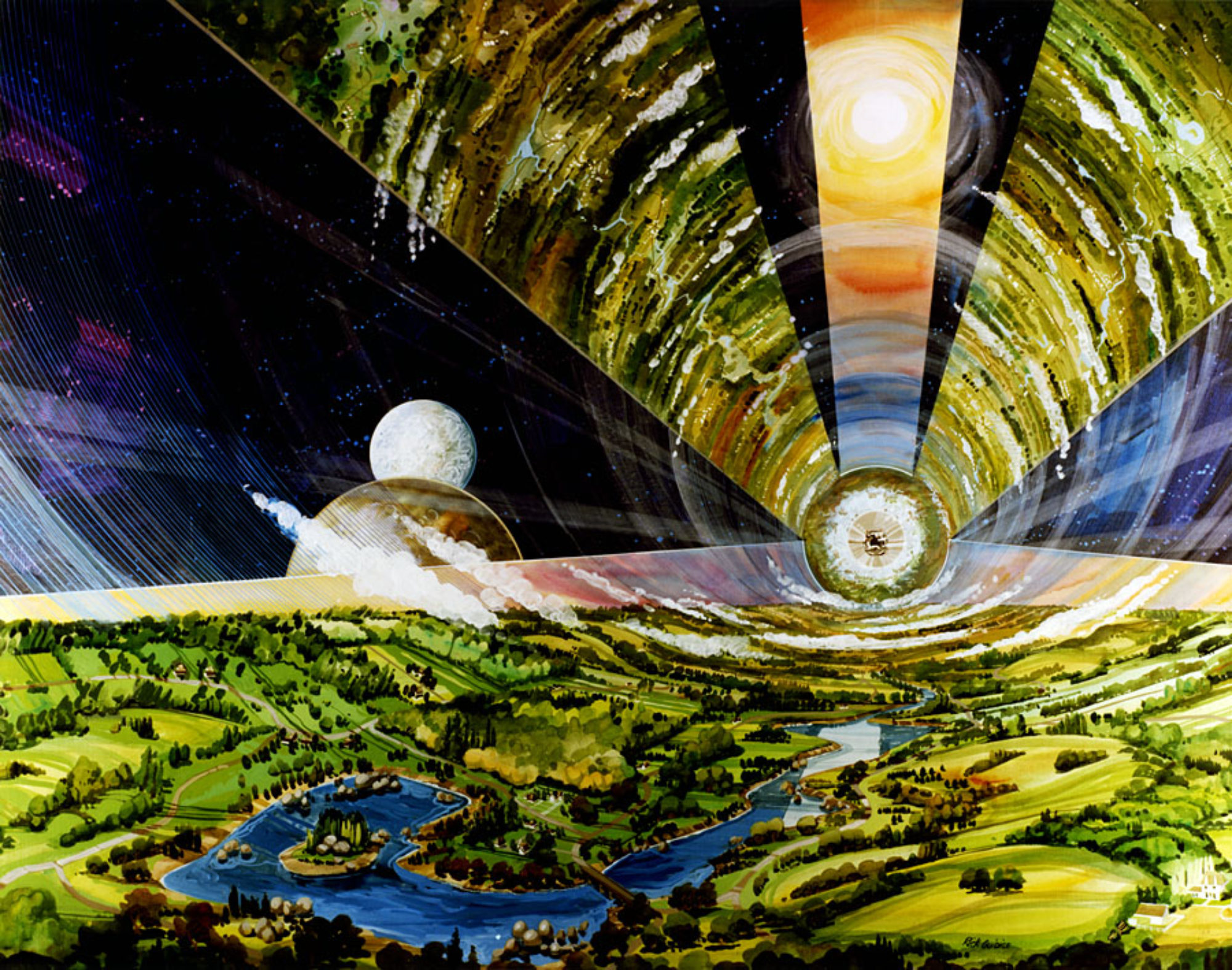

In an article in the National Space Society Space Settlement Journal, Bryce Meyer examines the integration of Artificial Intelligence (AI) into computer networks for space settlements. Meyer, an aerospace engineer, computer scientist and biologist is the founder and CEO of Cyan React, LLC, a startup that designs compact photobioreactors and provides expertise in space agriculture and life support for space habitats.
The paper describes the critical role of AI networks will play in enabling sustainable space settlements whether they be on the Moon, Mars, or in free space. These colonies, envisioned to minimize Earth resupply and achieve self-sustaining commercial operations, will face challenges due to limited human occupants (often under 100) and the absence of specialized expertise. AI systems can provide a solution that will bridge knowledge gaps, manage complex operations, and ensure rapid responses to critical issues, such as life support failures, where human reaction times may be insufficient.
The article categorizes AI into distinct families suited for space applications. Neural networks, good at pattern recognition, could help identify equipment anomalies. Generative AI (GAI), excellent at diagnostics and creative problem-solving, could propose solutions for crop failures in space farms or other equipment failures. Regression models would be leveraged for predictive analytics like forecasting resource needs.
These AI systems require robust integration with settlement infrastructure, using standard protocols like TCP/IP for communication. Training of AI agents involves learning from a pre-settlement knowledge base, periodic updates from Earth, and real-time inputs from sensors monitoring environmental conditions, equipment, and biological systems. Error management will be managed with AI outputs cross-checked by other AIs, rule-based systems, or human oversight to prevent cascading failures in critical systems.
Network architectures are key, with Local Area Networks (LANs) enabling low-latency, high-speed communication for real-time tasks like alarms and life support, while Wide Area Networks (WANs) connect settlements to external systems, such as orbital infrastructure or Earth-based servers . AI placement is strategic, positioned near action points within habitats (e.g., farms, life support systems) to minimize latency and ensure reliability in harsh extraterrestrial environments. Power constraints and radiation hardening are critical considerations for AI hardware.
The article presents a detailed scenario illustrating AI coordination in a mass flow system, as would be required in space farm. For example, crop wilting is detected by sensors, triggering a cascade of AI-driven actions: neural networks diagnose the issue, GAI suggests solutions (e.g., adjusting nutrient levels), and regression models predict outcomes. Human settlers, guided by augmented reality interfaces, validate and implement solutions, ensuring effective collaboration. The scenario underscores the need for AI to operate at multiple scales—individual plants, farm systems, and settlement-wide networks.
Bryce agreed to be interviewed via email on this enabling technology for space settlement. I am very grateful for him taking the time to dive deeper into the topic and for his detailed responses to my questions. Here is our discussion:
SSP: You mentioned that many of these AI systems are already in use in indoor farms and factories. Can you provide some examples of these instances?
BM…Not trying to pump a particular company but here are common examples:
Siemens is one of many companies that make networks of these AI enabled control systems, with control center software now: Siemens Industrial Copilot and SmartTron as well as AIRLOCK(InterLock) Systems.
Water Control: Evonik
There are also many new entry startups in this area, such as AGEYE (see below), and others, many have already tried and failed as businesses. Emerson Process is similar, with many offerings and architectures in Chemical Process Automation and Response. BASF is another with it’s xarvio® Digital Farming Solutions. Monnit makes Internet of Things (IoT) plant sensors and sensor reporting software.
It is a very active business area bridging strict rules based to AI enabled rules based and GAI systems with IoT.
SSP: In your example of an AI farm agent detecting a wilting problem with a tomato plant and coming up with a solution, you acknowledged that there are many ways in which ecosystem failures could a occur in a space farm and these scenarios would have to be anticipated to train the AI systems. Has work already been started on an AI controlled farm fault tree analysis, perhaps by the entities running the indoor farms you mentioned in Item 1?
BM…Absolutely! IoT and AI are used in combination in many indoor farms now, just not all the way to the point as shown in the paper, including the ‘recreational plant’ market and for food plants. This is in active work now by many companies, AGEYE is one company that does have integrated solutions like the farm part of the paper (or very close to it). With a little development, automated control will combine the systems in #1, with the farm systems, with more advanced and trained systems, IoT sensors and controllers, to get to the settlement level. It will take a merger of these to get there, but we are very close. Have parts, just need to integrate to get to the vision in the paper.
SSP: Prior to implementation for safe use in a space colony, AI systems would have to be trained on a variety of settlement functions in ground-based analogs. Perdue University’s Resilient ExtraTerrestrial Habitats Institute is doing work in this area as well as the Space Analog for the Moon and Mars at the Biosphere 2 facility in Arizona, and of course MELISSA in the EU. Are you aware of any other teams in academia or government working on this now?
BM…Really miss Ray Wheeler’s et al. NASA Biomass Production Chamber, which was the right size and type, would just need updates.
South Pole research station would work well for testing these systems…in a harsh place, limited human presence.
I know Space Development Network is proposing an inflatable farm to develop this technology too, though it needs funding.
AI control for factories and indoor farming is an active corporate area and they have their own extensive facilities, including near my home in St. Louis with Bayer (formerly Monsanto), though they aren’t focused on the particulars of space, per se, yet.
China also has extensive analog labs, since they do seek to beat the USA to long term Moon and Mars settlement. They occasionally publish.
Many colleges have funded work on vertical and indoor farming, several in my home state including at [University of Missouri-St. Louis] UMSL’s planned Yield Lab. Technical Schools like Ranken also teach and develop methods for indoor farming that could help development of these AIs. All of these facilities can be used to shake out AI systems too.
SSP: In private industry, a few companies are actively involved in developing space-based agriculture. I’ve covered one such company, Orbital Farms, which leverages Earth’s “Dark Ecosystem”, the food chain based on bacteria that are chemotrophic, i.e. deriving their energy from chemical reactions rather than photosynthesis. An example of these type of organisms are bacteria that live near volcanic sulfur vents at the bottom of the ocean. The energy inputs and material flows of these ecosystems are 100 times more efficient in water and energy use per unit volume when compared to conventional photosynthetic food production. The very same organisms can be engineered to make pharmaceuticals, plastics, and a variety of other useful complex organic compounds. Have you considered this approach to optimize mass flows and utility in space farm ecosystems?
BM…Of course. I have considered bioreactors, both photobioreactors and non-light based systems, for a decade. They are the Swiss Army Knife of mass balancing, though I don’t see them as primary food source except in emergencies unless 3d printing and other methods become far better in the culinary sense. Food is critical for psychology too. As is the need to see green and feel and smell plants and crops. Bioreactors have many profiles and uses on Earth now, and the dark cycle chemosynthetic systems are among these. I don’t see a lack of electrical power a problem, just my 2 cents, due to nuclear reactors or space solar power in long term settlements, so I see gardens and farms. Carbon is the problem in a mass cycle. However, the dark cycle systems would be essential for making biochemicals that are either lacking from farms and algae or needed to control the mass cycling in systems. Since we are minus the huge soil ecosystem on Earth for a long while, and may need time sensitive production, the dark cycle systems would be a must just to control the overall system. I do see those on spacecraft that have limited volume, that provide bulk calorie cycling, along with smaller plant systems.
SSP: In your example in Figure 12 of a small settlement of 10 people where the mass flows are 22kg per day to and from the farm, how big is the farm in cubic meters and what would be grown there to provide enough sustenance and oxygen for the occupants?
BM…Around 1400 square meters, 2400 cubic meters (very pessimistically) assuming a VERY diverse crop mix including a few shrimp, multiple veggies and crops like potatoes or peanuts/soy, and bioreactor array with tanks, and walking areas, with continuous crop production ad infinitem. Sounds big, but that is about the size of two three-story healthy midwestern suburban houses, very roughly. Less diverse crop sets can shrink the farm drastically, to around 25% of the size, but with less dietary diversity.
SSP: With respect to training AI systems to be “space rated”, the first iterations to be implemented off Earth will not be entirely autonomous (as you have shown in your examples) and will have humans in the loop until error rates can be reduced to some tolerable level. With the speed at which AI and robotics are progressing today, while at the same time, settlement of the Moon and Mars seems to be advancing at a snail’s pace, do you see the two technologies converging in the near future so that when permanent colonies are finally established, AI networks will be able to autonomously control most critical functions without human intervention?
BM…I never will fully trust AI for everything, and I don’t think the settlers will either, at a minimum due to cybersecurity. That said, the advances in both systems and software will continue to allow more complex settlements monitored by fewer people. Automation will really will be a core technology in expanding settlements, and starting them. Farms could be growing and operating steady state before the first long term residents arrive, and as a settlement expands, it could add modules and let AI get it started and growing before bolting it onto a smaller settlement. Some things will see robotics as repair agents. The AI technology expansion will allow for more long term optimization as well, and continue to add resiliency to the settlement.
You could see a retirement home or factory on the moon with only a few human workers to keep the settlement running, a few medical technicians that are AI assisted, and robots that fix many things without bothering the staff.
SSP: You have suggested in a previous post on SSP that space farms on Mars could be the bread basket for the outer solar system. Another space farm advocate, retired software engineer Marshall Martin, has proposed a roadmap for their implementation starting with ground based analogs, but progressing mainly to rotating free space settlements, eventually resulting in millions of farms feeding billions of people throughout the solar system. When do you think we’ll see the first prototype closed loop farm implemented in space?
BM…I want farms everywhere, grounded and floating [in free space], because I want to see Trillions of Happy, Smiling Babies everywhere.
I would bet either Artemis, a company, or China fields one in the next 35 years for sure, likely sooner, just to prove the concept. Orbital factories could drive the need as much as a lunar base, just to limit resupply, but a Mars base or space station that is beyond cis lunar space will have to have such a close[d] cycle farm as a must due to limited resupply. So, when depends on if the cost to orbit gets very cheap, and cost to [the] Moon gets cheap. Cheap lift in cislunar space would limit the need to fully recycle, but beyond that distance the case gets much stronger. If it stays expensive to [get to] the Moon, the Moon would drive the need, and the farm gets built sooner.
In his conclusion to the article Meyer holds that AI complexity must align with settlement needs, balancing sophistication with reliability. Interdisciplinary collaboration is essential to refine these systems through scenario-based testing and practical implementation. By empowering minimally trained settlers, AI networks enhance sustainability, safety, and mission success, laying a foundation for long-term human presence in space.
Meyer has his own website where he collates his research and links about closed cycle farming and other space ecology topics. He is also a NSS Space Ambassador.


