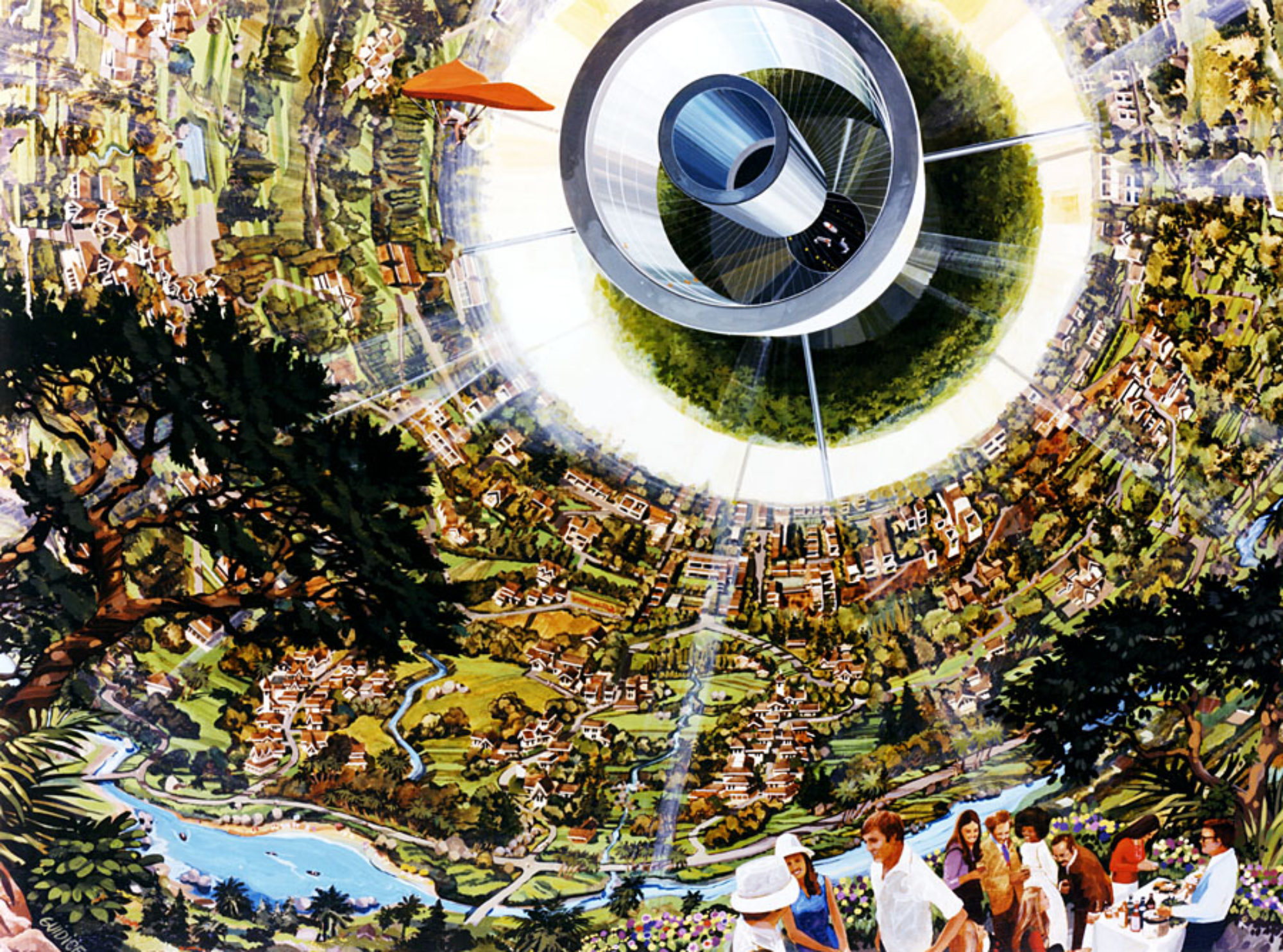

In a presentation at this year’s International Space Development Conference, which took place in McLean, Virginia, June 4th through June 7th, National Space Society (NSS) COO/SVP Dale Skran announced the kickoff of an open-source Orbital Space Settlement Design (OSSD) Project. The initiative has been under active development for over a year within the NSS Space Settlement Advocacy Committee (SSAC) and the newly forming NSS Board of Scientific and Technical Advisors (BSTA). Full disclosure: Yours truly is a member of the SSAC. It was officially approved as an NSS Project last March. The content of this post is based on Skran’s presentation, supplemented with subsequent material presented to the SSAC, with permission.
The current OSSD project Study Group core team consists of Dale Skran, Frederick (Rick) Jenet, PhD, and Bryce Meyer, with all BSTA and SSAC members actively involved in review and discussion. Work is currently focused on establishing a foundational set of design inputs in the form of “Questions” (see below). A dedicated workshop to refine these questions will be held at the NSS Space Settlement Summit taking place at the University of Central Florida, October 25th and 26th. This will be followed by a public announcement and formal request for comment from the broader community. In addition, the “OSSD Terms of Reference” (TOR) and the design input Questions will be located on a dedicated NSS website. The final recommendations will be published in the NSS Space Settlement Journal.
What are Terms of Reference?
The TOR is a formal document that defines the mandate, scope, responsibilities, boundaries, and working methods of the OSSD project. TORs are recursive — a large project such as this one can be subdivided, with each subdivision having its own TOR. This powerful technique is derived from the International Telecommunications Union (ITU) standards development process.
What is the Objective of the OSSD Project?
The core goal is to produce the first complete buildable engineering design for a rotating space settlement. The project is primarily an engineering and systems-design effort, not a policy activity, although legal and economic aspects are necessarily included because they affect feasibility.
Why Pursue This Project?
Rotating space settlements as envisioned by Gerard K. O’Neill will remain an empty dream until they become buildable realities. To many observers, it has not yet been fully established that such settlements are feasible. A fully realized engineering design will be a huge leap forward in making the case that settlements in free space lie in humanity’s future. The research and development required could also address many important issues back on Earth (e.g., closed-loop systems, resource efficiency, energy production, materials science, and robotics).
Why Should the NSS Lead This Effort?
The NSS is uniquely positioned because it is:
- Non-partisan.
- Not aligned with any particular company or region.
- Interested in broadening access to space for all of humanity.
- Possesses the necessary contacts to convene such a project.
- Has the longevity and reputation to be taken seriously.
- Can serve as a respected “honest broker” between different companies, products, technologies, and design approaches.
- Operates as a non-profit.
Why Now?
Several converging factors make 2026 the right moment:
- It is over 50 years since the landmark 1975 NASA-Ames space settlement summer study and since the founding of the L5 Society, which later merged with the National Space Institute in 1987 to form the NSS.
- The NSS laid critical groundwork with the invitation-only Space Settlement 2021 Workshop (SSW), resulting in the book “A Dream Renewed: O’Neill’s Vision in the 21st Century,” a paperback/magazine provided to NSS members, ISDC attendees, and coming out in hardcover on August 25, 2026, available for pre-order.
- Sufficient knowledge has accumulated, and technology has improved over five decades, such that O’Neill’s original concepts can be updated to a buildable design.
- Low-cost, fully reusable launch vehicles — which existed only on paper in 1975 — are now a reality on the launch pad.
- The open-source movement has demonstrated a path to the democratization of technology that was not envisioned in O’Neill’s era.
- Increasingly powerful artificial intelligence tools now enable a relatively small science and engineering team to address large, complex design questions at a level impossible during O’Neill’s time.
Scope and Boundaries of the OSSD Project
Scope of the Engineering Design:
- A place where people, including families, can safely live on a permanent, economically self-sustaining basis.
- Nominal population target: 1,000, with analysis covering populations from 100 to 10,000 for comparison.
- Designed for direct comparison to the 10,000-person NASA Ames summer study and the British Interplanetary Society (BIS) Avalon project.
- Positioned as a component in a cislunar economic network (not required to be autarkic or totally biologically self-sufficient).
- Assumes the baseline human species; human modification or enhancement is explicitly out of scope.
- Design target: 1 gravity or a high fraction of 1g (since humans have evolved over millions of years on Earth, and the minimum gravity level for long-term human thriving in space has not been firmly established).
What’s included:
- Engineering design for a rotating space settlement.
- Examination and development of assumptions related to available construction materials and their costs.
- Exploration of the legal, treaty, and economic prerequisites needed for the engineering design to be feasible.
- Investigation of resilience to both natural and artificial assaults, with particular attention to electromagnetic hazards, biological threats, and meteor/space debris strikes.
What’s excluded (The idea being “Don’t boil the ocean”; i.e., focus only on the space settlement design, not all the other ancillary infrastructure and supply chains):
- Lunar mass drivers
- Lunar mining technology
- Construction shacks
- Asteroid mining technology
- Launch vehicles
- In-space transport vehicles
- Detailed design of robotic construction equipment
- Weapons systems for settlement defense that are not necessary to protect against natural phenomena
- Military plans relating to settlement defense
What Happens Next? The Five-Year Roadmap
The project will proceed through disciplined, question-driven workshops rather than attempting to design everything at once:
- NSS, led by the BSTA, will organize high level workshops to define specific design input questions, to be drafted at this fall’s Space Settlement Summit and subsequently flowed down to subordinate working groups.
- The questions will be categorized into a few topic areas to help assign subject matter experts, such as High-level Requirements, Agriculture/Biological, and Physical/Construction.
- The BSTA will assign Rapporteurs to lead these working groups in each question area.
NOTE: Each Rapporteur is expected to organize their work as they see fit and report at least annually to the BSTA with a readout of their progress, including draft recommendations. The normal working method will be workshops, but other means can be used. Unlike the ITU-T, which rotates its meetings across continents, workshops will typically be held in the USA, although this is not strictly required. Rapporteurs are unpaid volunteers, typically with jobs in the space industry
- In a workshop, carefully framed draft questions will be presented and tagged with a dependency (i.e., TOR, Economic Model, Location, etc.) The questions form the intellectual backbone driving the entire OSSD project.
- The workshop groups will do the hard work to define good questions with the core philosophy that “Good questions drive good answers.”
- Workshops will cover a focused set of questions and continue until a Recommendation is produced to define a design output.
- Target: After five years, the accumulated Recommendations will add up to a complete, buildable engineering design.
The Questions:
The following list is an evolving work in progress as of the date of this post, of potential questions to be finalized by the BSTA and then flowed down to the working groups to flesh out the details. It is by no means complete.
- What is the target reliability/safety standard? (Depends on TOR)
Options range from aviation-like to nuclear-plant-like, to “ISS-like”. Telecom, chip, or automotive standards? This decision drives redundancy, inspection cadence, acceptable risk to children, and the critical safety-vs-uptime trade-off (space habitats cannot have downtime). It also requires choosing a reliability level target (e.g., 5-sigma vs. 6-sigma) and deciding which parts of the habitat are held to which standards. - What are the core services provided to residents? (Depends on TOR – for discussion)
Includes housing space per person, privacy, recreation, food variety, internet latency, and governance/rights baseline. The question invites comparison to services provided by a small town on Earth and asks how to avoid the tragedy of the commons for “free goods,” while also defining the proper limits of what planners/designers should dictate. - What is the Economic Model? (Depends on Q4)
This involves answering fundamental questions like: How will settlers add economic value? How will the settlement be economically sustainable? - Where exactly in cislunar space will the settlement be located? (Depends on TOR)
Candidate locations: Near-Rectilinear Halo Orbit (NRHO), distant retrograde orbit, Earth-Moon Lagrange (EML)1/EML2 halo, high lunar orbit, or EML4/EML5. Location dramatically affects eclipses, station-keeping, communications, debris environment, thermal design, and the economic model itself. - What is the logistics doctrine with Earth? (Depends on Q3, Q4)
Covers cadence for spares and consumables, allowed lead times, acceptable downtime, and precisely which items must be “topped off” and how often. Items such as trace elements, pharmaceuticals, replacement electronics, specialty foods, nitrogen/argon, etc. need to be defined. Spares/consumables strategy may itself be an outcome of the economic model rather than a question per se. - What population size and target demographics are required for social stability? (No dependency)
Includes sex ratio, age distribution, and other demographic factors. Questions about non-cisgender humans are out of scope. This is not to exclude them explicitly, but the intent of the question is to focus on critical biological issues. - What population size is required for operational stability? (No dependency)
Focuses on skill sets, trades, and degree of automation needed for settlers to maintain safe operations. May depend on downstream recommendations about agriculture and other operations. - What population size is required for economic viability? (Depends on Economic Model)
Considers export/service revenue versus internal labor needs, degree of specialization, downtime tolerance, training pipeline, and explicitly excludes a small population of the very rich as a viable model. - What population size, including pets, is required for mental health? (No dependency)
Studies have found that 1 in 20 people who overwinter in Antarctica develop serious mental health issues. This suggests that a population of ~200 (typical Antarctic winter-over size) may be too small, or that aspects of the Antarctic station model need correction for space application. - Therefore, what is the minimum viable steady-state population? (Depends on the Q6, Q7, Q8, Q9)
A synthesizing question that derives a minimum that satisfies the criteria from the related questions, with a suggested floor of 100 occupants. - What governance model applies? (Depends on TOR)
The TOR states that the settlement is assumed to be under the legal jurisdiction of the launching state. The question explores issues arising from applying the laws of the launching state to the settlement and how those issues can be resolved. - What Ownership Model Applies? (Depends on Economic Model)
This question is strongly linked to the economic purpose of the settlement, and should cover corporate ownership/company townships, co-ops, condominiums, employee-owned corporations, and other models. - What international legal regime is required to allow the first settlement to be funded? (Depends on TOR)
Focuses on what legal interpretation of the Outer Space Treaty is necessary to permit construction of a settlement in orbital space. - What maximum rotation rate (rpm) is acceptable for a multi-generation population? (Depends on TOR)
Because artificial gravity is fixed at approximately 1g, the rotation rate directly sets the required radius, which in turn drives structural mass and construction approach. Why 1g? The TOR states: “Since the minimum gravity level for human thriving has yet to be firmly established, the design target will be either 1 gravity or a high fraction of 1 gravity…” I’ve posted on the topic previously. - What radius/geometry follows from the g level and rpm? (Depends on Radius, also TBD)
Explores torus vs. cylinder vs. multi-ring vs. hammerhead configurations, habitable deck layout, and zoning. - What is the docking/visiting vehicle strategy relative to rotation? (Depends on Q15)
Will there be total spin-down? Will there be a non-rotating hub, and if so, how will the transfer from rotating-to-nonrotating spaces be accomplished? - What radiation standard do we design to for families/children? (Depends on Q1)
Annual dose targets, pregnancy limits, and Solar Particle Event shelter requirements need to be specified. Note that Medevac doesn’t help for chronic exposure to Galactic Cosmic Radiation. - What shielding approach meets Q17 at minimum mass/cost? (Depends on Q17, Q4)
Decisions on how bulk shielding (e.g. water and/or regolith) will be distributed, need to be made, accounting for storm shelters. Shielding-as-storage, active shields, and layered shields should be considered. - Where does shielding mass come from? (Depends on Q4, Q18)
Weigh the options of Earth-launched vs lunar-derived vs extracted from an asteroid, keeping in mind that sourcing material for initial habitats may change for future growth. - What closure level is required to be “permanent” with imports allowed? (Depends on Q2, Q3, Q4, Q5)
Define which consumables must be recycled (e.g., water, oxygen, nitrogen) vs what can be imported. - What food system meets nutrition, variety, and psychological considerations at minimum mass/power? (Depends on Q10, Q20, Q25)
The hydroponics/vertical farming mix, lighting strategy, protein plan, and storage buffers all need to be determined, fully considering the recycling system and ecological balance of the biosphere. - What will be the atmosphere model and fire safety regime? (Depends on Q1, TOR)
The total pressure, O₂ fraction, diluents (N₂/Ar), toxic pollutants control, and fire suppression doctrine all need to be determined. - What water/waste architecture achieves Q20 with acceptable failure modes? (Depends on Q1, Q2, Q20)
Water recovery, sanitation, pathogen control, waste processing, and a plan for “what if” contingencies need to be defined. - How can an overly clean habitat environment be avoided? (TBD)
Children who grow up on farms have very low allergy rates; we want to make sure kids in the settlement are exposed to diseases to develop their immune systems. - What total power level is required (steady state and peak)? (Depends on Q1, Q3, Q21, Q23)
This will be a cumulative summing the contributions from the habitat, agriculture, industry, propulsion, and reserves. - What power source architecture is optimal in cislunar space?(Depends on Q4, Q25)
Solar vs nuclear vs hybrid, taking into account storage needs, safety considerations, and maintenance. - What thermal rejection system is required? (Depends on Q25, TBD)
This will drive radiator design, cooling system loops, heat reuse, zoning, and orientation constraints. - What minimum local manufacturing/repair capability is required? (Depends on Q5, Q9)
Operations to consider include, but are not limited to, planning for spare parts, maintenance of seals/filters, facilities for machining, electronics repair, additive manufacturing, and QA. - What structural concept meets loading requirements, while taking into account micrometeoroids, internal pressure, and rotation rate, and minimizing mass? (Depends on Q4, Q15, Q18, Q22)
At a minimum, requires consideration of materials, compartmentalization approach, Whipple shielding design, and pressure hull segmentation. - What is the assembly and spin-up strategy? (Depends on Q4, Q15, Q18, Q29)
Requires decisions on which modules are preassembled vs built on-orbit. Will the construction be carried out robotically or by crew? What is the optimal timing of when shielding is added, taking into account how balance will be maintained when rotation is initiated? - What is the fault-tolerant operations concept? (Depends on Q1, Q10, Q28)
This will help determine the staffing requirements, levels of training, emergency response procedures, maintenance cycles, inspection needs, spares policy, and cross-training. - What are the top “design basis accidents” and how are they handled? (Depends on Q1, Q22, Q23, Q29, Q31)
Scenarios include, but are not limited to, fire, depressurization, toxic release, collision, loss of rotation control, and loss of power. - What is the growth path from the minimum viable system to a larger one? (Depends on Q15, Q18, Q29, Q30)
This question will help to decide when to add rings/modules, how governance and economy scale, and how to avoid redesign.
O’Neill’s Vision of Free Space Settlements is Closer Than Ever
The OSSD project is a major strategic step for the NSS. After completing and publishing the foundational 2021 workshop proceedings in both accessible paperback and soon-to-be-released premium hardback formats, the organization is now moving from vision and discussion to disciplined, engineering-driven action. By framing the project around a rigorous, design input question methodology with clear scope boundaries, plans to assign rapporteurs, workshop processes, and a five-year horizon for producing buildable recommendations, the NSS is taking the lead as the honest broker and convening authority capable of coordinating the complex, multi-disciplinary work required to turn O’Neill’s dream of rotating space settlements into engineering reality.
The interactive workshop approach using carefully crafted design questions demonstrates a commitment to grassroots community input and iterative refinement rather than a top-down prescription. The careful separation of in-scope engineering/systems issues from excluded topics (launch vehicles, mining technology, mass drivers, etc.) shows a mature project management philosophy designed to keep the effort focused and achievable.
In summary, the OSSD Project will bridge the inspirational legacy of Gerard K. O’Neill and the 1975 NASA-Ames study with the practical realities of 2026: reduced launch costs via reusable rockets, open-source methodology, powerful leverage of AI, accumulated knowledge, and an organized NSS ready to lead the next phase of space settlement engineering. This initiative is positioned as the logical next step after the SSW book — turning the “long list of areas for future research” identified in that publication into concrete, actionable engineering questions whose answers will collectively constitute the first credible, buildable design for a rotating space settlement.
I cohosted The Space Show with Dr. David Livingston on August 7 when Dale Skran was our guest, sharing more details about the project. You can watch the archived Zoom recording of the show on The Space Show Substack page or listen to an audio recording on The Space Show website. Visit the NSS OSSD project website for the latest updates. Let’s make this happen!


