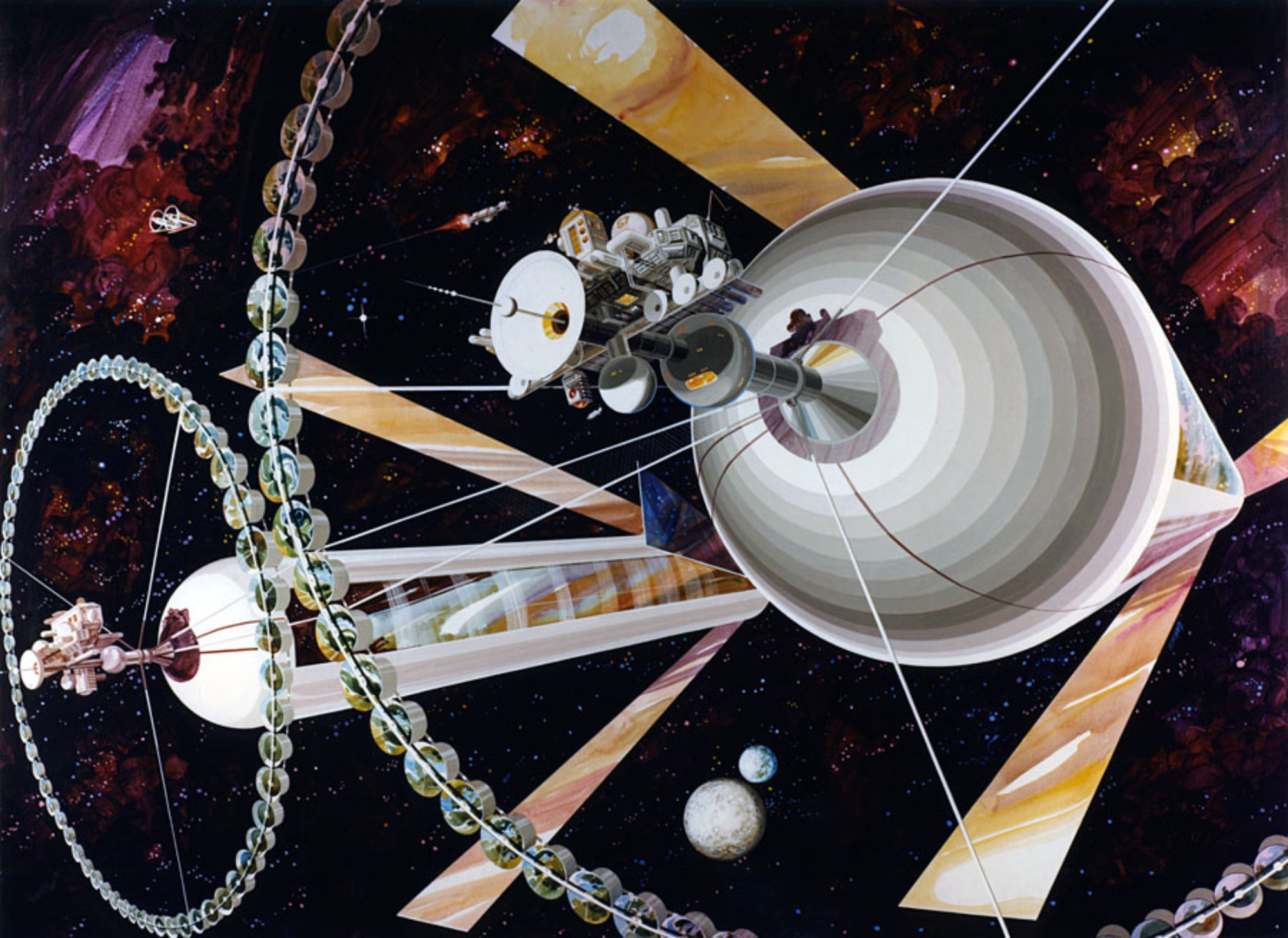

The Resilient ExtraTerrestrial Habitats Institute (RETHi) is at the forefront of developing autonomous and resilient habitats essential for space settlement. The NASA-funded organization just released its Impact Report summarizing work completed to date. SSP reported on RETHi back in 2020.
A key driver for RETHi’s imperative of autonomy in these habitats is the increasing communication delays and limited bandwidth that will severely restrict interaction with controllers on Earth as habitats are established further from home. These limitations necessitate new approaches for managing space habitats autonomously, fundamentally shifting the operational philosophy for future missions. Unlike near-Earth operations where Mission Control provides real-time oversight and intervention, the remote and harsh environment of deep space demands that habitats become self-sufficient entities. This means that intelligence, diagnostic capabilities, and decision-making must reside on-board, transforming the paradigm from remote control to local autonomy. This is a critical design constraint that permeates all of RETHi’s research, influencing everything from structural design to life support systems and robotics.
RETHi’s research is organized into three interrelated thrusts, each addressing a critical aspect of a comprehensive framework for self-managing systems:
- Resilience (Architecture): This thrust focuses on the fundamental design of habitats. It involves choosing design features and tools to maximize resilience, assessing safety controls, and developing a resilience-based design procedure aligned with NASA’s processes. This ensures that resilience is embedded into the very fabric of the habitat from its inception, making it inherently robust.
- Awareness (Detection + Diagnosis + Decisions): Addressing the need for autonomy in operations, this thrust aims to detect damage and disruptions, diagnose issues, and support decision-making autonomously. This represents a significant departure from traditional human space flight operations, which rely heavily on large Mission Control teams. The goal is to enable the habitat to “understand” its own state and the nature of any anomalies.
- Robotics (Enable Action): This thrust is dedicated to expanding the capabilities of autonomous systems by increasing the scope of interventions that can be carried out automatically by robots. This is crucial for construction, maintenance, and repair in hazardous environments where human presence might be limited or too risky.
RETHi’s research is supported by three complementary testbeds, each serving a distinct but integrated purpose, forming an efficient iterative design and validation pipeline:
- HabSim: This is a computational model of core space habitat subsystems. It incorporates damageable and repairable properties, sensors, and agents for anomaly detection and repair. HabSim can simulate various disruption scenarios, including micrometeorite impacts, fires, Moonquakes, and nuclear leakage. It primarily helps users learn to create and maintain resilient habitats by assessing decision strategies and resilience through simulation-based design, which can reduce mission costs and increase crew safety.
- CDCM (Control-oriented Dynamic Computational Model): This capability provides a specialized language for rapid prototyping of machine-readable models that capture causal relationships in complex systems. This enables automatic diagnostic reasoners and uncertainty quantification, which are crucial for developing intelligent, self-diagnosing systems.
- HARSH (Human-Centered Autonomous Resilient Space Habitats): This testbed is a cornerstone of RETHi’s research, providing a unique cyber-physical platform for validating the complex interplay of hardware and software in autonomous space habitat systems. As the physical validation layer, HARSH takes the insights, algorithms, and models developed and refined in HabSim and CDCM, and tests them in a hardware-in-the-loop environment to confirm their real-world efficacy.
These three complementary testbeds provide a sophisticated, multi-stage approach to research and development. HabSim allows for broad, rapid computational exploration of scenarios and design strategies, providing initial insights. CDCM provides the formal language and tools for precise diagnostic reasoning and model building. HARSH then serves as the high-fidelity, cyber-physical validation platform, where the most promising concepts from the computational realm are rigorously tested against physical realities. This iterative process—from broad simulation to precise modeling to hardware validation—minimizes risk, optimizes design, and accelerates the development cycle for a mature engineering pipeline of complex, safety-critical systems.
The RETHi Impact Report summarized the status of many of the Institute’s research initiatives. Although all are important, this post will highlight progress in two key areas of interest: The HARSH testbed and the design of a habitat’s Environmental Control and Life Support System (ECLSS).
Purpose and Unique Capabilities of HARSH
HARSH is a cyber-physical testbed designed to investigate advanced systems health management capabilities for complex systems with deep informational dependencies. The facility bridges the gap between digital simulation and physical reality, allowing for a more comprehensive understanding of system behavior.
The platform’s unique strength lies in its ability to trigger realistic disruption scenarios using hardware and test autonomous recovery. This capability distinguishes HARSH from purely computational models by enabling real-world interaction, sensor feedback, and the validation of autonomous responses against actual physical system behavior. While computational models like HabSim and CDCM are invaluable for initial design and rapid prototyping, HARSH serves as the crucial validation bridge from simulation to reality. It is where theoretical models and algorithms are put to the ultimate test against physical realities, including hardware limitations, sensor noise, latency, and real-world environmental interactions. This is an indispensable step for ensuring reliability and eventual flight certification of autonomous systems.
Facilitating Investigation of Advanced Systems Health Management
HARSH’s cyber-physical nature allows for the investigation of advanced systems health management capabilities, which are crucial for maintaining complex space habitats, especially those with deep informational dependencies. This entails a focus on integrated diagnostics, prognostics, and self-healing mechanisms across multiple interconnected subsystems. In a deep space habitat, a failure in one system, such as a power supply, can quickly cascade to others, like the ECLSS or communication networks.
The ability to test autonomous recovery under realistic hardware-induced disruptions is central to HARSH’s role in validating the Awareness (detection, diagnosis, decision) and Robotics (enable action) thrusts in a practical, integrated setting. To attain advanced systems health management capability, a focus that transcends simple fault detection is required. It implies a sophisticated ability to continuously monitor, diagnose, and predict the health of complex, interconnected systems. HARSH’s ability to test deep informational dependencies and autonomous recovery provides a proactive approach to resilience, where the system not only identifies a problem but also takes corrective action to prevent cascading failures and restore functionality, thereby minimizing the need for human intervention and ensuring mission continuity.
Advancing Life Support Systems for Deep Space: RETHi’s ECLSS Research
As we all know, the ECLSS is critical for sustaining human life in the hostile, closed environment of deep space settlements. The life support system provides essential functions such as breathable air revitalization, water recovery, waste management, and thermal control, directly impacting crew health and performance. The extended durations of deep space missions (and eventual evolution to permanent communities) necessitate a highly reliable and resilient ECLSS, capable of operating autonomously and recovering from disruptions without immediate help from Earth, given the significant communication delays and the unlikelihood of the success of rescue operations due to long transit times.
While a habitat’s structural integrity and autonomous systems are vital, the ECLSS provides the breathable air, potable water, and stable thermal environment necessary for human survival. Any significant failure in these systems directly jeopardizes the safety of the habitat’s occupants, making them the ultimate determinant of mission duration and crew survivability. Therefore, the resilience of an ECLSS will directly dictate how long a mission can last and whether the crew can survive unforeseen events, particularly when autonomous recovery is the only option.
Development of High-Fidelity, Physics-Based Simulation Models
RETHi has developed a high-fidelity, physics-based simulation model for an ECLSS, a sophisticated approach that accounts for the underlying physical principles governing the system’s behavior, allowing for a deep and accurate understanding of its performance.
This advanced model is specifically designed to predict interior conditions under nominal and disruptive scenarios. This capability is vital for understanding how the habitat’s internal environment responds to various stresses, from equipment failures to external impacts, and for evaluating the effectiveness of mitigation strategies. This method of modeling can predict interior conditions under nominal and disruptive scenarios, enabling a proactive, rather than reactive, approach to resilience. Instead of waiting for failures to occur and then responding, RETHi is developing tools to anticipate how the ECLSS will behave under various forms of stress. This predictive capability allows designers to identify vulnerabilities, optimize system responses, and develop robust contingency plans before a space habitat is established, significantly enhancing safety, reliability, and the potential for autonomous recovery. It moves beyond simple performance modeling to detailed stress-testing and failure mode analysis in a virtual environment.
Evaluation of ECLSS Resilience Under Nominal and Disruptive Scenarios
The ECLSS simulation model allows for the evaluation of system resilience. This means the model can assess the system’s ability to withstand disturbances, adapt to changing conditions, and recover from various challenges, ensuring continuous life support. By simulating disruptive scenarios, researchers can understand the precise impact of failures, optimize control strategies, and develop autonomous recovery protocols for critical life support functions, minimizing the need for human intervention during emergencies.
Evaluating system resilience under disruptive scenarios goes beyond merely ensuring individual ECLSS components are reliable. It validates that the system has the ability to maintain its critical functions even when components fail or external disturbances occur. This shifts the focus from preventing individual failures to ensuring the overall system can adapt and recover, which is a hallmark of true resilience in complex, high-stakes environments where human intervention may be limited. This holistic view is essential for long-duration deep space missions, where adaptability is paramount.
SSP covered similar research by Curt Holmer in his master degree thesis modelling the stability of an ECLSS back in 2021. That work attempted to capture the complex web of interactions between biological, physical and chemical processes and detecting early warning signs of critical transitions between systems so that appropriate mitigations can be taken before catastrophic failure occurs. RETHi’s approach takes stability modelling to a deeper level, enabling ECLSS designers to understand the complex interdependencies and vulnerabilities of the system to determine proactive countermeasures.
Conclusion: Paving the Way for Future Space Habitats
The Resilient ExtraTerrestrial Habitats Institute at Purdue University is playing an indispensable role in driving the design and development of resilient and autonomous habitats, which are critical for the future of space colonization. The institute’s integrated, multi-faceted approach to autonomous resilience, exemplified by the HARSH cyber-physical testbed and its pioneering ECLSS research, is foundational for achieving long-duration human presence off Earth.
RETHi’s strategic organization into resilience, awareness, and robotics initiatives address the complex challenges of human survival in deep space, where communication delays necessitate on-board intelligence and self-sufficiency. HARSH serves as the crucial validation bridge, transforming theoretical models and algorithms into tested, real-world solutions for autonomous recovery and systems health management. Concurrently, the high-fidelity ECLSS models ensure that the fundamental life support functions remain robust and adaptable under stress, directly impacting crew safety and settlement longevity.
The comprehensive nature of RETHi’s work positions it as a leader in future large-scale, interdisciplinary research initiatives for resilient space habitats. The Institute’s holistic understanding of the complex challenges of space colonization fosters integrated solutions across multiple scientific and engineering domains, supported by robust testing infrastructure. The Institute’s current research findings are a blueprint for effective advanced research and development needed for the next frontier of human expansion into the solar system, emphasizing a paradigm shift towards self-sufficient extraterrestrial settlements.


