An underground habitat on Mars excavated by autonomous rovers reinforced with 3D printed concrete from Martian regolith. Credits Henriette Bier et al.* / Technical University Delft
A team* of researchers at Technical University Delft (TUD) in the Netherlands led by Henriette Bier published a paper last year describing a method for robotically excavating and building structures in cavities below the surface of Mars to provide living spaces for colonists that would be both protected from radiation and thermally insulated from extreme cold. The process would be initiated by autonomous digging rovers hogging out tunnels in a spiral pattern and utilizing the excavated regolith to create concrete for the next step. Using a process developed by TUD called Design-to-Robotic-Production (D2RP) the concrete would be extruded by a 3D printer to reinforce the tunnel walls. Called “Scalable Porosity” TUD has pioneered this process for Earth based architectural applications.
The assumption is that the generated structure is a structurally optimized porous structure, which has increased insulation properties … and requires less material and printing time.
Credits: Technical University Delft
Once structurally sound, the material between the tunnels would be removed to create habitat spaces to be filled by inflatable structures made from materials also sourced in situ.
Although not addressed in detail in the article the authors propose that electrical power be provided by a combination of solar energy and an innovative kite based platform, a highly efficient airborne energy system based on soft wing technology pumped by persistent winds at high altitudes. TUD pioneered this renewable energy technology based on inflatable membrane wings tethered to a ground based generator through its Kite Power research group. A startup called Kitepower B.V. was spun off as a result of this research to commercialize the technology hear on Earth.
Credits: Kitepower B.V.
The D2RP process is data driven and
“…integrates advanced computational design with robotic techniques in order to produce architectural formations by directly linking design to building production.”
For example, the habitat will require a life support system which includes a plant cultivation facility, water recycling and oxygen production controls. These design inputs are coded in the 3D printing program to fabricate the structure around sensor-actuator systems that regulate plant growth and wiring for control mechanisms.
TUD’s goal is to develop a fully self sufficient D2RP system for fabricating subsurface settlements on Mars via ISRU.
* TUD Team members: Henriette Bier, Edwin Vermeer, Arwin Hidding, Krishna Jani
Artist rendering of an earlier version of Starship (formerly BFR, Interplanetary Transport System) approaching Mars. Credits: SpaceX
A mission architecture for Starship is described in a preprint open access article published online December 2 to be released in the next issue of the New Space Journal. The paper lays out a proposed strategy for using the yet to be validated SpaceX reusable spacecraft to establish a self sustaining colony on Mars. The authors* are a mix of space practitioners from NASA, the space industry and academia. No doubt Elon Musk may be thinking along these lines as he lays his company’s plans to assist the human race in becoming a multi-planet species.
Starship is a game changer. It is being designed from the start to deposit massive payloads on The Red Planet. It will be capable of delivering 100 metric tons of equipment and/or crew to the Martian surface, and after refueling from locally sourced resources, returning to Earth. This capability will not only enable extensive operations on Mars, it will open up the inner solar system to affordable and sustainable colonization.
Some of the assumptions posited for the mission architecture are based on Musk’s own vision for his company’s flagship space vehicle as articulated in the New Space Journal back in 2017, namely that two uncrewed Starships would initially be sent to the surface of Mars with equipment to prepare for a sustainable human presence.
“These first uncrewed Starships should remain on the surface of Mars indefinitely and serve as infrastructure for building up the human base.”
The initial landing sites will be selected based on where the water is. The priority will be finding and characterizing ice deposits so that humans will eventually be able to locally source water for life support and to produce fuel for the trip home. The automated payloads of these initial missions will be mobile platforms similar in design to equipment planned for upcoming robotic missions to the Moon in the next couple of years. One such spacecraft, the Volatiles Investigating Polar Exploration Rover (VIPER) is discussed with its suite of instruments that will be used to assess the composition, distribution, and depth of subsurface ice to inform follow-on ISRU operations.
“The use of water ice for ISRU has been determined as a critical feature of sustainability for a long-term human presence on Mars.”
Conceptual depiction of the NASA VIPER rover planned for delivery to the Moon’s south pole in late 2023. A mobile platform with a similar suite of instruments based on this design could be launched to Mars aboard Starship. Credits: NASA
To harvest water from subsurface ice the authors suggest using proven technology such as a Rodriguez Well (Rodwell). In use since 1995, a Rodwell has been providing drinking water for the U.S. research station in Antarctica. The U.S. Army Engineer Research and Development Center’s (ERDC) Cold Region Research and Engineering Laboratory (CRREL) has been working with NASA to prove the technology for use in space in advance of a human outpost on Mars.
Diagram depicting how a Rodriquez Well works. Credits: U.S. Army Engineer Research and Development Center
“Rodwell systems are robust and still in routine use in polar regions on Earth.”
The next order of business is power generation. The authors suggest using solar power as a first choice because the technology readiness level is the most mature at this time. Autonomous deployment of a photovoltaic solar array would be carried out on the initial uncrewed missions. But due to frequent dust storms that could diminish the array reliability, nuclear power may be a more appropriate long term solution once space based nuclear power is proven. NASA’s Glenn Research center is working on Fission Surface Power with plans for a lunar Technology Demonstration Mission in the near future. A solid core nuclear reactor is also an option as the technology is well understood.
These initial missions will robotically assess the Martian environment at the landing sites to inform designs of subsequent equipment to be delivered by crewed Starship missions in future launch windows occurring every 26 months. Weather monitoring will be performed as well as measurements of radiation levels and geomorphology to inform designs of habitats and trafficability. Remotely controlled experiments on hydroponics will also be performed to understand how to produce food. Testing will be needed on excavation, drilling, and construction methods to provide data on how infrastructure for a permanent colony will be robustly designed.
Starship’s ample payload capacity will allow prepositioning of supplies of food and water to support human missions before self sustaining ISRU and agriculture can be established. Communication equipment will be deployed and landing sites prepared for the arrival of people. Much of these activities will be tested on the Moon ahead of a Mars mission.
Production of methane and oxygen in situ on Mars will enable refueling of Starship for the trip home, as envisioned in 1990 by Robert Zubrin and David Baker with their Mars Direct mission architecture. Zubrin’s Pioneer Astronautics may even play a role through provision of equipment for ISRU as they are already working on hardware that could be tested on the Moon soon. One could envision a partnership between Zubrin and Musk as their organizations have common visions, and Zubrin has written about the transformative potential of Starship. When people arrive on Starship during a subsequent launch window after the placement of uncrewed vehicles, further testing of ISRU and life support equipment will be performed with humans in the loop to validate these technologies that will enable Mars settlements to sustain themselves.
If Musk is successful in establishing a permanent self-sustaining colony on Mars will it be a true settlement? The National Space Society in their definition says that a space settlement “..includes where families live on a permanent basis, and…with the goal of becoming…biologically self-sustaining…”, i.e. capable of human reproduction. The definition is agnostic as to if the settlement is in space or on a planetary surface. Musk wants to established cities on the planet housing millions of people by mid century. But does this make sense if settlers can’t have healthy children in the lower gravity of Mars? SSP explored this question in a recent post. Hopefully, once Starship becomes operational, an artificial gravity research facility in LEO will be high on Musk’s priority list to answer this question before he gets too far down the Martian urban planning roadmap. Would he ever consider a change in space settlement strategy in favor of O’Neill type free space colonies? Starship could certainly help facilitate the realization of that vision.
If all goes according to plan, SpaceX will attempt the first orbital flight of a Starship prototype sometime next year, which also happens to be when the next launch window opens up for trips to Mars. Obviously, nothing in rocket development goes according to plan, so the initial flight ready design is at least a year away optimistically. And we know Musk’s timelines are notoriously aspirational. As ambitious as Musk is in driving his company toward the goal of colonizing Mars, it seems unlikely that an initial uncrewed mission with all its flight ready automated hardware as described above could be ready by the next launch window in 2024. But what about 2026? NASA’s current plans for return to the Moon call for a human rated version of Starship as a lunar lander “…no earlier then 2025”. However, Japanese billionaire Yusaku Maezawathe’s Dear Moon mission sending 8 crew members around Luna with a crewed Starship is still planned for 2023. A lot of details are yet to be worked out and we still have not covered the topic of Planetary Protection nor the granting of a launch license to SpaceX by the FAA, but could a Starship human mission to Mars take place in 2028? Let me know what you think.
“The SpaceX Starship vehicle fundamentally changes the paradigm for human exploration of space and enables humans to develop into a multi-planet species.”
* Authors of Mission Architecture Using the SpaceX Starship Vehicle to Enable a Sustained Human Presence on Mars Jennifer L. Heldmann, Margarita M. Marinova, Darlene S.S. Lim, David Wilson, Peter Carrato, Keith Kennedy, Ann Esbeck, Tony Anthony Colaprete, Rick C. Elphic, Janine Captain, Kris Zacny, Leo Stolov, Boleslaw Mellerowicz, Joseph Palmowski, Ali M. Bramson, Nathaniel Putzig, Gareth Morgan, Hanna Sizemore, and Josh Coyan
Conceptual illustration of the Lunar OXygen In-situ Experiment (LOXIE) Production Prototype. Credits: Mark Berggren / Pioneer Astronautics
Here’s a novel way to produce both oxygen and steel in situ on the Moon and eventually on Mars. Under a NASA SBIR Phase II Sequential Contract, Pioneer Astronautics along with team members Honeybee Robotics and the Colorado School of Mines are developing what they call Moon to Mars Oxygen and Steel Technology (MMOST), an integrated system to produce metallic iron/steel and oxygen from processed lunar regolith.
In a presentation at a meeting of the Lunar Surface Innovation Consortium last month, Mark Berggren of Pioneer Astronautics gave an update on the team’s efforts. Progress has been made on several key processes under development as part of the overall manufacturing flow. Output products will include oxygen for either life support or rocket fuel oxidizer and metallic iron for additive manufacturing of lunar steel components.
MMOST process flow diagram. Credits: Mark Berggren / Pioneer Astronautics
The immediate next steps for the MMOST development program will be continual refinement of each process module, protocols for minimization of power requirements, demonstration of LOXIE in a vacuum environment and then optimization of mass, volume and power specifications for a scaled-up system toward flight readiness hardware.
Potential follow-on activities may include a robotic sub-scale LOXIE lunar flight experiment that could be sent to the Moon via a Commercial Lunar Payload Services (CLPS) lander. As part of the Artemis program crews could possibly demonstrate a pilot unit to validate manufacturing in the lunar environment. If successful, a full scale MMOST commercial system could come next in support of lunar base operations as part of a cis-lunar economy.
Conceptual illustration of the Wind Rider plasma magnet drive: Credits: Brent Freeze
When humanity eventually moves out into the galaxy to settle new worlds, we will need to take stock of potentially habitable planets capable of sustaining life as we know it to identify potential new homes. The James Webb Space Telescope will have the capability to search for exoplanets in the habitable zones of stars in our local neighborhood by using spectroscopy to reveal biosignatures in the planet’s atmosphere as starlight filters through it when transiting across the disk of the host star. But to discern more detail on the surfaces of these distant new Earths, much more powerful methods for imaging will be needed.
One such method could be to utilize a solar gravitational lens (SGL), a property arising from the Theory of Relativity where large gravitating masses bend light resulting in the possibility of a natural telescope capable of very powerful magnification and significant angular resolution. This would require placing a detector beyond 550 astronomical units from the sun. Such an instrument could potentially resolve the size and shape of continents adjacent to oceans on exoplanets orbiting TRAPPIST-1 or other nearby stars. Located 40 light years away, this star is an ultra-cool red dwarf with seven rocky planets, three of which are in the habitable zone where liquid water can exist.
But getting out to this distance with conventional rockets would take over a hundred years. Voyager 1 is currently over 150 AU from the sun and was launched back in 1977. Enter the Wind Rider plasma magnet drive. A pathfinder mission using this concept to demonstrate the technology of a mission out to the SGL to image planets in the TRAPPIST-1 system will be presented by Brent Feeze, an AIAA mechanical engineer, in a poster session at the American Geophysical Union meeting this month. Calculations show that a spacecraft using this drive could sprint to the SGL focal plane in about eight years. The Wind Rider was also described recently by Alex Tolley on Centauri Dreams.
Originally conceived by John Slough at the University of Washington under a NASA NIAC grant from 2004 – 2005, the system is a propellentless drive that works by creating a rotating magnetic field that traps the charged particles in the solar wind to create a large circular electric current, inducing a large scale magnetosphere. Thrust is imparted to the craft via magnetic fields, analogous to the coupling induced in an electric motor. Unlike a solar sail, the trajectory of the craft is a straight line out from the sun toward its destination, with no gravity assists from other planets and a rapid acceleration to a velocity approaching that of the solar wing (400 km/s).
Jeff Greason, Board Chairman of the Tau Zero Foundation covered the technology during a presentation at the Tennessee Valley Interstellar Workshop back in 2017. He called it a “Ridiculously high thrust to weight magnetic sail” that by chemical propulsion standards is “blindingly fast”. Greason was looking into how Tau Zero could help support a small technology demonstrator on a ride share launch but it would have to be on payloads headed out toward cislunar space to be free of the Earth’s magnetosphere which deflects the solar wind.
Alex Tolley: “If it works as advertised, it would open up the solar system to exploration by fast, cheap robotic probes and eventually crewed ships.”
To be able to image a potentially new world for interstellar settlement is an exciting technology. The hardware required is not expensive and the scientific payoff of such a mission would be valuable from an astrophysical perspective. However, what we already know about the TRAPPIST-1 system is that life as we know it would have a tough time getting started and persisting because these worlds are bathed in intense ultraviolet radiation as they orbit within a range of about 3 – 6 million kilometers from TRAPPIST-1. That said, a pathfinder mission of a Wave Rider to send imaging equipment to the SGL could help prove the technology for rapid transit to the outer solar system as well as validating imaging techniques which could be used on more promising exoplanet candidates for eventual settlement. And expanding our knowledge of planetary systems in the galaxy would be icing on the cake.
TRAPPIST-1e – JPL Travel Poster. Beautiful but life is unlikely due to intense radiation from stellar winds: Credits: Jet Propulsion Laboratory
A fully autonomous self replicating factory in space requires significant advancements in artificial intelligence, robotics, and other fields. Such facilities are mainly theoretical at this point and may not be feasible for many decades. But if humans could “guide” the operation remotely via computer control, a colony on the Moon could be started relatively soon. This could be the proving ground for establishing such facilities on other worlds which Shubov believes could be set up on Mercury, Mars and in the Asteroid Belt eventually leading to exponential growth allowing humanity to expand out into the solar system and beyond. He suggests that rather then using the usual definition of self-replication in which a factory would make a duplicate copy of itself, until this capability is realized, a better figure of merit would be the “doubling time”. This is how long it takes to double the facility’s mass, energy production, and machine production.
I reached out to Dr. Shubov about this article and discovered that he has been busy with a variety of scholarly papers on several technologies needed for space settlement. He agreed to a wide ranging interview via email about these topics and his vision of our future in space.
SSP: Thank you Dr. Shubov for taking the time for this interview. With respect to your work on Guided Self Replicating Factories (GSRF), there are already companies developing semiautonomous robots for in situ resource utilization on other worlds. OffWorld, Inc. states that “We envision millions of smart robots working under human supervision on and offworld, turning the inner solar system into a better, gentler, greener place for life and civilization.” Their business model is focused on developing a robotics platform for mining and construction on Earth, then leveraging the technology for use in space. Do you think this is a good approach to get started?
MS: Thank you Mr. John Jossy for taking interest in my work!
In my opinion, remotely guided robots will be very effective for construction of a colony on the Moon. These robots could be guided by thousands of remote operators on Earth. They would be linked to Earth’s Internet via Starlink which is already being deployed by Elon Musk via SpaceX. Starlink will consist of thousands of satellites linked by lasers and providing broadband Internet on Earth. About 1,646 satellites are already orbiting the Earth.
Hopefully, it would be possible to produce [an] Earth-Moon Internet Connection of about a Terabit per second. That would enable people on Earth to remotely operate hundreds of thousands of robots.
Using these robots on Asteroids and other planets of Solar System will be much more difficult due to low bandwidth and high delay of communication. For example, latency of communication between Earth and Mars is 4 to 21 minutes.
SSP: Obviously, establishing outposts on other worlds where astronauts could teleoperate robots to build a GSRF would eliminate the latency problem, which you address in your paper.
You’ve envisioned four elements of a GSRF: an electric power plant, a material production system (ore mining, beneficiation, smelting), an assembly system in which factory parts are shaped and fabricated, and a space transportation system. With respect to the space transportation system you cover both launch vehicles and in-space propulsion systems. The space transportation element of a GSRF, although vital for its implementation, seems to be an external part of the system. In fact, you stated that “Initially, spaceships will be built on Earth. Fuel for refueling spaceships will be produced in space colonies from the beginning.” So, when calculating the doubling time of a GSRF, we are not including the production of space transportation systems, correct?
MS: In my opinion, [the] space transportation system may become part of GSRF at later stages of development. How soon space transportation becomes a part of GSRF depends on the speed of development of different technologies.
If inexpensive space launch from Earth becomes available, then there will be less reliance on self-replication and more reliance on transportation of materials from Earth. In this case, space transportation system will not be part of GSRF for a long time.
If rapid growth of a Space Colony by utilization of in situ resources is possible, then many elements of space transportation system would be produced at the colony. In this case, [the] space transportation system will become a part of GSRF relatively soon.
SSP: You suggest that an important product produced by a GSRF in the Asteroid Belt would be platinum group metals to be delivered to Earth, and that they would help finance expansion of space colonization. Some space resource experts, including John C. Lewis, believe that “…there is so vast a supply of platinum-group elements in the NEA [Near Earth Asteroids] … that exploiting even a tiny fraction of them would cause the market value to crash, bringing to an end the economic incentive to mine and import them.” Some suggest the market for these precious metals may be in space not on Earth. When you say “delivered to Earth” what markets were you envisioning to generate the profits needed to finance the GSRF?
MS: In my opinion the main applications of platinum group metals would be in industry. First, PGM are very important as chemical reaction catalysts. In particular, platinum is used in hydrogen fuel cells and iridium is a catalyst in electrolytic cells. It is likely that demand for platinum, iridium and other PGM will grow along with hydrogen economy. Second, platinum and palladium is used in glass fiber production.
Third, Iridium-coated rhenium rocket thrusters have outstanding performance and reusability. Rhenium is also used in jet engines. These thrusters will also provide a market for iridium and rhenium metals.
SSP: As the need for PGM grows exponentially in the future, especially with energy and battery production needs on Earth in the near future, the environmental impacts of mining these materials on Earth may be another reason to source these materials off world.
Mining water to produce hydrogen for rocket fuel is a theme throughout your writings. In a paper submitted to the arXix.org server last month entitled Feasibility Study For Hydrogen Producing Colony on Mars, you propose that a technologically mature Martian factory could produce and deliver at least 1 million tons of liquid hydrogen per year to Low Earth Orbit. Does placing a hydrogen production facility on Mars for fuel used in near-Earth space make sense from a delta-v perspective? You acknowledge that initially it will be cheaper and easier to access the Moon’s polar ice to produce hydrogen. But in the long term, Near Earth Asteroids (NEA) or even the Asteroid Belt are easier to access and they include CI Group carbonaceous chondrites which contain a high percentage (22%) of water. Can you reconcile the economics of sourcing hydrogen on Mars over NEAs?
MS: Delivery of Martian hydrogen into the vicinity of Earth may be necessary only when the space transportation technology is relatively mature. In particular, as I mention in my work, Lunar ice caps contain between 48 million and 73 million tons of easily accessible hydrogen. Until at least 16 million tons of Lunar hydrogen is used, hydrogen from other sources would not be needed.
As I calculate in my work, delta-v for transporting hydrogen from Low Mars Orbit to LEO is 3.5 km/s accomplished by rocket engines plus about 3.2 km/s accomplished by aerobreaking. This would be economic if vast amounts of electric energy will be produced on Mars easier than on asteroids. An important and renewable resource on Mars is the heat sink in the form of dry ice. This may enable production of vast amounts of electric energy by nuclear power plants.
Even if delivery of hydrogen from Low Mars Orbit to Earth turns out to be economically infeasible, hydrogen depots in near-Mars deep space would still play a very important role in transportation to and from Asteroid Belt as well as [the] Outer Solar System.
SSP: Your first choice of a power source for the colony on Mars is an innovative heat engine utilizing dry ice harvested from the vast cold reservoirs at the planet’s polar caps. You suggest that the initial heat source for this sublimation engine be a nuclear reactor. Why not simply use the nuclear reactor to produce electricity? Nuclear reactors coupled to high efficiency Stirling engines for electricity generation like NASA’s Kilopower project have very high power density per unit weight and the technology will be relatively mature soon. Your second choices are solar and wind which are not as reliable as a nuclear power source, especially with reduced solar flux at Mars’s orbit and the problem caused by dust in the atmosphere. Why was a more mature nuclear power technology for direct electricity production not considered?
MS: Thank you. As I understand now, a regular nuclear reactor with a heat engine using water or ammonia as a working fluid is the best choice for energy production on Mars. Dry ice should only be used as a heat sink and not as working fluid. Given the very low temperature and ambient pressure of Martian dry ice, it is likely that power plants will have thermal efficiency of at least 50%.
Almost all components of Martian power stations can be manufactured from in situ resources. Only the reactors themselves and the nuclear fuel will have to be delivered from Earth.
SSP: A booming space transportation economy will need cryogenic fuel depots to store hydrogen for rocket fuel in strategic locations throughout the inner solar system. You’ve got this covered in your recent paper Hydrogen Fuel Depot in Space. Some start ups like Orbit Fab have already started work in this area, albeit on a smaller scale, and United Launch Alliance integrated cryogenic storage into their Cislunar-1000 plans a few years back, but this initiative seems to have slowed down due to delays in ULA’s next generation Vulcan launch vehicle. In this paper you calculate the required energy to refrigerate hydrogen in one smaller (400 tons) and another larger (40,000 tons) depot. In both cases, a sun shield is required to block sunlight to prevent boil off. You don’t mention the method of power generation to provide energy for the refrigeration units. Could the sun shield have a dual use function by incorporating photovoltaic solar cells on the sun facing side to generate electricity to power the refrigeration system?
Diagram depicting a cryogenic liquid hydrogen storage depot with 40,000 ton capacity. Credits: Mikhail Shubov
MS: Power for the refrigeration system will be provided by an array of solar cells placed on the sun shield. As I mention in my work, the 400 ton depot requires 80 kW electric power for the refrigeration system, while the 40,000 ton depot requires 840 kW electric power. This power can be easily provided by photovoltaic arrays.
SSP: SpaceX has proven what was once believed impossible: that rockets could be reused and that turnaround times and reliability could approach airline type operations. Although we are not there yet, costs continue to come down. In your paper entitled Feasibility Study For Multiply Reusable Space Launch System you calculate that with your proposed system in which the first two stages are reusable and the third stage engine can be returned from orbit, launch costs could be reduced to $300/kg. Musk is claiming that with the projected long term flight cadence, eventually Starship costs could be as low as $10/kg. Even if he is off by a factor of 10 that is still lower than your figure. What advantages does your system offer over Starship?
MS: The main advantage of the Multiply Reusable Space Launch System is the relatively light load placed on each stage. As I mention on p. 10, the first stage has delta-v of 2.6 km/s and the second stage has delta-v of 1.85 km/s. The engines have high fuel to oxidizer ratio and a low combustion chamber temperature of 2,100oC. These relatively light loads on the rocket airframes and engines should make these rockets multiply reusable similar to airliners. The launch system should be able to perform about 300 space deliveries per year.
Hopefully Elon Musk would succeed [in] reducing launch costs to at least $100 per kg. Unfortunately, many previous attempts at drastic reduction of launch costs did not succeed. Hence, we may not be sure of Starship’s success yet.
SSP: You state in several of your papers that:
“A civilization encompassing the whole Solar System would be able to support a population of 10 quadrillion people at material living standards vastly superior to those in USA 2020. Colonization of the Solar System will be an extraordinary important step for Humankind.”
Why do you think that colonization of the solar system is important for humanity and when do you think the first permanent settlement will be established on the Moon or in free space? Here I use the National Space Society’s definition of a space settlement:
‘ “A space settlement” refers to a habitation in space or on a celestial body where families live on a permanent basis, and that engages in commercial activity which enables the settlement to grow over time, with the goal of becoming economically and biologically self-sustaining as a part of a larger network of space settlements. “Space settlement” refers to the creation of that larger network of space settlements. ‘
MS: In my opinion colonization of Solar System will bring unlimited resources and material prosperity to Humankind. The human population itself will be able to grow by the factor of a million without putting a strain on the available resources.
As for the time-frame of establishment of human settlements on the Moon and outer space, I have both optimistic and pessimistic thoughts. On one hand, Humankind already possesses technology needed to establish rapidly growing space settlements. This means that Solar System colonization can start at any time. On the other hand, such technology already existed in 1970s. This technology is discussed in Gerard K. O’Neill’s 1976 book “The High Frontier: Human Colonies in Space”. Thus, space colonization can be indefinitely delayed by the lack of political will. Hopefully space colonization will start sooner rather then later.
Credits: Gerard K. O’Neill / Space Studies Institute Press
The NERVA solid core nuclear rocket engine. Credits: NASA
James Dewar believes it is time to reconsider the solid core nuclear thermal rocket, like what was developed in the 1960s under the NASA’s Nuclear Engine for Rocket Vehicle Application (NERVA) Project, as a high thrust cargo vehicle for opening up the solar system and for solving problems here on Earth. A tall order, as he explained in his appearance on The Space Show (TSS) October 26, because nuclear propulsion within the atmosphere and close to the Earth was taken off the table by NASA over 60 years ago and research on nuclear rockets was put on ice after 1973 until recently. Dewar worked on nuclear policy at the Atomic Energy Commission and its successor agencies, the Energy Research and Development Administration and the Department of Energy. He has documented his views in a paper linked on TSS blog.
What is old could be new again. NERVA had a very light high power solid core reactor with Uranium 235 fuel in a graphite matrix creating nuclear fission to heat hydrogen to produce rocket thrust. The specific impulse (efficiency in conversion of fuel to thrust) of the first iteration of NERVA was about 825 seconds, or almost twice that of chemical rockets. More efficient versions were on the drawing board. The compact design (35×52-inch core) lends itself to low development costs and would be inexpensive to fabricate and operate. It has the potential to lower launch costs significantly and research could pick up where it left off nearly 50 years ago.
So why is NASA announcing development of new nuclear thermal propulsion systems for missions to Mars in the distant future? The reactor cores like those used in Project NERVA are known technologies that can it be adapted for other useful applications and it can be done safely on Earth. There could be a large niche market for energy production in remote rural areas such as Alaska or Canada, or supplementing base load utilities during power disruptions due to severe weather events. With their high operating temperatures, these reactors can replace fossil fuel power generation for manufacturing industries that require process heat such as steel/aluminum or chemical production, which cannot be powered efficiently by wind or solar energy. There may also be a cost advantage and environmental benefit to replacing carbon based fuels for powering maritime oceangoing vessels.
“Even the Greens may support it…What if a reestablished program included making a nuclear propelled 1000-foot tanker sized skimmer to rid the oceans of plastic?”
Additionally, a nuclear reactor of this type could service manufacturing centers in both space and on Earth. It could inexpensively launch satellites and provide power for environmental and solar weather stations to monitor and protect Earth’s health. Dewar even thinks that the solid core nuclear reactor could be used to address the growing global problem of industrial waste by melting it down to its chemical constituents and then separating out commercially valuable components from the actual waste prior to permanent disposal. The low launch costs of the nuclear rocket may actually make disposal of waste off Earth economically feasible. Whole clean industries could spring up around these process centers. So this type of reactor could address many national goals and objectives rather than just crewed missions to Mars or deep space.
But what about the elephant in the room? Safety, radiation and fear of all things “nuclear”? Would the public support ground based testing if a NERVA type solid core nuclear thermal rocket program were restarted? Dewar covers this in detail in his book The Nuclear Rocket, Making Our Planet Green, Peaceful and Prosperous. As reported by the EPA in 1974, “…It is concluded that off-site exposures or doses from nuclear rocket engine tests at [the] NRDS [Nuclear Rocket Development Station] have been below applicable guides.”
What about regular launches of a nuclear rocket in the Earth’s atmosphere? First, the launch range proposed would be in an isolated ocean area over water to eliminate the possibility of failure or impact in populated regions. Second, the nuclear core would be enclosed in a reentry vehicle type cocoon for safe recovery in the event of an accident. Third, the nuclear engine is envisioned as an upper stage and would not be “turned on” until boosted high in the stratosphere, thus emission of gamma rays and neutrons from the fission reaction would not be any different then the radiation already impinging on our atmosphere from cosmic and solar radiation.
“…the best way to banish fear is for citizens to profit from the program.”
There is also the potential for the U.S. and its citizens to profit from this venture. Dewar suggests a governance framework for creating a public/private corporation in which the private sector is in charge, but leases assets from NASA and DOE. The government would support the venture via isolated testing sites, providing technical advice, supplying the uranium fuel and security to guard against potential nuclear proliferation. The public/private partnership would be set up to incentivize citizen participation through stock purchases and distribution of dividends in addition to providing jobs and funding the missions.
“Another source of funding would exist beyond the government or private billionaires: the public now has access”
Dewar concludes his paper with an inspirational statement: “…a new space program emerges based on science, not emotion, one that maximizes the technology for terrestrial applications, one that neuters the rocket equations and democratizes the space program, allowing citizens to participate and profit, and one that ever integrates Earth into the Solar System.”
Launch of the Space Shuttle Atlantis (STS-66) on November 3, 1994. The mission carried an experiment called NIH.Rodent 1, the first of only two study’s to date on rats launched at mid-pregnancy and landed close to full term to study the effects of microgravity on reproduction. Credits: NASA
In a MDPI Journal Life paper, Alexandra Proshchina and a team* of Russian researchers summarize the research that has been performed thus far on reproduction of invertebrates in space. As mentioned in the article, the only data we have on mammalian reproduction in microgravity since the dawn of the space age is from two experiments carried out over 26 years ago. The studies looked at pregnant rats launched aboard the Space Shuttle on missions STS-66 and STS-70 in 1994 and 1995 respectively, and there have never been any births of mammals in space. This huge knowledge gap on reproduction in space is problematic for human space settlement. Yet Elon Musk, The Mars Society, and other groups are charging ahead with plans for cities on Mars. What if we discover that humans cannot have healthy babies in 0.38g? SSP has covered the quest for determining the gravity prescription before looking at JAXA’s effort to at least start experimenting with artificial gravity in space, albeit on adult mammals (mice). We are still waiting for JAXA’s published results of 1/6g experiments carried out in 2019.
The data from the Space Shuttle program only looked at part of the gestation period (after 9 days) and only in microgravity. The results did not bode well for reproduction in space. Some findings “…clearly indicate that microgravity, and possibly other nonspecific effects of spaceflight, can alter the normal development of the brain itself.”
Histological cross section through a representative rat brain from NIH.Rodent 1 experiment from STS-66. Left side (a) is low magnification and right side (b-d) are high magnification. Red arrows show areas of neurodegeneration. 1 – Nasal cavity, 2 – olfactory nerve, 3 – olfactory bulb, 4 – eye, 5 – cortex telencephali, 6 – hippocampus, 7 – fourth ventricle, 8 – cerebellum. Credits: Alexandra Proshchina et al.*
So we have this one piece of data for reproduction in microgravity and nothing in higher gravitational fields except what we know here on Earth in 1g.
Would partial gravity like on the Moon or Mars be sufficient for normal fetal development in rats (or mammals in general, especially humans) during the full gestation period? If problems are identified could it be extrapolated to human reproduction? The fact that homo sapiens and their ancestors evolved on Earth in 1g for hundreds of thousands of years is a big red flag for future space colonists that hope to settle on the surface of planetary bodies and have children.
We don’t know how lower gravity conditions could affect embryonic cell growth. How would the changes in surface tension and embryo cell adhesion be altered in these environments? We have very little data on cellular mechanisms and embryonic alterations that lower gravity may induce that could affect fetal development.
“There are also many other questions to be answered about vertebrate development under space flight conditions.”
A recent report on giving birth in space by SpaceTech Analytics looks at many of the factors that need to be considered for human reproduction off Earth. Most problems could be potentially mitigated through engineering solutions such as radiation protection, medical innovations tailored for space use, life support technology, etc. In this entire presentation the authors gave very little consideration to partial gravity affects on human embryos and child birth. One slide (number 70) out of 85 discusses these issues.
It is clear that more and longer term experiments will be necessary to determine how partial gravity affects the reproduction and development of mammals before humans settle space. Some researchers are actually considering genetic modification to allow healthy reproduction in space, and the ethical considerations associated with this course of action. Obviously, such a drastic methods would come only if there was no other alternative. One would think that building O’Neill type habitats rotating to produce 1g of artificial gravity would be preferable to such extreme measures.
Clearly, we need a space based artificial gravity laboratory to carry out ethical clinical studies on the gravity prescription for human reproduction, starting with rodents and other lower organisms. SSP recently covered a kilometer long version of such a facility that could be deployed in a single Falcon Heavy launch. And don’t forget Joe Carroll’s proposal for a LEO partial gravity test facility. Doesn’t it make sense to invest in such a facility and do the proper research before (or at least in parallel to) detailed engineering studies of colonies on the Moon or Mars intended for long term settlement? This research could inform decision making on where we will eventually establish permanent space settlements: on the surface of smaller worlds or in free space settlements envisioned by Gerard K. O’Neill. Elon Musk may want to consider such a facility before he gets too far down the road to establishing cities on Mars.
* Authors of Reproduction and the Early Development of Vertebrates in Space: Problems, Results, Opportunities: Alexandra Proshchina, Victoria Gulimova, Anastasia Kharlamova, Yuliya Krivova, Nadezhda Besova, Rustam Berdiev and Sergey Saveliev.
A tongue-in-cheek Freedom Engineering poster encouraging space settlers to produce oxygen through plant growth as an alternative to dependency on centralized oxygen production facilities. Credits: Charles Cockell
At the 24th Annual International Mars Society Convention held October 14 – 17, Dr. Charles Cockell, professor of Astrobiology in the School of Physics and Astronomy at the University of Edinburgh, gave a talk on what he calls Freedom Engineering. His viewpoint was also published in a paper via the journal Space Policy in August of 2019. Cockell makes the case that due to the extreme constraints imposed by the laws of physics on living conditions in space settlements, freedom of movement will necessarily be restricted. Such conditions could be exploited by tyrannical governments to limit social, political and economic freedoms as well. To address these concerns Cockell suggests that colony designers utilize proactive engineering measures in planning off Earth communities to maximize liberty in the space environment. For example, rather then one centralized oxygen production facility or method that may be leveraged by a despot to control the population, it is suggested that settlements be designed with multiple facilities distributed widely and if possible, other types of oxygen production (e.g. greenhouses) be employed to minimize the chance of monopolization.
This engineering philosophy raised many questions among colleagues of mine so I reached out to Dr. Cockell for an interview via email to provide answers. He graciously agreed and I’m very grateful for his responses.
SSP: How is Freedom Engineering different from standard engineering practices of designing for redundancy to prevent single point failure?
CC: There is a strong overlap. For example, if you want redundancy, you multiply oxygen production. That would also be a desired objective to minimize the chances of monopolistic control over oxygen. So often the objectives are the same. However, I suggest that freedom engineering is a specific focus on engineering solutions that cannot be used to create coercive extraterrestrial regimes, which is not always the same as redundancy. For example, we might minimize the use of cameras and audio devices to monitor habitats for structural integrity, an objective consistent with general engineering demands, but potentially antithetical to human freedoms.
SSP: Since the added costs are significant and we may not be able to follow these practices initially, how do we get around the problems you mention after being on the Moon a decade or two? Wouldn’t the forces of tyranny have already won?
CC: Liberty is never cheap in resources and human effort. You can take a cost-cutting approach and hope that tyrannical regimes don’t take hold in a settlement or you can plan before hand to minimize their success, even if that involves more cost. However, as many freedom engineering solutions are compatible with redundancy, it is not necessarily the case that introducing measures like maximizing oxygen production and spacesuit manufacture motivated by considerations on liberty would add significantly to a cost already incurred by ensuring redundancy.
Liberty is never cheap in resources and human effort.
SSP: How do we avoid centralized control of transportation? Will we have two or more landing pads, several sets of rockets? – e.g., Musk, Bezos, and ULA?
CC: I would say that maximizing the number of entities with transportation capabilities is a good idea. Here too, we would want to achieve this for redundancy, but it would also reduce the chances of monopolization and the isolation of a settlement (particularly if leaving the settlement can only be achieved with one provider). This could also include multiplying the physical number of rocket launch and arrival points.
SSP: There are always non-redundant systems, which you acknowledge. At some level there are critical infrastructures that cannot be made redundant because then we get into an infinite loop. If a tyrannical power wanted to control everything on the Moon, for example, that is where they would focus their control. Can you comment?
CC: That’s true. It goes without saying that, as on Earth, a determined despot with enough support can find ways to take over a society. However, as the framers of the US Constitution understood, if you can introduce enough checks and balances you can make tyranny an outcome that requires many of those to fail. You reduce the risk. So by minimizing the number of single point controls in an extraterrestrial society you never eliminate the chances of tyranny, but you reduce the number of options open to those with tyrannical tendencies.
It goes without saying that, as on Earth, a determined despot with enough support can find ways to take over a society.
SSP: How would a tyrannical off-Earth settlement get its citizens when moving to such a settlement would seem like a terrible idea?
CC: It’s true that an overtly tyrannical settlement may eventually find it difficult to recruit people and might therefore fail. One might hope that this would be a feedback loop that would discourage tyranny in space. However, when building free government[s], it’s a good idea to assume the worse to achieve the best, i.e. assume that people will attempt to, and can, create a tyranny, and then build a system that minimizes this possibility. It’s also worth pointing out that once people are in a settlement, they will be physically isolated under some governance power. Just as it isn’t trivial to remove a tyranny on Earth that has a population corralled under it once it is established, it may not be easy to free a settlement once it has a population under its control. It is worthwhile to attempt to design societies that avoid this possibility from the beginning.
SSP: Would a space settlement economy with multiple competing companies providing essential needs such as life support, obviate the requirement for engineering redundancy since it would be more difficult for a tyrannical government to take over all the means of production?
CC: Yes, I think in many ways multiple competing companies is a form of redundancy – providing many conduits for production and minimizing single points of control or failure. Maximizing productive capacity is essential. I would mandate some basic level of oxygen production capability, for example, that any settlement must be capable of producing to keep people alive, and then try and stimulate a private market in fashionable oxygen machines of various kinds, different oxygen production methods etc. Of course, one should not be utopian. A coercive monopoly could still control a lot of this, but in general the more entities that produce vital resources, the more likely real choice can emerge in some form.
SSP: One reasonable measure that can be taken that doesn’t fall under normal engineering approaches is standardizing data transparency. It might make sense that it should be a matter of public record, and easily assessable, the records of who does what with vital resources and how activities that seriously impact human safety are managed. This can be done without compromising anyone’s intellectual property. The full light of day can be good protection especially when used proactively, and establishing such standards would head off the opportunity to wave things away as bias or smear campaigns. Open-source approaches to data are already a big thing for all the space agencies and may be the best course of action. Do you have an opinion on this philosophy?
CC: I think this is essential. The freedom engineering approach I suggest is just one mechanism for reducing coercive governance, but a free society is constructed from many other needs. In some of my previous papers I have discussed exactly this – the need for transparency in information about oxygen production, who is funding it, and how etc. A general culture of openness is necessary. There may be some novel approaches such electing members of the settlement by lot to take part in meetings to do with oxygen or water production, for instance, and write public reports. Corporations will find all this very annoying of course, but the wider culture of liberty will be enhanced by a very ‘leaky’ society with respect to information. Other essential things are a free press (even if that is just informal lunar or Martian newspapers), transparency in elections for running the settlement, and perhaps maximum terms on people involved in health and safety tasks to create fluidity in the network of officialdom that oversees the potentially large number of health and safety concerns with respect to radiation, dust, production of essential items.
Corporations will find all this very annoying of course, but the wider culture of liberty will be enhanced by a very ‘leaky’ society with respect to information.
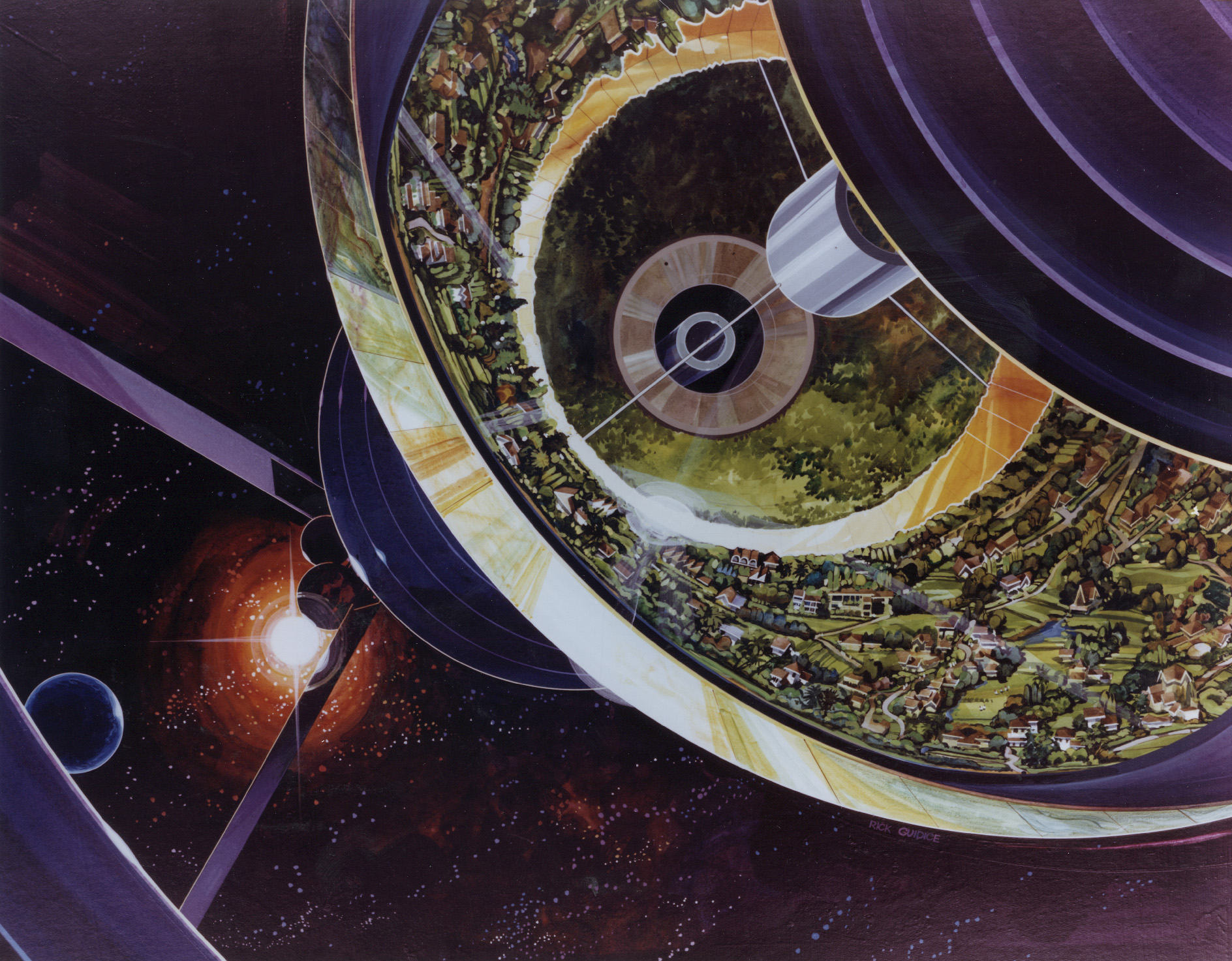
Living space in a Kalpana orbital space settlement. Credits: Bryan Versteeg
Kasper Kubica presents an optimistic business case for space tenants moving in (er, up) to deluxe condominiums orbiting the Earth within 10 years. Initially for the ultra rich, the price tag is comparable to high end real estate currently on the market. Of course the devil is in the details, so lets dive in.
In a post on Medium, Kubica uses the rotating habitat Kalpana as an illustrative example of his “Spacelife Direct” approach for an orbital settlement spinning to create 1G of artificial gravity and hosting north of 400 condominiums in LEO. Such a facility would be shielded from radiation by Earth’s magnetosphere if it were located in low equatorial orbit and therefore could be constructed with less shielding. This results in a significant reduction of mass driving costs way down. Running the numbers on this scenario opens up exciting possibilities with the amazing capabilities of Elon Musk’s Starship currently under development by SpaceX.
Using the scaled down Kalpana Two version as discussed in Tom Marotta and Al Globus’ book, The High Frontier, an Easier Way, the cylindrical habitat is sized at just over 100 meters in diameter and the same in length, weighing in at 16, 800 metric tons. Kubica estimates that it would take 140 launches to loft the required mass to LEO. Assuming costs keep coming down as Starship launch cadence increases (a safe bet), at $10M/launch the cost of just the materials to LEO would be $1.4B. Of course there are many more expenses associated with design, development and fabrication, not to mention insurance of such an orbital condo complex. For the sake of argument Kubica triples that figure arriving at a total price tag of $4.2B.
But would there be a market for real estate in LEO? Kubica provides comparable examples of skyscrapers with similar costs and over 200 condominiums recently selling for over $10M in Manhattan.
“The clamor for earthside luxury condos is massive and growing. Orbital condos — representing an exclusive experience far beyond that available to anyone on earth — could generate astronomical demand.”
With the economics of Starship opening up limitless possibilities, Kubica lays out a roadmap over the next 10 years to realize the Spacelife Direct opportunity. First would come financing the venture though a team of visionary entrepreneurs and investors (are you listening Dylan Taylor?). Design and development would come next including the robotic systems that would be required for assembly in space. Laying the groundwork for this infrastructure may be completed soon by Orbital Assembly Corporation which could potentially be leveraged as a Spacelife Direct supplier. To keep labor costs down much of the facility would be fabricated on Earth in launchable modules that would be assembled in orbit. The final stages would activate life support systems and finish out the interiors for the occupants to begin moving in.
So what about the rest of us? As history has shown in the aerospace industry at the beginning of the last century and we see unfolding in the space tourism market today, the rich help pave the way so that mass production and economies of scale will drive down costs eventually making space settlement affordable for the masses.
“We don’t want to live in space because it’s an economic necessity, we want to live in space because we are explorers and adventurers, and space is humanity’s next frontier!”
Diagram depicting the market sectors of the nascent in-space economy. Credits: Erik Kulu / Factories in Space
Erik Kulu, a Senior Systems Engineer in the satellite industry, has a passion for emerging technologies…especially those in the in-space manufacturing field. He’s created the largest public database of companies active in the emerging in-space economy. Called Factories in Space, it tracks companies engaged in microgravity services, space resources, in-space transport services, the economies of LEO, cislunar space, the Moon and much more.
Kulu provides an overview of commercial microgravity applications for both terrestrial and in-space use. His listing and analysis of potential business ventures provides a comprehensive summary of unique profitable commodities manufactured in microgravity, including fiber optics, medical products, exotic materials and many more.
Breakdown of the in-space manufacturing sector of the space economy. Credits: Erik Kulu / Factories in Space
“This is the missing piece to speed up development for the exciting Star Trek-like future. I believe in-space manufacturing will be the kickstarter and foundation.”
In a recent industry survey examining the commercial landscape of space resources in 2021, Kulu renders a statistical breakdown of the currently evolving development stages of in-space manufacturing companies, levels of funding by market sector, timing of company founding and geographical location of the main players. His analysis shows a marked increase in the formation of companies from 2016 – 2018 dropping off over the last 3 years.
Prominent founding peak of space resource companies in 2018 with drop at end of the last decade. Credits: Erik Kulu / Factories in Space
I asked Kulu about what he thought caused the downward taper because it seemed to have started before the COVID-19 pandemic, and so was probably unrelated. He agreed, and offers this explanation:
“Primarily, I think the decline is a mix of following:
There was a boom of some sorts, which has slowed down in terms of very new startups. Similar graphs [indicate the same trend] for nanosatellite, constellation and launcher companies. Funding boom is continuing though.
As many of those space fields do not have obvious markets, some potential new actors might be in wait mode, because they want to see what happens financially and technically to existing companies.
Startups could be in stealth mode or very early stage and as such I have not become aware of them yet. They will likely partially backfill.”
“While there was a decline, I forecast Starship and return to the Moon will kick off another wave in about 2-3 years.”
Kulu also tracks NewSpace commercial satellite constellations, small satellite rocket launchers and NewSpace funding options through his sister site NewSpace Index. But he doesn’t stop there. The world’s largest catalog of nanosatellites containing over 3200 nanosats and CubeSats can be found in his Nanosats database.
Learn more about how Erik Kulu got started tracking the in-space economy in this interview from earlier this year over on Filling Space. And be sure and tune in live to The Space Show next month when I cohost with David Livingston for his debut appearance, exact date to be determined. You can call the show and ask Erik questions directly. Check TSS Newsletter, updated weekly, for the show date once its set. This post will be updated when the schedule is finalized, so readers can check back here as well.