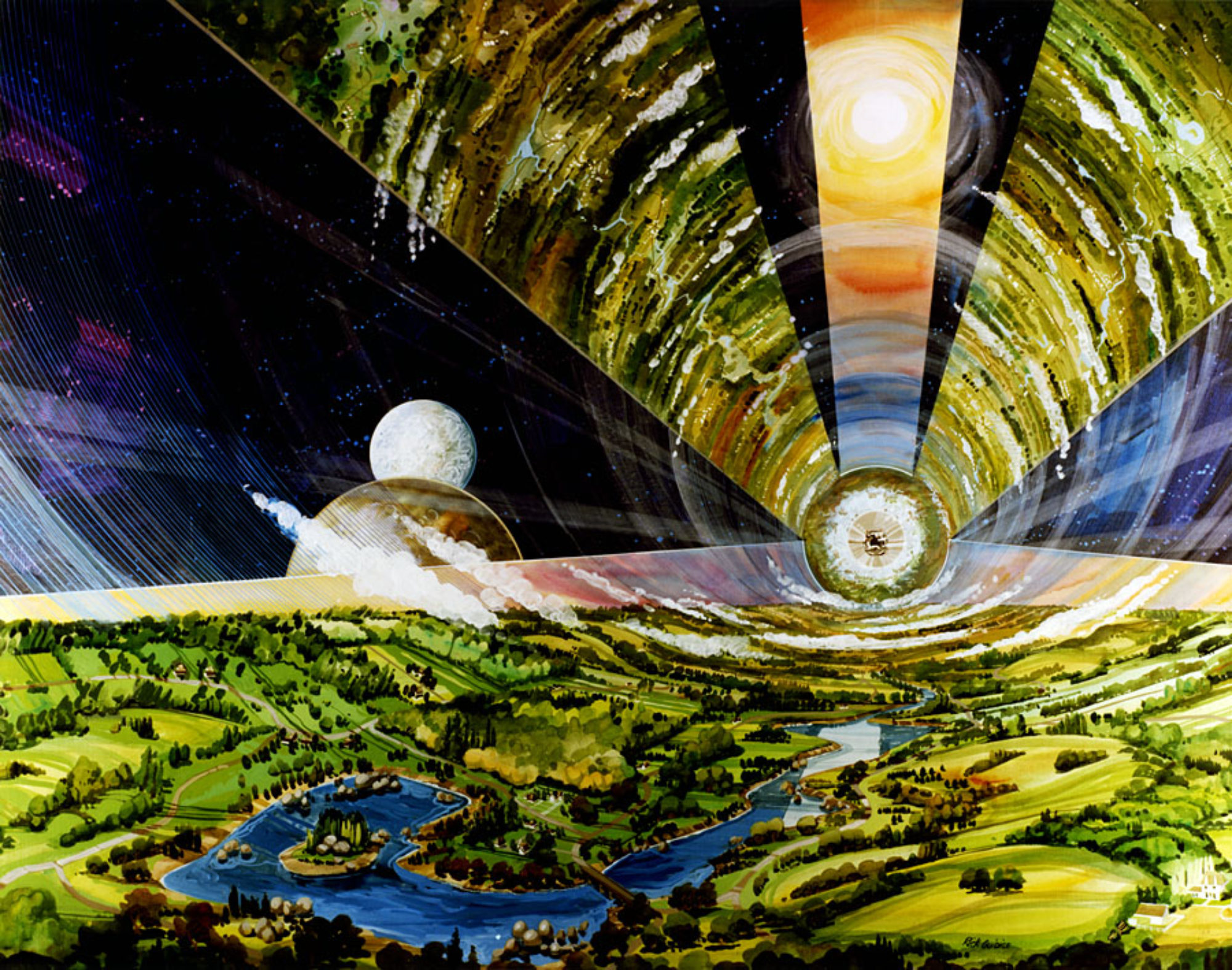


At the 54th International Conference on Environmental Systems held in Prague, Czechia, this past July, a paper was presented describing an innovative design of a large-scale Mars Cycler. The authors, A. Scott Howe, John Blincow, Theodore W. Hall, and Colin Leonard, make the assumption that a significant planetary migration to Mars will happen in the near future, citing Elon Musk’s often stated goal of establishing a one-million person colony on the Red Planet by 2050. The authors argue that Starship will not be a suitable transportation method for a large, non-professional clientele on what has historically been a six-month journey due to the physiological and psychological health risks of a long-duration mission (not withstanding a recent paper penned by University of Santa Barbara physics undergrad Jack Kingdon proposing two trajectories that reduce transit times to between 90 to 104 days each way).
Instead, they envision a “cruise ship” approach using a large, robotically constructed Mars Cycler that would continuously travel between Earth and Mars. The concept for a Mars Cycler was first conceived by Buzz Aldrin in a 1985 paper, and in recognition of his invention, is often referred to as an Aldrin cycler. This particular cycler design is advantageous because it would use minimal propellant to maintain its trajectory. The concept features a dual-torus structure, with a non-rotating outer torus for docking and a rotating inner torus to provide artificial gravity. The paper lays out in detail the specifications for a minimal-sized version with crew capacity of 52-61 people, and calculates the mass and equipment required for the vessel. The authors estimate that it would take 63 Starship launches (version 3) to deliver the construction materials and propellant to low Earth orbit (LEO). A scaled up larger cruise ship-sized version with a capacity of 1000 occupants would take 428 Starship version 3 launches, which is within the range of engineering possibility and certainly within the launch rate of thousands of Starships Elon Musk envisions as part of his Mars colonization plans.
The Mars Cycler would be assembled using Offworld Industries Corporation’s Sargon System, a family of new construction machines the company claims could build an entire space station in half a year (Blincow is CEO of Offworld Industries Corp). The novel construction technology autonomously assembles preformed hull panels loaded in a magazine, robotically dispensed, formed and welded into large toroidal (or other shaped) space stations ready to be pressurized.
The paper advocates for the cycler to provide artificial gravity to mitigate the deleterious health impacts of microgravity allowing occupants to maintain healthy muscle and bone density throughout the journey. The proposed design decouples an inner artificial gravity centrifuge from an outer non-rotating torus, which offers several operational benefits:
- Distributed docking ports: The non-rotating outer torus can accommodate multiple visiting vehicles docking at various points around its perimeter.
- Fixed systems: Solar panels and radiators can be mounted without the need for gimbals or motorized mounts, simplifying the design.
- Seamless transfer: Crew and cargo can be transferred between visiting vehicles and the cycler without the need for spin-up or spin-down procedures.
The paper identifies several challenges to overcome in order to realize an operational Mars Cycler. The top five include:
- Large-scale space construction: The project requires the construction of very large orbital structures. A key challenge is maintaining tolerance control during assembly, ensuring panels fit together precisely and the torus closes properly.
- Attitude control and maneuvering: The paper assumes, but does not detail, that maneuvering large quarter-toroids in proximity to each other will be possible without “exotic solutions’. This is a significant challenge because each section would have its own center of mass and orbit, creating strain on connected elements.
- Artificial gravity implementation: A number of difficulties are discussed, including economic spin-up/spin-down, docking procedures while the structure is spinning, and performing extra-vehicular activities (EVAs) under rotation. The paper also notes that transferring power, control, information, and liquids between the rotating and non-rotating segments would be challenging.
- Mars surface infrastructure: The paper acknowledges that a major challenge is the “big elephant in the room of Mars surface infrastructure”. The entire concept is based on the assumption that the necessary infrastructure, such as propellant production facilities, will be in place on Mars by the time the cycler is ready.
- Life Support Systems: Sustaining human crews on a cycler for extended periods (e.g., months-long transits) requires robust life support systems for air, water, food, and waste management. The paper underscores the challenge of maintaining these systems with minimal resupply over multiple cycles.
Assuming these challenges could be solved, this interplanetary cruise ship design of a Mars Cycler is a new approach to deep-space travel, elegant in its simplicity. It offers a potential solution to the challenges of long-duration missions by providing artificial gravity via a rotating inner torus to ensure the health and well-being of future Mars colonists.
In addition to these cyclers providing a mode of safe space transportation, such large artificial gravity space stations could be permanently located in orbit around planets or moons that have surface communities in split life cycle space settlements which SSP covered recently. Such a facility could have duel use as an Earth-normal gravity crèche, providing birthing centers and early child development for families settling in the region. Colonists could choose to split their lives between rearing their young in healthy normal gravity settings until their offspring are young adults, then moving down to live out their lives in lower gravity surface settlements – or they may choose to live permanently in free space.


