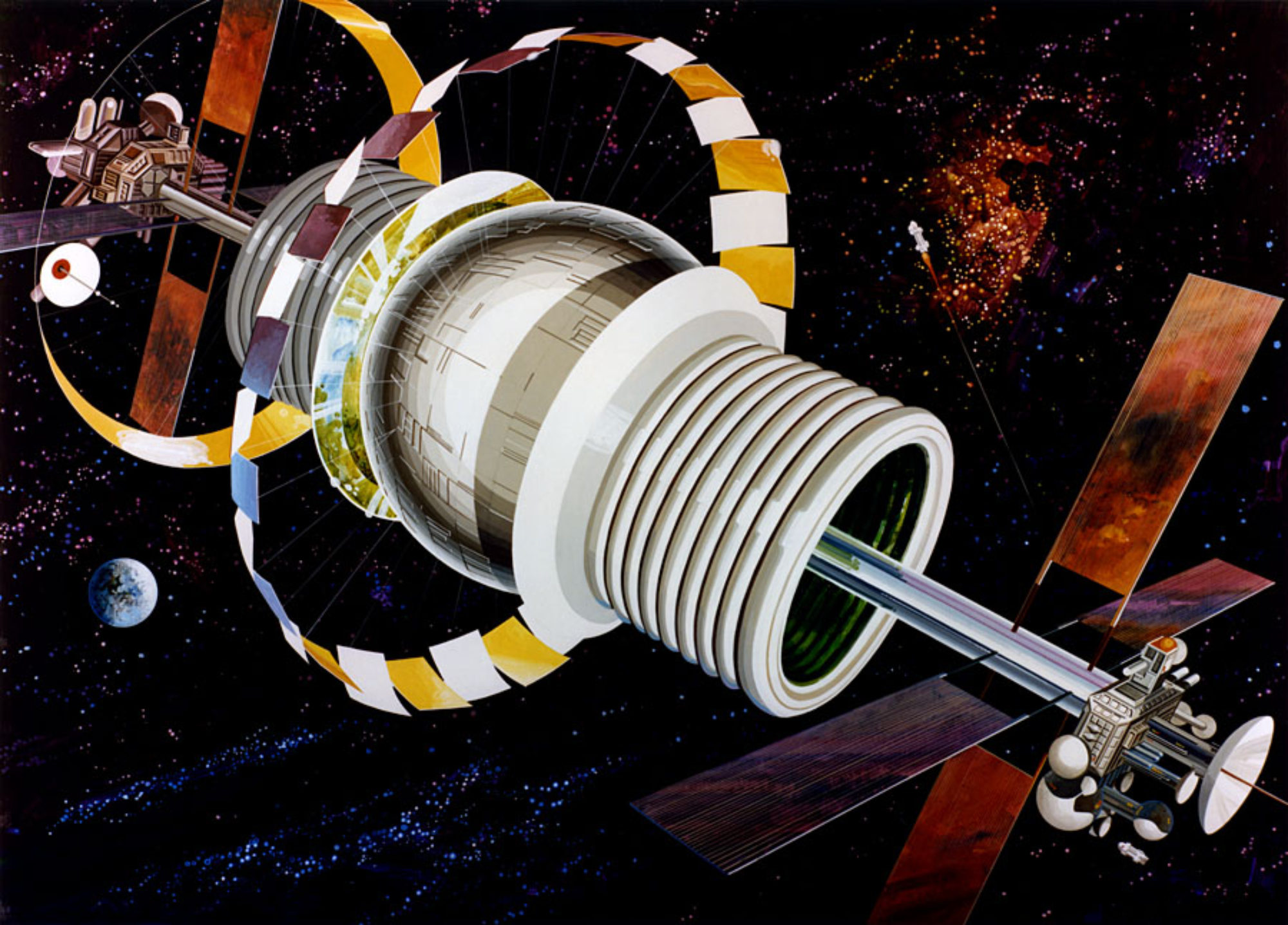
Artist rendering of EBIOS Experimental BIOregenerative Station. Credits: Interstellar Lab
Interstellar Lab has a mission to help build a future full of life on earth and beyond. To get started, the company plans modular villages on Earth designed as sealed facilities with environmental control and life support systems. EBIOS space-inspired communities will combine architecture, engineering, product design along with international collaboration in environmental science, agriculture, biochemistry, psychology and other disciplines. Each EBIOS will be a hospitality science center open to the public as well as scientists to facilitate awareness and needed research for self-sustaining space settlements. The company is developing methods and simulation software for integrated food production, water and waste systems to support human life in any environment.
Image credit: Richard Bizley, bizelyart.com / National Space Society
In a paper published in New Space last March, Peter Hague describes a figure of merit he developed to drive policy decisions to help accelerate space exploration and space settlement. The aim of the paper was to generate a single metric for every potential space mission on a common scale for comparison purposes. This ‘mass value’ is the amount of mass that would need to be placed in low Earth orbit (LEO) to perform the same mission using a baseline method. That method would use only storable propellants and Hohmann transfer orbits – no gravity assists, aerocapture, high energy propellants or ISRU.
This approach puts a price on all the add-ons which expand the mission beyond the baseline. One can then use a single normalized scale to calculate how much mass to LEO you would save by making propellant on Mars for example, or by taking advantage of a certain launch window to get a gravity assist.
A hands-off government entity could subsidize space expenditures at a flat rate per kg of mass value, confident they are promoting space development without having legislators involved in engineering decisions.
Aggregating all the missions by a nation, company, or other entity could be used to calculate an analogue of GDP for a space civilization. While this does not measure everything we care about – scientific merit, human occupation, etc – neither does GDP. It does capture the overall capability to move around the solar system; and as such, is as useful for charting our journey to becoming a Type II civilization on the Kardashev Scale as it is for analyzing individual missions.
Thanks to Peter Hague for the material in this post. We’ve heard a rumor that there may be a book forthcoming on the subject. Looking forward to it!
The U.S. Space Force, Air Force Research Laboratory and the Defense Innovation Unit just completed a workshop on the state of the U.S. space industry. The virtual event, hosted by New Space New Mexico, brought together more than 120 representatives across the federal government, industry, and academia to access the current health of the America’s space industry and to provide recommendations for strengthening that industrial base. The resulting report called “State of the Space Industrial Base 2020” has just been released this month.
The workshop focused on 6 key areas thought to be the locus of future space industry activities:
Space policy and finance tools
Space information services
Space transportation and logistics to, in and from cislunar space and beyond.
Human presence in space for exploration, space tourism, space manufacturing and resource extraction
Power for space systems to enable the full range of emerging space applications
Space manufacturing and resource extraction
Recommendations included:
Industry should aggressively pursue partnerships with the US government to develop and operate joint commercial, civil and defense space capabilities. These partnerships should jointly fund developing capabilities that benefit from but are not heavily reliant on US government investment and revenue for their commercial viability.
Entrepreneurs with innovative and potentially dual-use technologies must improve the protection of their intellectual property from unintended foreign assimilation, including protecting their networks from cyber exfiltration attempts, and avoiding exit strategies that transfer intellectual property to foreign control hostile to US interests.
Businesses should engage across the US educational system to guide and develop the future STEM workforce to fuel the future space economy, to include funding for undergraduate scholarships/loans for STEM students, internships and providing space professionals to support instruction in space subjects.
Industry should improve ties and partnerships with domestic and allied parts, subcomponent and subsystem manufacturers to strengthen trust and resilience in space supply chains.
Without adequate shielding, humans will be bombarded with lethal galactic cosmic radiation in deep space. Credits: NASA / scitechdaily.com
Galactic cosmic radiation poses a significant risk to humans in deep space. If a type of shielding could be found that could be “grown” through biotechnology starting from microscopic sources, significant savings in mass needed to be launched from Earth could be realized. It is already known that certain fungi can convert high-energy radiation into chemical energy through a process called radiosynthesis, analogous to photosynthesis in plants. Fungi have been found thriving in extremely radioactive environments such as the Chernobyl Nuclear Power Plant and even on the exteriors of spacecraft in Earth orbit.
In a paper just uploaded to the preprint server for biology bioRxiv, results of a study carried out on the International Space Station have shown that a microbial lawn of the fungus C. sphaerospermum can be cultivated in microgravity and not only consumes and thrives on radiation, it provides shielding that if scaled up, could sufficiently protect humans in deep space settlements.
Artist’s impression of a space elevator. Credits: Steve Bowers / orionsarm.com
The International Space Elevator Consortium (ISEC) has just published a position paper on the technology readiness of this alternative to launch vehicles subject to the constraints of the rocket equation. Recent advances in material science of single crystal graphene and other alternatives show potential for fabrication of tethers long enough and with the required strength to enable space elevators by the late 2030s. The authors present a case that the demand for launching enough mass to support ESA’s Moon Village, space based solar power and Elon Musk’s vision for Mars colonies far exceeds projected conventional rocket capabilities. Space elevators could fill this need while being better for the environment.
A nuclear thermal rocket concept. Credits: NASA/Wired
In a paper presented at the 8th Symposium on Space Resource Utilization (2016), Bryan Palaszewski analyzes multiple mission architectures for human voyages to the inner and outer solar system. The planet Mercury has permanently shadowed craters at its poles which likely contain frozen water enabling ice mining for rocket propellant and oxygen for breathable air to sustain settlements. The outer planets and their moons are reservoirs of significant amounts of useful gases such as hydrogen, helium 3, methane, ethane, and ammonia which can be utilized as in-situ resources. Through nuclear propulsion and living off the land with ISRU, travel times can be reduced and payloads increased for both robotic and human missions. With a positive vision for eventual space settlement, Palaszewski concludes the paper with “These technological innovations will enable Krafft Ehricke’s vision of a polyglobal civilization“.
Illustration of an early space settlement. Credits: Beyond Earth Institute, Inc.
The newly formed nonprofit just issued their June 2020 BE Report outlining what steps need to be taken by government and industry in the areas of export controls, best practices and multilateral agreements to foster a future where millions of people will be living and working in space, while in compliance with the Outer Space Treaty.
Artist rendition of Starship exploring Saturn. Image credit SpaceX/Flickr
In an interview by Stuart Clark in BBC Science Focus Magazine, Vice President for North American operations for the International Space University Gary Martin answers questions on how private enterprise is changing space exploration. Companies like SpaceX and Blue Origin, through their own initiatives and public/private partnerships are opening up the final frontier, paving the way for space settlement.
Illustration of the SHEPHERD Concept. Credits: Peter Jenniskens, et al., New Space (2015)
Although somewhat dated this paper is still relevant and the technology is not only feasible, its open source and available for any startup company interested in capitalizing on the the resources available from asteroid mining. Be sure and catch the Ted Talk by Dr. Bruce Damer himself.
Checkout the trailer for the upcoming documentary The High Frontier: The Untold Story of Gerard K. O’Neill which was shown for the first time yesterday on the live stream of Yuri’s Night annual celebration party. The trailer begins with an introduction by Rick Tumlinson at 2:57.