AI generated image of crops growing in sealed enclosure within a radiation protected lava tube on Mars. Credits: Microsoft DALL-E Image Creator
Agriculture on Mars is problematic. Even if radiation exposure could be solved (perhaps by locating greenhouses in lava tubes) and sufficient sources of water secured, there is that pesky perchlorate in the soil. Not to worry. The Interstellar Research Group has us covered. IRG, who’s mission is to assist in building a technological, philosophical, and economic infrastructure that advances the goal of establishing outposts throughout the Solar System and, finally, achieving a pathway to the stars, has initiated MaRMIE – the Martian Regolith Microbiome Inoculation Experiment. An informative summary of the project is provided by Alex Tolley over on Centauri Dreams.
SSP has addressed the biological remediation of perchlorates in Martian regolith previously. The research paper linked in that article examined phytoremediation which uses aquatic plants for perchlorate removal and microbial remediation processes utilizing microorganisms and extremophiles. IRG focused on the latter but noted that since the contaminants are water soluble, simply rinsing of the Martian regolith may be a potential solution for removal of the contaminants if sufficient sources of water can be found.
Perchlorates are only one piece of the puzzle to create fertile soil on Mars. So IRG expanded the scope of this initiative to design an experiment to simulate crop growth under the extreme conditions we can expect on Mars, taking into account the composition and pressure of the atmosphere, temperature extremes and high levels of ionizing radiation. The group envisioned a framework of research that would include five phases. The first phase would address the perchlorate issue experimenting with a variety of bacterial and microfungal agents applied to simulated Martian regolith mixed with perchlorates.
In the next phase, the simulated regolith would be conditioned by creating a microbiome to inoculate the regolith. This would include evaluation of pioneer plant species under Martian environmental conditions to transition the regolith into fertile soil.
The third phase would then attempt to grow crops in the mock soil under Martian lighting and atmospheric conditions with increasing ambient pressures until plant growth is satisfactory.
In the fourth phase, the experiment would be repeated with the same settings as in the third phase but decreasing the temperature to find when plant grow tapered off to unacceptable levels. This approach would home in on the optimum conditions for crop growth in the prepared Martian soil.
Finally, the infrastructure to create a farm implementing these conditions on the surface of Mars with appropriate protection from radiation would be defined.
It is not the intention of IRG to actually run these experiments. The output of the effort would be a published paper documenting the known issues and providing an outline of the required studies. Tolley explains that “IRG hopes that this framework will be seen and used as a structure for designing experiments and building on the results of previous experiments, by any researchers interested in the ultimate goal of viable large-scale agriculture on Mars.”
Conceptual rendering of a Blue Alchemist solar cell fabrication facility on the Moon. Credits: Blue Origin
Jeff Bezos’ new initiative called Blue Alchemist made a splash last month boasting that the team had made photovoltaic cells, cover glass and aluminum wire from lunar regolith simulant. This is an impressive accomplishment if they have defined the end-to-end process which (with refinements for flight readiness) would essentially provide a turnkey system to fabricate solar arrays to generate power on the Moon. The announcement claimed that the approach “…can scale indefinitely, eliminating power as a constraint anywhere on the Moon.” Actually, this may not be possible at first for a single installation as surface based solar arrays can only collect sunlight during the lunar day and would have to charge batteries for use during the 14 day lunar night, unless they were located at the Peaks of Eternal Light near the Moon’s south pole. But if scaling up manufacturing is possible, coupled with production of transmission wire as described, a network of solar power stations in lower latitudes could be connected to distribute power where it is needed during the lunar night.
Very few details were revealed about the design outputs of the end products (not surprisingly) in Blue Origin’s announcement, particularly the “working prototype” solar cell. An image of the component was provided but it was unclear if the process fabricated the cells into a solar array or if the energy conversion efficiency was comparable to current state of the art (around 21%). Nor do we know how massive the manufacturing equipment would be, how much periodic maintenance is needed or if humans are required in the process. Still, if a turnkey manufacturing plant could be placed on the Moon and it’s output was solar arrays sourced from in situ materials, it would significantly reduce the costs of lunar settlements by not having to transport the power generation equipment from Earth. This particular process has the added benefit of producing oxygen as a byproduct, a valuable resource for life support and propulsion.
Research into production of solar cells on the Moon from in situ materials is not new. NASA was looking into it as recently as 2005 and there are studies even dating back to 1989. Blue’s process produces iron, silicon, and aluminum via electrolysis of melted regolith, using an electrical current to separate these useful elements from the oxygen to which they are chemically bound. Solar cells are produced by vapor deposition of the silicon. The older studies referenced above proposed similar processes.
It would be interesting to perform an economic analysis comparing the cost of a solar power system supplied from Earth by a company focusing on reducing launch costs (say, SpaceX) with that of a company like Blue Origin that fabricated the equipment from lunar materials. Peter Hague has done just that in a blog post on Planetocracy using his mass value metric.
Hague runs through the numbers comparing SpaceX’s predicted cost per kilogram delivered to the Moon by Starship with that of Blue Origin’s New Glenn. At current estimates the former is 5 times cheaper than the latter. Thus, to best Starship in mass value, Blue Alchemist would have to produce 5kg of solar panels for every 1kg of equipment delivered to the Moon, after which it would be the economic winner. Siting a recent analysis of lunar in situ resource utilization by Francisco J. Guerrero-Gonzalez and Paul Zabel (Technical University of Munich and German Aerospace Center (DLR), respectively) predicting comparable mass output rates, Hague believes this estimate is reasonable.
Perhaps we should not get ahead of ourselves as Blue Origin’s timeline for development of their New Glenn heavy-lift launch vehicle is moving a glacial pace and one wonders if they have the cart before the horse by siphoning off funds for Blue Alchemist. Jeff Bezos is free to spend his money any way he wishes and definitely seems to be in no hurry.
Conceptual illustration of New Glenn heavy-lift launch vehicle on ascent to orbit. Credits: Blue Origin
But SpaceX’s Starship has not made it to space yet either and after we see the first orbital flight, hopefully as early as next week, the company will have to demonstrate reliable reusability with hundreds of flights to achieve economies of scale commensurate with their predicted launch cost of $2M – $10M. As SpaceX has demonstrated with it’s launch vehicle development process it is not a question of if, it is one of when.
Image of full stack Starship at Starbase in Boco Chica, TX. Credits: SpaceX
As both companies refine their approach to space development, will it be the tortoise or the hare that wins the mass value price race for the cheapest approach to power on the Moon? Or will each company end up complementing each other with energy and transportation infrastructure in cislunar space? Either way, it will be exciting to watch.
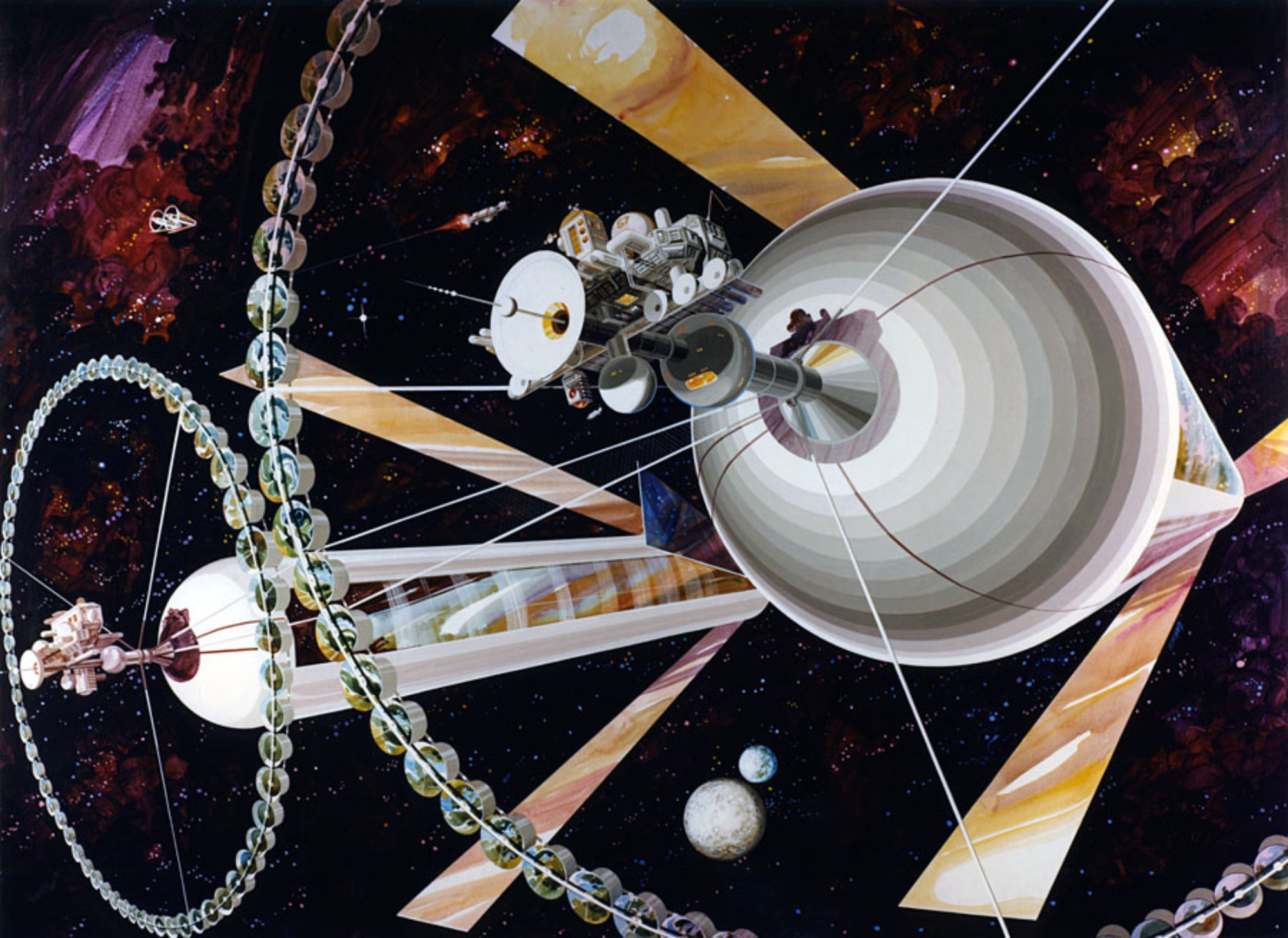
Artist impression of a rotating space settlement constructed from an asteroid. Credits: Bryan Versteeg, spacehabs.com
When Gerard K. O’Neill first proposed building enormous rotating space settlements at the Earth-Moon Lagrange points back in the 1970s he envisioned many space shuttle flights to launch the initial equipment and people into space. He thought that mass drivers placed on the Moon would be an efficient and cost effective mechanism for lofting copious amounts of lunar regolith needed for radiation shielding to protect colonists aboard the settlements. Alas, the economics of the shuttle did not work out back then, as reusability (among other things) was not ready for prime time, making launch costs a show stopper. Also, O’Neill thought that hundreds of people would be working under weightless conditions in space to fabricate the settlements. This was problematic because of the health hazards of exposure to radiation and microgravity.
All three problems can be solved according to David W. Jensen in an article posted on the ArXiv server. He envisions restructuring an asteroid into a spin gravity space settlement using self replicating robots to process asteroid materials in situ. High launch costs would be solved with a single modest-size probe containing a small number of seed robots that fashion more robots, tools and equipment. This approach bootstraps the colony fabrication through self replicating machines and in situ resource utilization.
“The restructuring process improves the productivity using self-replication parallelism and tool specialization.”
By removing humans from the initial asteroid processing activities, health risks from radiation and the deleterious effects of microgravity would be eliminated. Restructuring of the asteroid would take about a decade, after which colonists would have a rotating space settlement the size of a Stanford Torus providing Earth normal gravity and a safe living space shielded from radiation, ready for buildout and eventual occupation.
Cutaway view of a Stanford Torus space settlement. Credits: Rick Guidice / NASA
The key to this approach is self replication of robots delivered in the initial seed payload which significantly reduces costs by launching only one rocket to the target asteroid. The first machines sent are called replicators, or spiders for short. Four of these spiders with a minimum of supplies use the raw materials of the asteroid to make thousands of copies of themselves plus additional helper machines (tools and equipment). The spiders and helpers cooperate to produce end products of construction materials and the colony structures.
Jensen does not assume total self-replication, meaning that the robots do not need to make complete copies of themselves. A small percentage of more complex mechanisms such as microprocessors are provided in the initial payload as supplemental “vitamins” to finish out the machines. The intent is to minimize the need for humans in the initial construction phase. The objective is to fabricate a basic scaffolding for a rotating space settlement with access to an abundant storehouse of volatiles and metals. The final enclosed structure would then support migration of colonists who would complete construction and add more advanced manufacturing technologies such as solar cell production and microelectronics. As SSP has explained previously, complete closure of self-replicating machines is very challenging, but is not needed in this case.
The technology has wide applications and could be applied to Earth’s desserts, on the surface of the Moon or Mars, or even on the satellites of Jupiter and Saturn.
“We plan to apply and study these concepts for use in lunar, Titan, and Martian environments.”
Jensen’s restructuring process could complement or be combined with other asteroid mining architectures such as the University of Rochester’s approach which builds spin gravity cities starting with a carbon fiber collapsible scaffolding completely encapsulating the target asteroid. As the process matures it could be applied to even larger bodies such as the asteroid Ceres eventually combining settlements into a mega satellite community as envisioned by Pekka Janhunen.
“The equipment and process are scalable and … create a space station structure that can support a population of nearly one million people.”
Artist’s impression of a lunar landing pad. Credits: SEArch+
When humanity returns to the Moon and begins to build infrastructure for permanent settlements, propulsive landings will present considerable risk because rocket plumes can accelerate lunar dust particles in the bare regolith to high velocities which could result in considerable damage to nearby structures. Obviously, nothing can be done about the first spacecraft that will return to the moon later this decade unless they use their own rocket plume to create a landing pad like the concept proposed in a NIAC Grant by Masten Space Systems (now part of Astrobotic).
Flight Alumina Spray Technique (FAST) instant landing pad deployment during lunar landing. Source: Matthew Kuhns, Masten Space Systems Inc (now Astrobotic)
Therefore, before significant operations can begin on the Moon that require lots of rockets, a high priority will be construction of landing pads to prevent sandblasting by rocket plume ejecta of planned structures such as habitats, science experiments and other equipment. Several methods are currently being studied. Some require high energy consumption. Others could take a long time to implement. Still others are technologically immature. Which technique makes the most economic sense? Phil Metzger and Greg Autry examine options for the best approach to this urgent need in a November 2022 paper in New Space.
A lunar landing pad should have an inner and outer zone. The inner zone will have to withstand the intense heat of a rocket plume during decent and ascent. The outer zone can be less robust as the expanding gases will cool rapidly and decrease in pressure but will still be expanding rapidly, so erosion will have to be mitigated over a wider area.
Landing pad layout showing inner and outer zone measurements proposed in this study (Figure 1 in paper). Credits: Philip Metzger and Greg Autry / New Space – Lunar surface image credit: NASA.
Several processes of fabricating landing pads were examined by the authors. Sintering of regolith is one such technique, where dust grains are heated and fused by a variety of methods including microwave heating or focused solar energy. SSP has reported on the latter previously, but in this study it was noted that that technology needs further development work. Fabricating pavers by baking in ovens in situ was also examined in a addition to infusion of a polymer into the regolith to promote particle adhesion.
An economic model was developed to support construction of landing pads for NASA’s Artemis Program based on experimental data and the physics for predicting critical features of construction methods. Factors such as the equipment energy consumption, the mass of microwave generators compared to the power output needed to sinter the soil to specified thickness, and the mass of polymer needed to infuse the regolith to fabricate the pads were included in the model. Other factors were considered including the costs associated with program delays, hardware development, transportation of equipment to the lunar surface, and reliability.
When varying these parameters and comparing different combinations of manufacturing techniques, the trade study optimized the mass of construction equipment to balance the costs of transportation with program delays. The authors found that from a cost perspective, microwave sintering makes the most sense for both the inner and outer regions of the landing pad, at least initially. When transportation costs come down to below a threshold of $110K/kg then a hybrid combination of microwave sintering in the inner zone and polymer infusion of regolith in the outer zone makes the most sense.
Once astronauts land safely and begin EVAs on the lunar surface, they can keep from tracking dust into their habitat by taking an electron beam shower.
Other lunar dust problems and their risks can be mitigated with solutions covered previously on SSP.
A cylindrical, spin gravity space settlement constructed from asteroid rubble like that from the Near Earth Asteroid Bennu. The regolith provides radiation shielding contained by a rigid container beneath the solar panels. The structure is spun up to provide artificial gravity for people living on the inner surface. Credits: Peter Miklavčič et al.*
Scientists and engineers* at the University of Rochester have conceived of an innovative way to capture a Near Earth Asteroid (NEA) and construct a cylindrical space colony using it’s regolith as shielding. In a paper in Frontiers in Astronomy and Space Sciences they propose a spin gravity habitat called Bennu after the NEA of the same name. Readers will recall that NASA’s OSIRIS-REx spacecraft launched in September 2016, traveled to Bennu, collected a small sample in October 2018 and is currently in transit back to Earth where the sample return capsule will reenter the atmosphere and parachute down in Utah later this year.
Near Earth Asteroid Bennu imaged by the spacecraft OSIRIS-REx. Credit: NASA Goddard Space Flight Center
It would be ideal if an asteroid could be hollowed out for radiation shielding and spun up to create artificial gravity. However, it is shown in this paper that this would not work for larger solid rock asteroids because they don’t have the tensile strength to withstand the rotational forces and smaller rubble pile asteroids (like Bennu) would fly apart because they are too loosely conglomerated.
The problem is solved by containing the asteroid in a carbon fiber collapsible scaffolding that initially has the same radius of the asteroid. As the container is spun up, the centrifugal force will cause the disintegrating rubble to push open the expandable cylinder to its final diameter.
“…a thick layer of regolith is created along the interior surface of this structure which forms a shielded interior volume that can be developed for human occupation.”
The mechanism to initiate the rotation of the structure is interesting. Solar arrays on the outer surface would power mass driver cannons which eject rubble tangentially exerting torque to produce spin.
Detailed engineering analysis and simulations are performed to calculate the stresses on a Bennu sized asteroid to create a cylindrical space colony 3 kilometers in diameter. This structure would have a shielded livable space of 56 square kilometers, an area roughly equivalent to Manhattan.
The authors conclude that the physics of harvesting small asteroids and converting them into rotating space settlements is feasible. They note that this approach would cost less and be easier from an engineering standpoint then fabrication of classic O’Neill cylinders. Concepts for asteroid capture and utilization have already been covered on SSP such as TransAstra’s Queen Bee and SHEPHERD.
The University of Rochester News Center provided a good write up of the paper last December.
* Authors of cited paper: Miklavčič PM, Siu J, Wright E, Debrecht A, Askari H, Quillen AC and Frank A – (2022) Habitat Bennu: Design Concepts for Spinning Habitats Constructed From Rubble Pile NearEarth Asteroids. Front. Astron. Space Sci. 8:645363. doi: 0.3389/fspas.2021.645363
Conceptual illustration of an oxygen pipeline located at the lunar south pole. Credits: Peter Curreri
This year’s list of NASA Innovative Advanced Concepts (NIAC) Phase I selections include a few awards that look promising for space development. For wildcatters (or their robotic avatars) drilling for water ice in the permanently shadowed craters at the lunar south pole and cracking it into hydrogen and oxygen, Peter Curreri of Houston, Texas based Lunar Resources, Inc. describes a concept for a pipeline to transport oxygen to where it is needed. Clearly oxygen will be a valuable resource to settlers for breathable air and oxidizer for rocket fuel if it can be sourced on the Moon. The company, whos objective is to develop and commercialize space manufacturing and resources extraction technologies to catalyze the space economy, believes that a lunar oxygen pipeline will “…revolutionize lunar surface operations for the Artemis program and reduce cost and risk!”.
Out at Mars, Congrui Jin from the University of Nebraska, Lincoln wants to augment inflatable habitats with building materials sourced in situ utilizing synthetic biology. Cyanobacteria and fungi will be used as building agents “…to produce abundant biominerals (calcium carbonate) and biopolymers, which will glue Martian regolith into consolidated building blocks. These self-growing building blocks can later be assembled into various structures, such as floors, walls, partitions, and furniture.” Building materials fabricated on site would significantly reduce costs by not having to transport them from Earth.
A couple of innovations are highlighted in this NIAC grant. First, Jin has studied the use of filamentous fungi as a producer of calcium carbonate instead of bacteria, finding that they are superior because they can precipitate large amounts of minerals quickly. Second, the process will be self-growing creating a synthetic lichen system that has the potential to be fully automated.
In addition to building habitats on Mars, Jin envisions duel use of the concept on Earth. In military logistics or post-disaster scenarios where construction is needed in remote, high-risk areas, the “… self-growing technology can be used to bond local waste materials to build shelters.” The process has the added benefit of sequestration of carbon, removing CO2 from the atmosphere helping to mitigate climate change as part of the process of producing biopolymers.
Graphical depiction of biomineralization-enabled self-growing building blocks for habitats on Mars. Credits: Congrui Jin
To reduce transit times to Mars a novel combination of Nuclear Thermal Propulsion (NTP) with Nuclear Electric Propulsion (NEP) is explored by Ryan Gosse of the University of Florida, Gainesville.
Conceptual illustration of a bimodal NTP/NEP rocket with a wave rotor enhancement. Credits: Ryan Gosse
NTP technology is relatively mature as developed under the NERVA program over 50 years ago and covered by SSP previously. NTP, typically used to heat hydrogen fuel as propellant, can deliver higher specific impulse then chemical rockets with attractive thrust levels. NEP can produce even higher specific impulse but has lower thrust. If the two propulsion types could be combined in a bimodal system, high thrust and specific impulse could improve efficiency and transit times. Gosse’s innovation couples the NTP with a wave rotor, a kind of nuclear supercharger that would use the reactor’s heat to compress the reaction mass further, boosting performance. When paired with NEP the efficiency is further enhanced resulting in travel times to Mars on the order of 45 days helping to mitigate the deleterious effects of radiation and microgravity on humans making the trip. This technology could make an attractive follow-on to the NTP rocket partnership just announced between NASA and DARPA.
Finally, an innovative propulsion technology for hurling heavy payloads rapidly to the outer solar system and even into interstellar space is proposed by Artur Davoyan at the University of California, Los Angeles. He will be developing a concept that accelerates a beam of microscopic hypervelocity pellets to 120 kilometers/s with a laser ablation system. The study will investigate a mission architecture that could propel 1 ton payloads to 500 AU in less than 20 years.
Artist depiction of pellet-beam propulsion for fast transit missions to the outer solar system and beyond. Credits: Artur Davoyan
Conceptual illustration of a lunar base in Mare Tranquilitatis Hole, believed to be an entrance to a lava tube about 100 meters below the lunar surface. Credits: Dipl.-Ing. Werner Grandl
In a new paper in Acta Astronautica Raymond P. Martin, a propulsion test engineer at Blue Origin and Haym Benaroya, a professor of mechanical and aerospace engineering at Rutgers describe the former’s research he carried out as a graduate student under the latter analyzing the structural integrity of lunar lava tubes after pressurization with breathable air. As reported previously on SSP, subterranean lava tubes on the Moon and Mars hold much promise as naturally occurring enclosures that are believed to be structurally sound, thermally stable and would provide natural protection from micrometeoroids as well as radiation. If they could be sealed off for habitation and filled with breathable air, life could be simplified for colonists as they would not have to don space suits for routine activities.
“This paper makes the argument that … lunar lava tubes present the most readily available route to long-term human habitation of the Moon”
Two views of a lunar skylight revealing a potential subsurface lava tube in Mare Ingenii. Credit: NASA/Goddard Space Flight Center/Arizona State University
Martin opens the paper with a history of the discovery and physical characteristics of lunar lava tubes tapping geological data dating back to the Apollo program. The existence of a lava tube is sometimes revealed by the presence of a “skylight”, a location where the roof of the tube has collapsed, leaving a hole that can be observed from space. Using an engineering simulation software called ANSYS, he developed a computer model to assess the structural integrity of these formations when subjected to internal atmospheric pressure.
Martin creates a model for his simulation based on the morphology of a relatively small lava tube known to exist from imagery taken by the Chandrayaan-1 spacecraft, the first lunar probe launched by the Indian Space Research Organisation . This structure averages 120 meters in diameter and was chosen because it has a rille-type opening level to the surface and could be sealed off at two locations. This approach makes sense as a starting point because the cavern would be easy to access and less energy would be be required to pressurize a smaller enclosure. Thus, the amount of infrastructure needed to establish early settlements would be minimized.
The goal of the simulation was to assess the integrity of the enclosed space under varying roof thicknesses and pressurization levels. Failure conditions were defined using commonly employed methods of assessing stability of tunnels in civil engineering and based on lunar basaltic rock general material properties known from testing of samples brought back from the Moon in the Apollo program and lunar meteorites. Finally, a formula was derived for safety factors associated with the failure conditions to ensure robustness of the design.
When running the simulation over various roof thicknesses and internal pressures, an optimum solution was found indicating that it is possible to pressurize a lava tube with a roof thickness of 10 meters with breathable air at nearly a fully atmosphere while maintaining its structural integrity. This would would feel like sea level conditions to people living there.
Being able to pressurize a lava tube for habitation could significantly simplify operations on the Moon as the infrastructure needed to make surface dwellings safe from radiation, micrometeorite bombardment and thermal extremes would be extensive adding costs to the settlement.
“A habitat within a pressurized tube would offer large reductions in weight, complexity, and shielding, as compared to surface habitats.”
Once a permanent settlement has been established and engineering knowledge advances to enable expansion into larger lava tubes, we can imagine how cities could be built within these spacious caverns, and what it would be like to live and work there. SSP explored just this scenario with Brian P. Dunn, who painted a scientifically accurate picture of such a future in Tube Town – Frontier, a hard science fiction book visualizing life beneath the surface of the Moon. Dunn envisions a thriving cislunar economy with factories producing spacecraft for Mars exploration.
Conceptual illustration of a spacecraft manufacturer inside a lava tube. Credit: Riley Dunn
Martin and Benaroya dedicated their paper to the memory of Brad Blair, a mining engineer who was a widely recognized authority on space resources.
Conceptual illustration of ESA’s SOLARIS space based solar power system. Credits: ESA
This year there were a lot of announcements and commentary regarding government support for studies that may lead to actual development activities for space solar power. These events, as well as some efforts by private companies, have been prompted by global initiatives to reduce carbon emissions toward net zero by midcentury in the hope of mitigating climate change.
Last January Japan codified into law an aggressive timetable to launch an end-to-end space solar power demonstration flight in LEO by 2025. From an English translation of Japan’s Basic Space Law provided by the National Space Society, the exact text reads “Each ministry will work together to promote the realization of space solar power generation. Concerning microwave-type space solar power generation technology, the aim will be to demonstrate by 2025 energy transmission from low Earth orbit to the ground.” If implemented on time, this would be the first such technical demonstration to be performed from space. Also, the fact that the initiative is codified into Japan’s laws means they are serious.
At a Royal Aeronautical Society conference last April in London called Toward a Space Enabled Net-Zero Earth, chairman of the Space Energy Initiative Martin Soltau outlined a 12-year timeline that would provide gigawatts of power from space for the UK by 2035. The Initiative, which is a collection of over 50 British technology organizations, has selected a space solar power satellite design called CASSIOPeiA after a cost benefit analysis performed by Frazer-Nash Consultancy initially covered by SSP. Incidentally, links to the final report by Frazer-Nash Consultancy completed in September 2021 and to the CASSIOPeiA system are available on the SSP Space Solar Power page.
At the International Space Development Conference in Washington D.C. last May, Nickolai Joseph of the NASA Office of Technology Policy, and Strategy (OTPS) announced an effort by the space agency to reexamine space based solar power. The purpose of the study is to assess the degree to which NASA should support its development. Joseph said the report was to be completed by the end of September but as this post goes to press, it had not been released. Head of the OTPS, Bhavya Lal, tweeted last month that the report was in final review but this Tweet has been deleted without explanation. We are still waiting.
Three items on space solar power came up in September. First, John Bucknell returned to The Space Show to give an update on Virtus Solis, his space-based power system that SSP covered previously in an interview. With the novel approach of a Molynia sun-synchronous orbit, Bucknell claims that Virtus Solis will provide baseload capacity at far lower cost. In addition, the choice of orbits allow sharing orbital assets globally enabling solutions for multiple countries and regions. Bucknell hopes to have a working prototype to test in space within the next few years.
Schematic illustration of a three-array Virtus Solis constellation in Molniya orbits serving Earth’s Northern Hemisphere and a two-array constellation serving the Southern Hemisphere of Luna. Credits: Virtus Solis
Later in the month, the American Foreign Policy Council published a position paper on space based solar power in the organization’s publication Space Policy Review. From the introduction, author Cody Retherford writes that space solar power “…satellites are a critical future technology that have the potential to provide energy security, drive sustainable economic growth, support advanced military and space exploration capabilities, and help fight ongoing climate change.”
Overview of Space-based Solar Power from Figure 1 in American Foreign Policy Council report. Credits: AFPC and U.S. Department of Energy.
Also in September, the European Space Agency proposed a preparatory program called SOLARIS to inform a future decision by Europe on space-based solar power. The proposal was submitted for consideration in November at the ESA Council at Ministerial Level held in Paris.
The goal of SOLARIS, conceptualized in the illustration at the top of this post, would be to lay the groundwork for a possible decision in 2025 to move forward on a full development program to realize the technical, political and programmatic viability of a space solar power system for terrestrial needs.
Upon the conclusion of the ESA Council at Ministerial Level meeting SOLARIS was approved as a program. The Council confirmed full subscription to the General Support Technology Programme, Element-1, which requested funding for SOLARIS development. The activities performed under Element 1 support maturing technologies, building components, creating engineering tools and developing test beds for ESA missions, from engineering prototype up to qualification. Still to be determined: how much funding will be allocated by each member of the EU.
Then in October an article published in Science asks the question “Has a new dawn arrived for space-based solar power?” The authors bring to light what many advocates have already realized: that better technology and falling launch costs have revived interest in the technology. Also in October, MIT Technology Review issued a report “Power Beaming Comes of Age”. Based on interviews with researchers, physicists, and senior executives of power beaming companies, the report evaluated the economic and environmental impact of wireless power transmission to flush out the challenges of making the technology reliable, effective and secure.
China announced in November that it plans to test space solar power technologies outside its Tiangong space station. Using the robotic arms attached to the station, they plan to evaluate on-orbit assembly techniques for a space-based solar power test facility which will eventually then orbit independently to verify solar energy collection and wireless power transmission. The China Academy of Space Technology has already articulated plans for development of their own space solar power system culminating in a 2 Gigawatt facility in geostationary orbit by 2050.
To cap off the year, aerospace engineer and founder of The Spacefaring Institute Mike Snead published a four-part series on evaluation of green energy alternatives including space solar power which he calls Astroelectricity. In the first part, he covers the history of humanity’s energy use and the dawn of fossil fuel use over the last century pointing out the fragility of the current system with respect to energy security. A gradual transition to fossil fuel free alternatives is needed to provide enough time for technology development and conversion over to green energy sources while not creating shocks to an economy based mostly on coal, oil and gas.
Next, nuclear power is addressed (and dismissed) as a green alternative with the next generation of smaller modular fission nuclear reactors currently under development. Due to waste heat challenges and nuclear weapons proliferation issues plus problems with scaling up enough of these power plants as base load supply to supplement intermittent wind and solar, this alternative is rejected as a viable green alternative. No mention is made of some the numerous fusion energy development activities in process or the promise of thorium molten salt reactors, so some readers may take issue with Snead’s position on this point.
In the third installment, if it is assumed that nuclear power is not a viable option, Snead examines to what extent wind and terrestrial based solar power has to be scaled up to replace fossil fuels in the latter part of this century given population growth and resulting energy needs. Not surprisingly, given the intermittent nature of wind and solar he finds these sources lacking, and they “… are not practicable options for America to go green.” Enter space solar power to fill the void.
In the last article in his series, Snead provides guidance for establishing a national energy security strategy for an orderly transition to green energy. He concludes that, “With America’s terrestrial options for going green not providing practicable solutions, the time for America to develop space solar power-generated astroelectricity has arrived. America now needs to pursue space solar power-generated astroelectricity to ensure that our children and grandchildren enjoy an orderly, prosperous transition to green energy.”
Finally, we close out the year with this: Northrop Grumman announced plans for an end to end space to ground demo flight in 2025 of their Space Solar Power Incremental Demonstrations and Research (SSPIDR) project funded by the Air Force Research Laboratory. SSP reported on the SSPIDR system previously. This development sets up a race between Japan, Virtus Solis (both mentioned above) and the U.S. government to be the first to beam power from space to the ground by the middle of this decade.
Conceptual illustration of Olympus, a lunar construction system based on in situ resource utilization. Credits: ICON
In a press release, the Austin based company reports how the Phase III award under NASA’s Small Business Innovation Research (SBIR) program will be used to adapt its existing additive manufacturing process for home building on Earth to the Olympus system using lunar regolith for fabrication of structures on the Moon. ICON envisions the system to be integrated into a rover that will be delivered to the Moon via a lander. The rover will then autonomously drive to a target site where the Olympus laser 3D printer will process lunar regolith into useful structures. The system can be used for fabricating roads, landing pads and habitats out of local resources without having to bring building materials from Earth, thereby significantly lowering costs. Once the system is proven on the Moon, perhaps in the later stages of Artemis, the same technology can be applied on Mars as well.
ICON plans to test the system “…via a lunar gravity simulation flight” although no details were revealed on such a mission. Presumably, this would be a parabolic flight in the Earth’s atmosphere. The company would use samples of lunar soil brought back during the Apollo missions and lunar regolith simulant to tune the process variables of their laser 3D printing equipment operating under these conditions. Once optimized, Olympus would be placed on the Moon “…to establish the critical infrastructure necessary for a sustainable lunar economy including, eventually, longer term lunar habitation.”
“The final deliverable of this contract will be humanity’s first construction on another world, and that is going to be a pretty special achievement.”
Artist’s rendering of a farming settlement on Mars. Credits: HP Mars Home Planet Rendering Challenge via International Business Times.
Space settlement will eventually require space farming to feed colonists and to provide life support. It’s clear that we will replicate our biosphere wherever we go. In that spirit, Bryce L. Meyer envisions Mars as the breadbasket of the outer solar system. In a presentation at Archon 45, a science fiction and fantasy convention held annually by St. Louis area fans, he makes the case for why the fourth planet would be the ideal spot to grow crops and feed an expanding population as part of the roadmap to agriculture in space.
Carbon dioxide and subsurface water ice are plentiful on Mars, critical inputs for crop photosynthesis. There is also evidence of lava tubes there which could provide an ideal growing environment protected from radiation, micrometeorite bombardment and temperature extremes. The regolith should provide good nutrients and there is already research on methods to filter out perchlorates, a toxic chemical compound in the Martian soil.
Image of Lava tubes on the surface of Mars as photographed by ESA’s Mars Express spacecraft. Credits: ESA/DLR/FU Berlin/G Neukum / NewScientist
Another advantage that Mars holds as a food production hub for the asteroids and beyond is its placement further out in the solar system. Since it is higher up in the sun’s gravity well, Meyer calculates that it would take less than 43% of the fuel needed to transport goods from Mars outward than from Earth. He even suggests that with its lower gravity and recent advancements in materials research, a space elevator at Mars could be economically feasible to cheaply and reliably transport foodstuff off the planet.
Meyer keeps a webpage featuring space agriculture, terraforming, and closed cycle microgravity farming where he poses the question “Why settle space?” I like his answer: “Trillions of Happy Smiling Babies!!!”
Basic input/output diagram of an environmental control and life support system like what would be expected in a space farm. Credits: Bryce L. Meyer
Meyer is the founder and CEO of Cyan React, LLC, a startup that designs compact photobioreactors and provides expertise in closed-cycle farming and life support especially for space settlement and space habitats. He is also a National Space Society Space Ambassador doing his part to educate the public about the potential benefits to humanity through the use of the bountiful resources in space. In a presentation at this year’s International Space Development Conference, he describes his research on bioreactors explaining how settlers will grow food and recycle waste sustainably on the high frontier.
Diagram depicting the flow of materials in a closed space farm habitat utilizing bioreactors. Credits: Bryce L. Meyer
Complete closure and stability of an environmental control and life support system (ECLSS) is challenging and not without limitations. As launch and space transportation costs come down in the near future and off-Earth supply chains become more reliable, complete closure will not be required at least initially. In situ resource utilization will provide replacement of some ECLSS consumables where available for colonists to live off the land. As missions go deeper into space reaching the limits of supply chain infrastructure and even out to the stars, closure of habitat ECLSS and resource planning will become more important. Meyer has done the math for farms in space to provide food and air for trillions of smiling babies…and their families as they move out into the solar system.