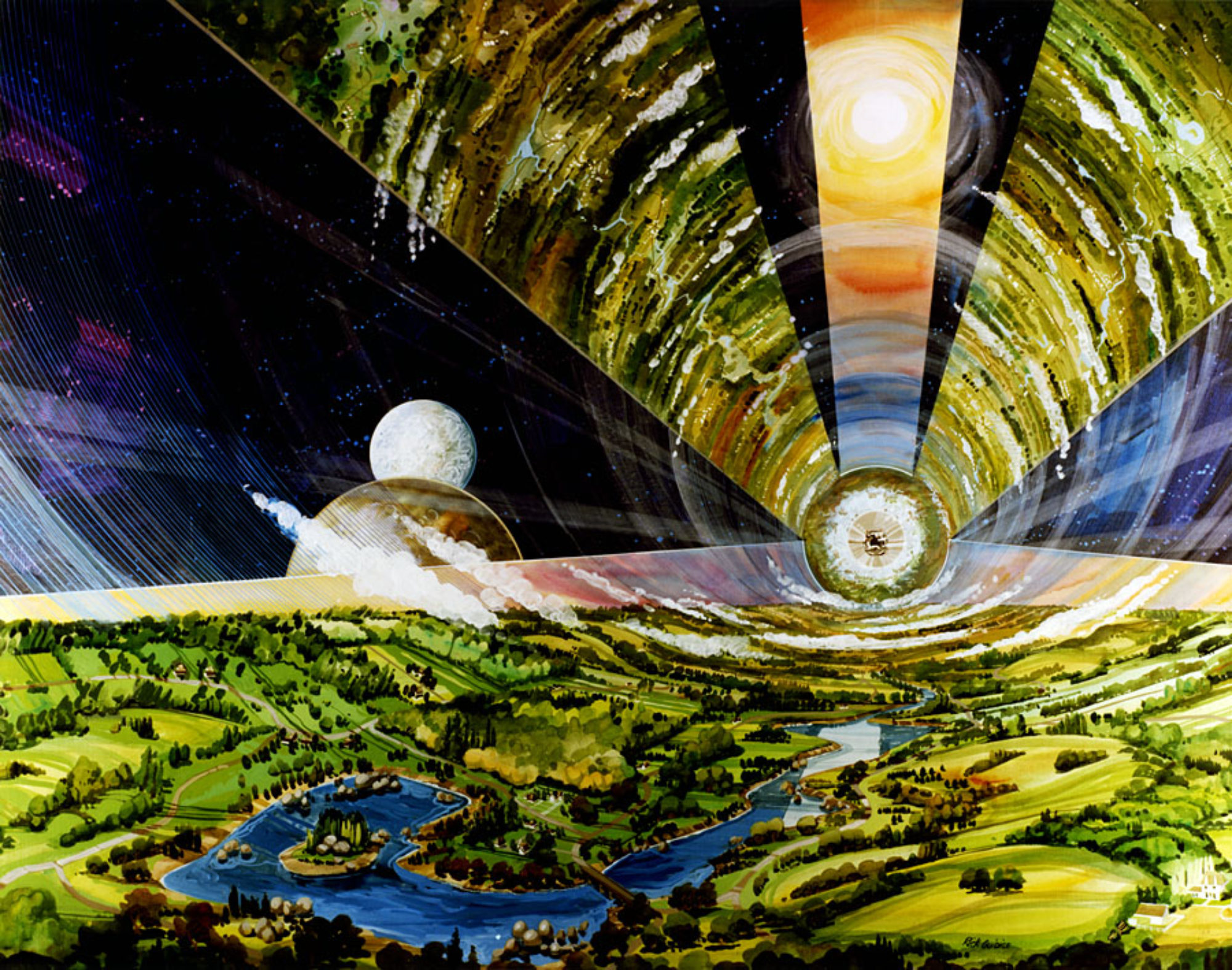
Above – Mars Cycler exploded section. Below – Cruise ship-sized Mars Cycler booster (left) and docking configuration (right). Credits: Offworld Industries Corp.
At the 54th International Conference on Environmental Systems held in Prague, Czechia, this past July, a paper was presented describing an innovative design of a large-scale Mars Cycler. The authors, A. Scott Howe, John Blincow, Theodore W. Hall, and Colin Leonard, make the assumption that a significant planetary migration to Mars will happen in the near future, citing Elon Musk’s often stated goal of establishing a one-million person colony on the Red Planet by 2050. The authors argue that Starship will not be a suitable transportation method for a large, non-professional clientele on what has historically been a six-month journey due to the physiological and psychological health risks of a long-duration mission (not withstanding a recent paper penned by University of Santa Barbara physics undergrad Jack Kingdon proposing two trajectories that reduce transit times to between 90 to 104 days each way).
Instead, they envision a “cruise ship” approach using a large, robotically constructed Mars Cycler that would continuously travel between Earth and Mars. The concept for a Mars Cycler was first conceived by Buzz Aldrin in a 1985 paper, and in recognition of his invention, is often referred to as an Aldrin cycler. This particular cycler design is advantageous because it would use minimal propellant to maintain its trajectory. The concept features a dual-torus structure, with a non-rotating outer torus for docking and a rotating inner torus to provide artificial gravity. The paper lays out in detail the specifications for a minimal-sized version with crew capacity of 52-61 people, and calculates the mass and equipment required for the vessel. The authors estimate that it would take 63 Starship launches (version 3) to deliver the construction materials and propellant to low Earth orbit (LEO). A scaled up larger cruise ship-sized version with a capacity of 1000 occupants would take 428 Starship version 3 launches, which is within the range of engineering possibility and certainly within the launch rate of thousands of Starships Elon Musk envisions as part of his Mars colonization plans.
The Mars Cycler would be assembled using Offworld Industries Corporation’s Sargon System, a family of new construction machines the company claims could build an entire space station in half a year (Blincow is CEO of Offworld Industries Corp). The novel construction technology autonomously assembles preformed hull panels loaded in a magazine, robotically dispensed, formed and welded into large toroidal (or other shaped) space stations ready to be pressurized.
The paper advocates for the cycler to provide artificial gravity to mitigate the deleterious health impacts of microgravity allowing occupants to maintain healthy muscle and bone density throughout the journey. The proposed design decouples an inner artificial gravity centrifuge from an outer non-rotating torus, which offers several operational benefits:
Distributed docking ports: The non-rotating outer torus can accommodate multiple visiting vehicles docking at various points around its perimeter.
Fixed systems: Solar panels and radiators can be mounted without the need for gimbals or motorized mounts, simplifying the design.
Seamless transfer: Crew and cargo can be transferred between visiting vehicles and the cycler without the need for spin-up or spin-down procedures.
The paper identifies several challenges to overcome in order to realize an operational Mars Cycler. The top five include:
Large-scale space construction: The project requires the construction of very large orbital structures. A key challenge is maintaining tolerance control during assembly, ensuring panels fit together precisely and the torus closes properly.
Attitude control and maneuvering: The paper assumes, but does not detail, that maneuvering large quarter-toroids in proximity to each other will be possible without “exotic solutions’. This is a significant challenge because each section would have its own center of mass and orbit, creating strain on connected elements.
Artificial gravity implementation: A number of difficulties are discussed, including economic spin-up/spin-down, docking procedures while the structure is spinning, and performing extra-vehicular activities (EVAs) under rotation. The paper also notes that transferring power, control, information, and liquids between the rotating and non-rotating segments would be challenging.
Mars surface infrastructure: The paper acknowledges that a major challenge is the “big elephant in the room of Mars surface infrastructure”. The entire concept is based on the assumption that the necessary infrastructure, such as propellant production facilities, will be in place on Mars by the time the cycler is ready.
Life Support Systems: Sustaining human crews on a cycler for extended periods (e.g., months-long transits) requires robust life support systems for air, water, food, and waste management. The paper underscores the challenge of maintaining these systems with minimal resupply over multiple cycles.
Assuming these challenges could be solved, this interplanetary cruise ship design of a Mars Cycler is a new approach to deep-space travel, elegant in its simplicity. It offers a potential solution to the challenges of long-duration missions by providing artificial gravity via a rotating inner torus to ensure the health and well-being of future Mars colonists.
In addition to these cyclers providing a mode of safe space transportation, such large artificial gravity space stations could be permanently located in orbit around planets or moons that have surface communities in split life cycle space settlements which SSP covered recently. Such a facility could have duel use as an Earth-normal gravity crèche, providing birthing centers and early child development for families settling in the region. Colonists could choose to split their lives between rearing their young in healthy normal gravity settings until their offspring are young adults, then moving down to live out their lives in lower gravity surface settlements – or they may choose to live permanently in free space.
Artist rendering of a robotic space farm on Mars controlled by a computer network utilizing artificial intelligence. Credits: Bryan Versteeg / Spacehabs.com
In an article in the National Space Society Space Settlement Journal, Bryce Meyer examines the integration of Artificial Intelligence (AI) into computer networks for space settlements. Meyer, an aerospace engineer, computer scientist and biologist is the founder and CEO of Cyan React, LLC, a startup that designs compact photobioreactors and provides expertise in space agriculture and life support for space habitats.
The paper describes the critical role of AI networks will play in enabling sustainable space settlements whether they be on the Moon, Mars, or in free space. These colonies, envisioned to minimize Earth resupply and achieve self-sustaining commercial operations, will face challenges due to limited human occupants (often under 100) and the absence of specialized expertise. AI systems can provide a solution that will bridge knowledge gaps, manage complex operations, and ensure rapid responses to critical issues, such as life support failures, where human reaction times may be insufficient.
The article categorizes AI into distinct families suited for space applications. Neural networks, good at pattern recognition, could help identify equipment anomalies. Generative AI (GAI), excellent at diagnostics and creative problem-solving, could propose solutions for crop failures in space farms or other equipment failures. Regression models would be leveraged for predictive analytics like forecasting resource needs.
These AI systems require robust integration with settlement infrastructure, using standard protocols like TCP/IP for communication. Training of AI agents involves learning from a pre-settlement knowledge base, periodic updates from Earth, and real-time inputs from sensors monitoring environmental conditions, equipment, and biological systems. Error management will be managed with AI outputs cross-checked by other AIs, rule-based systems, or human oversight to prevent cascading failures in critical systems.
Network architectures are key, with Local Area Networks (LANs) enabling low-latency, high-speed communication for real-time tasks like alarms and life support, while Wide Area Networks (WANs) connect settlements to external systems, such as orbital infrastructure or Earth-based servers . AI placement is strategic, positioned near action points within habitats (e.g., farms, life support systems) to minimize latency and ensure reliability in harsh extraterrestrial environments. Power constraints and radiation hardening are critical considerations for AI hardware.
The article presents a detailed scenario illustrating AI coordination in a mass flow system, as would be required in space farm. For example, crop wilting is detected by sensors, triggering a cascade of AI-driven actions: neural networks diagnose the issue, GAI suggests solutions (e.g., adjusting nutrient levels), and regression models predict outcomes. Human settlers, guided by augmented reality interfaces, validate and implement solutions, ensuring effective collaboration. The scenario underscores the need for AI to operate at multiple scales—individual plants, farm systems, and settlement-wide networks.
Bryce agreed to be interviewed via email on this enabling technology for space settlement. I am very grateful for him taking the time to dive deeper into the topic and for his detailed responses to my questions. Here is our discussion:
SSP: You mentioned that many of these AI systems are already in use in indoor farms and factories. Can you provide some examples of these instances?
BM…Not trying to pump a particular company but here are common examples: Siemens is one of many companies that make networks of these AI enabled control systems, with control center software now: Siemens Industrial Copilot and SmartTron as well as AIRLOCK(InterLock) Systems.
There are also many new entry startups in this area, such as AGEYE (see below), and others, many have already tried and failed as businesses. Emerson Process is similar, with many offerings and architectures in Chemical Process Automation and Response. BASF is another with it’s xarvio® Digital Farming Solutions. Monnit makes Internet of Things (IoT) plant sensors and sensor reporting software.
It is a very active business area bridging strict rules based to AI enabled rules based and GAI systems with IoT.
SSP: In your example of an AI farm agent detecting a wilting problem with a tomato plant and coming up with a solution, you acknowledged that there are many ways in which ecosystem failures could a occur in a space farm and these scenarios would have to be anticipated to train the AI systems. Has work already been started on an AI controlled farm fault tree analysis, perhaps by the entities running the indoor farms you mentioned in Item 1?
BM…Absolutely! IoT and AI are used in combination in many indoor farms now, just not all the way to the point as shown in the paper, including the ‘recreational plant’ market and for food plants. This is in active work now by many companies, AGEYE is one company that does have integrated solutions like the farm part of the paper (or very close to it). With a little development, automated control will combine the systems in #1, with the farm systems, with more advanced and trained systems, IoT sensors and controllers, to get to the settlement level. It will take a merger of these to get there, but we are very close. Have parts, just need to integrate to get to the vision in the paper.
SSP:Prior to implementation for safe use in a space colony, AI systems would have to be trained on a variety of settlement functions in ground-based analogs. Perdue University’s Resilient ExtraTerrestrial Habitats Institute is doing work in this area as well as the Space Analog for the Moon and Mars at the Biosphere 2 facility in Arizona, and of course MELISSA in the EU. Are you aware of any other teams in academia or government working on this now?
BM…Really miss Ray Wheeler’s et al. NASA Biomass Production Chamber, which was the right size and type, would just need updates.
South Pole research station would work well for testing these systems…in a harsh place, limited human presence.
I know Space Development Network is proposing an inflatable farm to develop this technology too, though it needs funding.
AI control for factories and indoor farming is an active corporate area and they have their own extensive facilities, including near my home in St. Louis with Bayer (formerly Monsanto), though they aren’t focused on the particulars of space, per se, yet.
China also has extensive analog labs, since they do seek to beat the USA to long term Moon and Mars settlement. They occasionally publish.
Many colleges have funded work on vertical and indoor farming, several in my home state including at [University of Missouri-St. Louis] UMSL’s planned Yield Lab. Technical Schools like Ranken also teach and develop methods for indoor farming that could help development of these AIs. All of these facilities can be used to shake out AI systems too.
SSP: In private industry, a few companies are actively involved in developing space-based agriculture. I’ve covered one such company, Orbital Farms, which leverages Earth’s “Dark Ecosystem”, the food chain based on bacteria that are chemotrophic, i.e. deriving their energy from chemical reactions rather than photosynthesis. An example of these type of organisms are bacteria that live near volcanic sulfur vents at the bottom of the ocean. The energy inputs and material flows of these ecosystems are 100 times more efficient in water and energy use per unit volume when compared to conventional photosynthetic food production. The very same organisms can be engineered to make pharmaceuticals, plastics, and a variety of other useful complex organic compounds. Have you considered this approach to optimize mass flows and utility in space farm ecosystems?
BM…Of course. I have considered bioreactors, both photobioreactors and non-light based systems, for a decade. They are the Swiss Army Knife of mass balancing, though I don’t see them as primary food source except in emergencies unless 3d printing and other methods become far better in the culinary sense. Food is critical for psychology too. As is the need to see green and feel and smell plants and crops. Bioreactors have many profiles and uses on Earth now, and the dark cycle chemosynthetic systems are among these. I don’t see a lack of electrical power a problem, just my 2 cents, due to nuclear reactors or space solar power in long term settlements, so I see gardens and farms. Carbon is the problem in a mass cycle. However, the dark cycle systems would be essential for making biochemicals that are either lacking from farms and algae or needed to control the mass cycling in systems. Since we are minus the huge soil ecosystem on Earth for a long while, and may need time sensitive production, the dark cycle systems would be a must just to control the overall system. I do see those on spacecraft that have limited volume, that provide bulk calorie cycling, along with smaller plant systems.
SSP: In your example in Figure 12 of a small settlement of 10 people where the mass flows are 22kg per day to and from the farm, how big is the farm in cubic meters and what would be grown there to provide enough sustenance and oxygen for the occupants?
BM…Around 1400 square meters, 2400 cubic meters (very pessimistically) assuming a VERY diverse crop mix including a few shrimp, multiple veggies and crops like potatoes or peanuts/soy, and bioreactor array with tanks, and walking areas, with continuous crop production ad infinitem. Sounds big, but that is about the size of two three-story healthy midwestern suburban houses, very roughly. Less diverse crop sets can shrink the farm drastically, to around 25% of the size, but with less dietary diversity.
SSP:With respect to training AI systems to be “space rated”, the first iterations to be implemented off Earth will not be entirely autonomous (as you have shown in your examples) and will have humans in the loop until error rates can be reduced to some tolerable level. With the speed at which AI and robotics are progressing today, while at the same time, settlement of the Moon and Mars seems to be advancing at a snail’s pace, do you see the two technologies converging in the near future so that when permanent colonies are finally established, AI networks will be able to autonomously control most critical functions without human intervention?
BM…I never will fully trust AI for everything, and I don’t think the settlers will either, at a minimum due to cybersecurity. That said, the advances in both systems and software will continue to allow more complex settlements monitored by fewer people. Automation will really will be a core technology in expanding settlements, and starting them. Farms could be growing and operating steady state before the first long term residents arrive, and as a settlement expands, it could add modules and let AI get it started and growing before bolting it onto a smaller settlement. Some things will see robotics as repair agents. The AI technology expansion will allow for more long term optimization as well, and continue to add resiliency to the settlement.
You could see a retirement home or factory on the moon with only a few human workers to keep the settlement running, a few medical technicians that are AI assisted, and robots that fix many things without bothering the staff.
SSP:You have suggested in a previous post on SSP that space farms on Mars could be the bread basket for the outer solar system. Another space farm advocate, retired software engineer Marshall Martin, has proposed a roadmap for their implementation starting with ground based analogs, but progressing mainly to rotating free space settlements, eventually resulting in millions of farms feeding billions of people throughout the solar system. When do you think we’ll see the first prototype closed loop farm implemented in space?
BM…I want farms everywhere, grounded and floating [in free space], because I want to see Trillions of Happy, Smiling Babies everywhere.
I would bet either Artemis, a company, or China fields one in the next 35 years for sure, likely sooner, just to prove the concept. Orbital factories could drive the need as much as a lunar base, just to limit resupply, but a Mars base or space station that is beyond cis lunar space will have to have such a close[d] cycle farm as a must due to limited resupply. So, when depends on if the cost to orbit gets very cheap, and cost to [the] Moon gets cheap. Cheap lift in cislunar space would limit the need to fully recycle, but beyond that distance the case gets much stronger. If it stays expensive to [get to] the Moon, the Moon would drive the need, and the farm gets built sooner.
In his conclusion to the article Meyer holds that AI complexity must align with settlement needs, balancing sophistication with reliability. Interdisciplinary collaboration is essential to refine these systems through scenario-based testing and practical implementation. By empowering minimally trained settlers, AI networks enhance sustainability, safety, and mission success, laying a foundation for long-term human presence in space.
AI generated image of Mars in the process of being terraformed. Credit: Gemini
The concept of terraforming Mars was first proposed by John B. S. Haldane in his 1927 essay “On Being the Right Size”, where he touches on the idea of altering planetary environments to make them habitable for humans, including Mars. However, the term “terraforming” itself was coined later by science fiction author Jack Williamson in his 1942 story “Collision Orbit”, where he described transforming alien worlds into Earth-like environments. Haldane’s speculative mention in 1927 is generally considered the earliest recorded proposal of the concept applied to Mars, though it was not detailed or Mars-specific. More technical discussions of Mars terraforming emerged in the mid-20th century with advancements in space science.
Carl Sagan discussed terraforming Mars in his scientific work and popular writings. In a 1971 paper, “The Long Winter Model of Martian Biology: A Speculation”, published in Icarus, Sagan explored the idea of making Mars habitable by using dark-colored plants or microorganisms to reduce the planet’s albedo, leading to better absorption of sunlight to warm the surface, which would release water and carbon dioxide from the polar caps and regolith. This would thicken the atmosphere and create conditions suitable for life. His ideas influenced later science fiction, including Kim Stanley Robinson’s magnus opus Mars trilogy, and remain a foundation for modern terraforming discussions.
The research up until now indicate that it is a complex, long-term project, taking hundreds of years and could be controversial due to ethical challenges. In an article in Nature Astronomy, a fresh look using innovative terraforming methods is presented which could accelerate the warming of Mars by at least 30°C within a few decades, although complete habitability for human flourishing would likely take at least a century. The paper emphasizes the need for scientific research to understand if and how this could be done. Ethical concerns are also addressed with care in the paper.
The article suggests that terraforming Mars should progress in three phases: first, warming the planet; then, introducing hardy organisms to start an ecosystem; and finally, engineering a biosphere with enough oxygen to support human life. The technology proposed to facilitate warming of the planet in the first phase includes orbiting solar sails, silica aerogels, nanocellulose, and engineered aerosols.
Large, lightweight reflective solar sails deployed in space would act as mirrors to reflect solar radiation on to the Martian surface, increasing the amount of heat the planet absorbs. The paper notes that the current insolation of Mars is ~130 W/m², with net absorbed energy at ~125 W/m², resulting in an average surface temperature of about -63°C. By redirecting additional sunlight, reflectors in orbit could significantly boost this energy input which would raise the surface temperature.
Ultra-light, porous silica aerogels with excellent insulating properties could be deployed in transparent or translucent blankets over Martian ice deposits, particularly in polar or high-latitude regions with abundant frozen water reserves. Aerogels trap heat by allowing sunlight to penetrate while preventing infrared radiation from escaping, creating a localized greenhouse effect. This would warm the underlying ice, potentially melting it without requiring global atmospheric changes. The paper emphasizes the aerogel’s biocompatibility, ensuring they would not harm the existence of a potential Martian ecosystem.
Nanocellulose is a lightweight, strong, and renewable nanomaterial derived from cellulose, It could be spread over the Martian surface acting as a thermal blanket similar to aerogels, or as a component in structures that trap heat. The paper suggests it could be tailored to maximize solar absorption in the visible spectrum while reflecting infrared to retain heat, contributing to localized or regional warming. Nanocellulose could support targeted warming, potentially complementing aerogels in creating habitable microenvironments. Its lightweight nature makes it practical for transport and deployment, aligning with the paper’s focus on mass-effective solutions.
Engineered aerosols are fine particles designed to be released into Mars’ thin atmosphere to enhance its greenhouse effect. Unlike older fluorocarbon proposals, which were less efficient and environmentally risky, these aerosols are optimized for biocompatibility and ease of control. These aerosols absorb and scatter solar radiation, trapping heat in the atmosphere. They can be tailored to target specific wavelengths, maximizing heat retention while minimizing harmful effects on potential biology. The paper notes that Mars’ low heat capacity allows these aerosols to warm the planet faster than on Earth, potentially achieving a 30°C increase within a century. By thickening the atmosphere’s greenhouse layer, aerosols could raise global or regional temperatures, facilitating the melting of ice and the release of water vapor, which further enhances warming because water vapor itself is a greenhouse gas.
Another option to facilitate atmospheric warming, proposed in a paper in Scientific Advances last year, would be to engineer and mass produce “nanorods” from Martian regolith tuned to strongly absorb infrared radiation, thereby supercharging a greenhouse effect.
Figure 3 from paper on a nanoparticle warming method for Mars terraforming efforts. Credits: Aaron M. Geller, Northwestern, Center for Interdisciplinary Exploration and Research in Astrophysics via Scientific Advances
Mid-term, anaerobic organisms tolerant to Mars’ harsh conditions could be introduced, initiating ecological succession and producing oxygen. The lead author on the Nature Astronomy paper is Erika Alden DeBenedictis, CEO of the San Francisco based nonprofit Pioneer Labs, who’s mission is to engineer microbes that can thrive in extreme environments. As stated on the website, “These new pioneer species can pave the way to greener planets by remediating soil, upcycling waste streams, and making harsh areas more friendly to life.”
SSP has covered a similar approach to terraforming the Red Planet with introduction of pioneer species such as the desert moss Syntrichia caninervis, an organism that can survive the frigid temperatures, low ambient pressure and harsh radiation on Mars while helping to boost oxygen levels and fostering soil fertility.
This middle phase would be ideal for para-terraforming, a more limited approach to making localized regions of Mars habitable, prior to fully terraforming the entire planet. It involves creating enclosed, controlled environments—such as domed habitats or sealed craters—where temperature, atmosphere, and other conditions are artificially maintained to support human life or simple ecosystems. Kent Nebergall, chairman of the Mars Society Steering Committee, has proposed this approach by building an enclosure over Hebes Chasma, a canyon the size of Lake Erie just north of Valles Marineris.
Top: Artist concept of kilometer scale arches built above space settlements and enclosing a Martian canyon to provide a para-terraformed environment. Bottom: Magnificent view from below depicting these domes at cloud level on a typical summer day. Credits: Kent Nebergall / Aarya Singh
The paper suggests terraforming in this middle phase could support upwards of 10,000 people per site with automated farming, while the end goals are constrained by physical, chemical, and biological limits, perhaps necessitating a multicentury timeline. This phased approach highlights the gradual, research-driven nature of the project, acknowledging the long timescales involved.
The final phase involves establishing a sustainable, oxygen-rich ecosystem capable of supporting advanced plant life and, eventually, the ability to support human settlements without life support systems. Atmospheric oxygen would be increased to at least 0.1 bar to enable humans to breathe without pressure suits. This would be achieved through the widespread propagation of photosynthetic organisms like engineered plants or cyanobacteria. The paper notes that this slow oxygen build-up, potentially taking over a century, requires sustained energy inputs, possibly from multi-terawatt power sources or solar concentrators, to accelerate the process. The project would need ongoing climate engineering to maintain temperature and pressure, such as controlled greenhouse gas releases. Because Mars does not have a magnetic field to deflect solar particle events and galactic cosmic rays, engineered solutions would be required to prevent loss of oxygen and to shield Martian settlers from radiation. Through deployment of large-scale electromagnetic coils or magnetic shields in orbit or on the surface, a localized or planetary magnetic field could be created, mimicking Earth’s magnetosphere. This concept has been proposed by Dr. James Green, former chief scientist at NASA who retired from that role in 2022.
With respect to ethical concerns, there is considerable debate over preserving Mars as a pristine environment versus transforming it, with implications for potential Martian life that may exist there. The paper notes that human presence during exploration and/or settlement will introduce orders of magnitude more Earth microbes (then those that may have been present on probes that have already landed there), necessitating a search for extant Martian life through sample returns and deep aquifer exploration prior to initiation of terraforming efforts. The authors suggest that terraforming technologies could benefit Earth, such as developing desiccation-resistant crops, but emphasize the need for science-informed engagement with stakeholders. The long timescale for terraforming is noted as a constraint for politics and science, highlighting the need for long-term planning and international cooperation.
There are more audacious proposals such as Robert Zubrin and Chris McKay’s plan for terraforming Mars in 50 years. Zubrin, a prominent advocate for Mars exploration and terraforming, argues that there is no extant life on Mars, thus alleviating ethical concerns about altering the planet’s environment soon. In his view put forward in his book The Case for Mars, extensive scientific investigations analyzing data from Mars rovers and orbiters, have found no conclusive evidence of current microbial or other life forms, suggesting Mars is a barren world. He contends that the absence of indigenous life eliminates moral objections to terraforming, as there are no ecosystems to disrupt or native species to harm. Zubrin emphasizes that terraforming Mars into a habitable environment for humans, would foster scientific advancement and human expansion without ethical conflicts, provided ongoing searches for life—such as soil sample returns—continue to yield negative results. This position is echoed in the paper which notes the need to confirm the absence of life through further exploration but supports initiating terraforming research given the evidence to date.
As Mars terraforming efforts advance, the viability of the planet as a sustainable environment for surface settlements may progress according to the Pancosmorio Theory which posits that ecosystems necessary to sustain life gradually acquire sufficient area and availability of resources (e.g. sources of energy) as their circular economies evolve toward closure such that dependency on supply chains from Earth begins to diminish.
The paper makes a compelling case for prioritizing Mars terraforming research, aligning with current exploration priorities while informing future decisions about an eventual human presence on Mars. The authors acknowledge the complexity, controversy, and long-term nature of the project, advocating for a science-driven approach to address feasibility, ethics, and potential benefits for both Mars and Earth.
Conceptual illustration of two Pale Red Dot villages on Mars serviced by SpaceX Starships. Credits: Pale Red Dot Team*
Pale Red Dot is an acronym for Polis-based Architecture for the Long-term Exploration of the Red planet, with Exciting and Diverse Developmental Opportunities to Thrive. This concept, which was the first place winner of the NASA 2023 RASC-AL competition in the category of Homesteading Mars by a team* at the Massachusetts Institute of Technology Space Resources Workshop, focuses on establishing a city-state with Earth-independence supporting extensive scientific exploration on Mars. NASA’s RASC-AL (Revolutionary Aerospace Systems Concepts – Academic Linkages) competitions foster innovation of aerospace systems concepts, analogs, and technology by bridging gaps through university engagement.
This architecture envisions sending robotic precursor missions to Mars following experience gained from NASA’s Artemis program to survey sites, test technologies, and stockpile resources like water and propellant. Lets be honest up front that this paper is two years old and timelines for return to the Moon have been moved out. Predictions on milestones in the paper for this plan as described below should take these delays into account. With the current Trump administration the fate of Artemis program is evolving. There are many possibilities being proposed to streamline NASA’s plans, one of which by retired aerospace engineer and entrepreneur Rand Simberg, leverages public-private partnerships to get humans back to the moon. Keeping this in mind, when humans return to the lunar surface, Pale Red Dot would leverage the engineering knowledge gained from robotic landers and human missions used in Artemis or any subsequent initiative that emerges.
Next, in 2035 (at the earliest), robotic cargo SpaceX Starships would deliver approximately 5,800 tons of equipment consisting of habitats, nuclear microreactors, farming modules, manufacturing facilities, and in-situ resource utilization (ISRU) systems. By 2040, two crewed Starships would transport 36 colonists to Mars to establish two closely located villages. Costs would be shared by nations that are signatories of the Artemis Accords, 56 and counting as of this post.
The study used a modelling approach that prioritized safety and crew health in design of the architectures, both in transportation and surface facilities. Relying heavily on NASA’s current career permissible limits for space radiation, exposure was minimized by splitting the crew among two Starships, each one adding a 71-ton 35cm polyethylene shield, and dashing to Mars within 113 days. Upon arrival, to guard against galactic cosmic radiation and solar particle events, the initial surface habitats will have integrated 3m water tanks in their roofs for radiation shielding. The plans call for gradually building out radiation-proof underground tunnel habitats. Although not considered in this scenario, locating the settlements in a lava tube could be advantageous not only for ready-made radiation protection but thermal management as well.
The Pale Red Dot (PBD) architecture emphasizes robustness and thriving, rather than just survival, through substantial infrastructure supporting 36 crew members across two Martian villages. This includes extensive makerspaces and significant reliance on ISRU. The two nearby villages are designed to be energy-rich, water-rich, food-rich, time-rich, and capability-rich, with substantial self-rescue capabilities.
Diagram from Figure 4 in the paper depicting one of two villages of the Pale Red Dot architecture showing zone layout with modules for farms, habitation, mission utilization and makerspaces. Credits: Pale Red Dot Team*
Extraction methods for sourcing in situ water were not addressed in the PRD architecture. This should not be a problem though as the communities could leverage methods that have already been validated, such as the RedWater System which could drill for, and collect, subsurface water ice.
The paper argues that such a large architecture, with its economies of scale and specialization, is crucial for mitigating the risks associated with a long-duration, minimally resupplied mission to Mars. Crew time modeling suggests that smaller missions with 12 or fewer people would not provide sufficient free surface traverse time for meaningful science and exploration. The estimated lifecycle cost for this campaign is $81 billion, with a peak annual cost of $6.6 billion.
The PRD concept highlights the potential for creating a true community on Mars with sufficient social complexity for humans to thrive. Furthermore, it proposes the geopolitically significant option of including crew members from every Artemis Accords signatory in the first human mission to Mars. Comprehensive details are provided on the dual-habitat architecture, concept of operations, mission control, technology roadmap, and risk burn-down plan.
Artist impression of a lunar habitat designed for resiliency and autonomy. Credit: Resilient ExtraTerrestrial Habitats Institute
The Resilient ExtraTerrestrial Habitats Institute (RETHi) is at the forefront of developing autonomous and resilient habitats essential for space settlement. The NASA-funded organization just released its Impact Report summarizing work completed to date. SSP reported on RETHi back in 2020.
A key driver for RETHi’s imperative of autonomy in these habitats is the increasing communication delays and limited bandwidth that will severely restrict interaction with controllers on Earth as habitats are established further from home. These limitations necessitate new approaches for managing space habitats autonomously, fundamentally shifting the operational philosophy for future missions. Unlike near-Earth operations where Mission Control provides real-time oversight and intervention, the remote and harsh environment of deep space demands that habitats become self-sufficient entities. This means that intelligence, diagnostic capabilities, and decision-making must reside on-board, transforming the paradigm from remote control to local autonomy. This is a critical design constraint that permeates all of RETHi’s research, influencing everything from structural design to life support systems and robotics.
RETHi’s research is organized into three interrelated thrusts, each addressing a critical aspect of a comprehensive framework for self-managing systems:
Resilience (Architecture): This thrust focuses on the fundamental design of habitats. It involves choosing design features and tools to maximize resilience, assessing safety controls, and developing a resilience-based design procedure aligned with NASA’s processes. This ensures that resilience is embedded into the very fabric of the habitat from its inception, making it inherently robust.
Awareness (Detection + Diagnosis + Decisions): Addressing the need for autonomy in operations, this thrust aims to detect damage and disruptions, diagnose issues, and support decision-making autonomously. This represents a significant departure from traditional human space flight operations, which rely heavily on large Mission Control teams. The goal is to enable the habitat to “understand” its own state and the nature of any anomalies.
Robotics (Enable Action): This thrust is dedicated to expanding the capabilities of autonomous systems by increasing the scope of interventions that can be carried out automatically by robots. This is crucial for construction, maintenance, and repair in hazardous environments where human presence might be limited or too risky.
RETHi’s research is supported by three complementary testbeds, each serving a distinct but integrated purpose, forming an efficient iterative design and validation pipeline:
HabSim: This is a computational model of core space habitat subsystems. It incorporates damageable and repairable properties, sensors, and agents for anomaly detection and repair. HabSim can simulate various disruption scenarios, including micrometeorite impacts, fires, Moonquakes, and nuclear leakage. It primarily helps users learn to create and maintain resilient habitats by assessing decision strategies and resilience through simulation-based design, which can reduce mission costs and increase crew safety.
CDCM (Control-oriented Dynamic Computational Model): This capability provides a specialized language for rapid prototyping of machine-readable models that capture causal relationships in complex systems. This enables automatic diagnostic reasoners and uncertainty quantification, which are crucial for developing intelligent, self-diagnosing systems.
HARSH(Human-Centered Autonomous Resilient Space Habitats): This testbed is a cornerstone of RETHi’s research, providing a unique cyber-physical platform for validating the complex interplay of hardware and software in autonomous space habitat systems. As the physical validation layer, HARSH takes the insights, algorithms, and models developed and refined in HabSim and CDCM, and tests them in a hardware-in-the-loop environment to confirm their real-world efficacy.
These three complementary testbeds provide a sophisticated, multi-stage approach to research and development. HabSim allows for broad, rapid computational exploration of scenarios and design strategies, providing initial insights. CDCM provides the formal language and tools for precise diagnostic reasoning and model building. HARSH then serves as the high-fidelity, cyber-physical validation platform, where the most promising concepts from the computational realm are rigorously tested against physical realities. This iterative process—from broad simulation to precise modeling to hardware validation—minimizes risk, optimizes design, and accelerates the development cycle for a mature engineering pipeline of complex, safety-critical systems.
The RETHi Impact Report summarized the status of many of the Institute’s research initiatives. Although all are important, this post will highlight progress in two key areas of interest: The HARSH testbed and the design of a habitat’s Environmental Control and Life Support System (ECLSS).
Purpose and Unique Capabilities of HARSH
HARSH is a cyber-physical testbed designed to investigate advanced systems health management capabilities for complex systems with deep informational dependencies. The facility bridges the gap between digital simulation and physical reality, allowing for a more comprehensive understanding of system behavior.
The platform’s unique strength lies in its ability to trigger realistic disruption scenarios using hardware and test autonomous recovery. This capability distinguishes HARSH from purely computational models by enabling real-world interaction, sensor feedback, and the validation of autonomous responses against actual physical system behavior. While computational models like HabSim and CDCM are invaluable for initial design and rapid prototyping, HARSH serves as the crucial validation bridge from simulation to reality. It is where theoretical models and algorithms are put to the ultimate test against physical realities, including hardware limitations, sensor noise, latency, and real-world environmental interactions. This is an indispensable step for ensuring reliability and eventual flight certification of autonomous systems.
Facilitating Investigation of Advanced Systems Health Management
HARSH’s cyber-physical nature allows for the investigation of advanced systems health management capabilities, which are crucial for maintaining complex space habitats, especially those with deep informational dependencies. This entails a focus on integrated diagnostics, prognostics, and self-healing mechanisms across multiple interconnected subsystems. In a deep space habitat, a failure in one system, such as a power supply, can quickly cascade to others, like the ECLSS or communication networks.
The ability to test autonomous recovery under realistic hardware-induced disruptions is central to HARSH’s role in validating the Awareness (detection, diagnosis, decision) and Robotics (enable action) thrusts in a practical, integrated setting. To attain advanced systems health management capability, a focus that transcends simple fault detection is required. It implies a sophisticated ability to continuously monitor, diagnose, and predict the health of complex, interconnected systems. HARSH’s ability to test deep informational dependencies and autonomous recovery provides a proactive approach to resilience, where the system not only identifies a problem but also takes corrective action to prevent cascading failures and restore functionality, thereby minimizing the need for human intervention and ensuring mission continuity.
Advancing Life Support Systems for Deep Space: RETHi’s ECLSS Research
As we all know, the ECLSS is critical for sustaining human life in the hostile, closed environment of deep space settlements. The life support system provides essential functions such as breathable air revitalization, water recovery, waste management, and thermal control, directly impacting crew health and performance. The extended durations of deep space missions (and eventual evolution to permanent communities) necessitate a highly reliable and resilient ECLSS, capable of operating autonomously and recovering from disruptions without immediate help from Earth, given the significant communication delays and the unlikelihood of the success of rescue operations due to long transit times.
While a habitat’s structural integrity and autonomous systems are vital, the ECLSS provides the breathable air, potable water, and stable thermal environment necessary for human survival. Any significant failure in these systems directly jeopardizes the safety of the habitat’s occupants, making them the ultimate determinant of mission duration and crew survivability. Therefore, the resilience of an ECLSS will directly dictate how long a mission can last and whether the crew can survive unforeseen events, particularly when autonomous recovery is the only option.
Development of High-Fidelity, Physics-Based Simulation Models
RETHi has developed a high-fidelity, physics-based simulation model for an ECLSS, a sophisticated approach that accounts for the underlying physical principles governing the system’s behavior, allowing for a deep and accurate understanding of its performance.
This advanced model is specifically designed to predict interior conditions under nominal and disruptive scenarios. This capability is vital for understanding how the habitat’s internal environment responds to various stresses, from equipment failures to external impacts, and for evaluating the effectiveness of mitigation strategies. This method of modeling can predict interior conditions under nominal and disruptive scenarios, enabling a proactive, rather than reactive, approach to resilience. Instead of waiting for failures to occur and then responding, RETHi is developing tools to anticipate how the ECLSS will behave under various forms of stress. This predictive capability allows designers to identify vulnerabilities, optimize system responses, and develop robust contingency plans before a space habitat is established, significantly enhancing safety, reliability, and the potential for autonomous recovery. It moves beyond simple performance modeling to detailed stress-testing and failure mode analysis in a virtual environment.
Evaluation of ECLSS Resilience Under Nominal and Disruptive Scenarios
The ECLSS simulation model allows for the evaluation of system resilience. This means the model can assess the system’s ability to withstand disturbances, adapt to changing conditions, and recover from various challenges, ensuring continuous life support. By simulating disruptive scenarios, researchers can understand the precise impact of failures, optimize control strategies, and develop autonomous recovery protocols for critical life support functions, minimizing the need for human intervention during emergencies.
Evaluating system resilience under disruptive scenarios goes beyond merely ensuring individual ECLSS components are reliable. It validates that the system has the ability to maintain its critical functions even when components fail or external disturbances occur. This shifts the focus from preventing individual failures to ensuring the overall system can adapt and recover, which is a hallmark of true resilience in complex, high-stakes environments where human intervention may be limited. This holistic view is essential for long-duration deep space missions, where adaptability is paramount.
SSP covered similar research by Curt Holmer in his master degree thesis modelling the stability of an ECLSS back in 2021. That work attempted to capture the complex web of interactions between biological, physical and chemical processes and detecting early warning signs of critical transitions between systems so that appropriate mitigations can be taken before catastrophic failure occurs. RETHi’s approach takes stability modelling to a deeper level, enabling ECLSS designers to understand the complex interdependencies and vulnerabilities of the system to determine proactive countermeasures.
Conclusion: Paving the Way for Future Space Habitats
The Resilient ExtraTerrestrial Habitats Institute at Purdue University is playing an indispensable role in driving the design and development of resilient and autonomous habitats, which are critical for the future of space colonization. The institute’s integrated, multi-faceted approach to autonomous resilience, exemplified by the HARSH cyber-physical testbed and its pioneering ECLSS research, is foundational for achieving long-duration human presence off Earth.
RETHi’s strategic organization into resilience, awareness, and robotics initiatives address the complex challenges of human survival in deep space, where communication delays necessitate on-board intelligence and self-sufficiency. HARSH serves as the crucial validation bridge, transforming theoretical models and algorithms into tested, real-world solutions for autonomous recovery and systems health management. Concurrently, the high-fidelity ECLSS models ensure that the fundamental life support functions remain robust and adaptable under stress, directly impacting crew safety and settlement longevity.
The comprehensive nature of RETHi’s work positions it as a leader in future large-scale, interdisciplinary research initiatives for resilient space habitats. The Institute’s holistic understanding of the complex challenges of space colonization fosters integrated solutions across multiple scientific and engineering domains, supported by robust testing infrastructure. The Institute’s current research findings are a blueprint for effective advanced research and development needed for the next frontier of human expansion into the solar system, emphasizing a paradigm shift towards self-sufficient extraterrestrial settlements.
Conceptual illustration of an excavator gathering lunar regolith, which upon separation and extraction of Helium-3, would transfer the valuable cargo to a spacecraft for shipment back to customers on Earth for industrial applications. Credits: Interlune
Payload reports that Seattle based Interlune, a space resources company, on May 7 inked a deal with its first customer Maybell Quantum to purchase thousands of liters of Helium-3 (He-3) sourced on the Moon. Interlune has developed an innovative excavator that will gather lunar regolith, process it and separate out He-3 for return to Earth. The company plans to launch a prototype of their equipment to the Moon in 2027, establish a pilot production plant by 2029, and deliver thousands of liters of He-3 to Maybell, a cutting edge quantum computing infrastructure company, for annual deliveries through 2035.
On the same day, Interlune entered in to a purchase agreement with the Department of Energy Isotope Program to deliver 3 liters of He-3 no later then 2029. The DOE IP utilizes He-3 primarily for scientific research, neutron detection, and cryogenic applications that support its mission to produce and distribute isotopes for research, medical, industrial, and national security purposes.
What’s the market for He-3? In 2023, the global He-3 market was valued at approximately USD 178.68 million, with projections to reach USD 224.59 million by 2031, growing at a compounded annual growth rate of 2.9% (2024–2031). Currently, He-3 has applications in medical imaging, neutron detection in border security, cryogenics and quantum computing; and of course aneutronic nuclear fusion research. This latter application has been touted for decades as a huge potential market for mining He-3 on the Moon as it is extremely scarce on Earth, with most supplies derived from tritium decay in nuclear weapon stockpiles, mainly in the U.S. and Russia. The going rate for Helium-3 is about $20M per kilogram.
Aneutronic fusion produces minimal neutrons as byproducts. This is advantageous because it reduces radioactive waste, simplifies reactor design, and allows for direct energy conversion (DEC). This method of generating power works by capturing the kinetic energy of the positively charged protons in the plasma, converting it directly into electricity using electromagnetic fields without the need for steam turbines. The most common He-3 fusion reaction is deuterium-Helium-3 (D-He-3), where deuterium (D, a hydrogen isotope) fuses with He-3 to produce a Helium-4 nucleus and a high-energy proton, releasing approximately 18.4 MeV of energy.
The current front runner using this approach is Everett Washington startup Helion Energy targeting commercial power generation by 2028. Their modular generators (roughly the size of a shipping container) are designed to power data centers or industrial facilities at a projected cost of ~1 cent per kWh. Helion signed a Power Purchase Agreement with Microsoft in May 2023 to deliver at least 50 MW of fusion power by 2028. They are also collaborating with Nucor, a North American steel products company, to build a fusion power plant on one of its steel mill sites in the United States.
Helion uses a pulsed non-ignition magneto-inertial fusion system called a Field-Reversed Configuration (FRC). Two FRC plasmoids (doughnut-shaped quasi-stable plasma structures) containing D-He-3 fuel are accelerated toward each other at over 1 million mph using magnetic fields, collide, and are compressed to fusion conditions (>100 million °C). Energy is extracted inductively as the plasma expands via DEC.
Achieving and maintaining 100 million °C will be extremely challenging. Some experts doubt Helion’s 2028 timeline, citing the difficulty of achieving net energy gain (Helion has not yet achieved engineering breakeven). This is why Interlune is focusing on more near term markets such as Maybell’s dilution refrigerators to provide cryogenic cooling for quantum computing customers.
Image of Maybell Big Fridge, a dilution refrigerator that utilizes He-3 to provide cryogenic cooling below 10 millikelvins for quantum computers. Credits: Maybell Quantum
Executing Interlune’s business plan will be difficult as all components in the supply chain provided by commercial partners need to work in concert like a well oiled machine. Launch vehicles will have to transport the excavators to lunar orbit and landers (still in development) need to deliver the equipment to the surface. After the He-3 is processed and stockpiled, a return craft will have to launch it back into space, return it to Earth, and reenter the atmosphere safely to deliver the cargo back home for distribution to customers.
On the bright side, if the company can secure a reliable supply chain for He-3 other potential customers with applications such as fusion propulsion for rapid transit throughout the solar system are gradually progressing toward technology readiness. Princeton Satellite Systems in New Jersey is close to developing a Direct Fusion Drive using their own FRC reactor design. The system is based on over 15 years of research at the Princeton Plasma Physics Laboratory (PPPL)
Conceptual illustration of a rocket utilizing fusion propulsion. Credits: Princeton Satellite Systems
According to the company’s website, once the support infrastructure is in place, “… Interlune will harvest other resources such as industrial metals, rare Earth elements, and water to support a long-term presence on the Moon and a robust in-space economy.”
Update July 10, 2025: Another company competing in this space, Scottsdale, AZ based Lunar Helium-3 Mining, LLC (LH3M) recently secured five patents for their end-to-end process for detection, extraction and refinement of He-3 sourced on the Moon.
Conceptual illustration of potential design of LH3M rovers harvesting He-3 from lunar regolith for refinement and transport back to customers on Earth. Credit: LH3M
Artist impression of Sierra Space’s Dream Chaser space plane Tenacity en route to the ISS. Credits: Sierra Space.
Honda is teaming up with Sierra Space and Tec-Masters to test their Circulative Renewable Energy System (CRES) designed to use water and sunlight to produce oxygen, hydrogen, and electricity for use on the Moon. The company’s research suggests that CRES could power a lunar colony, providing life support and fuel while recycling water in a closed-loop system from water sourced in situ.
Honda’s CRES is designed to support lunar activities by generating essential resources using sunlight and water extracted from lunar regolith or ice deposits, especially at the Moon’s polar regions. The system employs a high differential pressure water electrolysis process, which breaks down water into high-pressure hydrogen and oxygen. In a lunar colony, oxygen would be used for breathable air as well as stored in fuel cells to produce electricity, while the water byproduct is recycled back into the system, creating a closed-loop cycle. CRES is efficient, lightweight, and low-maintenance, ideal for settlements established in the harsh lunar environment, including extreme temperature fluctuations and low gravity. The system’s ability to operate under these conditions makes it suitable, potentially reducing reliance on Earth resupply and supporting a sustainable lunar presence.
Honda’s CRES is a sophisticated technology developed to support human activities on the Moon by leveraging local resources. It is part of a joint research effort with the Japan Aerospace Exploration Agency (JAXA), an international partner in NASA’s Artemis program, which seeks to establish a sustainable human presence on the Moon.
Circulative renewable energy system Honda is working to develop as part of the infrastructure for humanity’s sustained habitation on the Moon where resources other than sunlight and water are not available. Credits: JAXA / Honda
The core technology of CRES is a high differential pressure water electrolysis system, which electrolyzes water to produce high-pressure hydrogen and oxygen. Its is an evolution of Honda’s Power Creator technology, initially developed for fuel cell vehicles and hydrogen stations here on Earth, reflecting Honda’s broader commitment to carbon neutrality and sustainability.
Key technical specifications and advantages include:
Size and Weight: The electrolysis stack measures 420 mm tall and 210 mm wide, with the overall system at 980 mm tall, making it compact and lightweight, suitable for space transport where costs are approximately $700,000 per kilogram (delivered to the lunar surface).
Pressure Capability: It can store hydrogen at pressures up to 70 MPa, about 700 times Earth’s atmospheric pressure, enhancing storage efficiency.
Low Maintenance: The system requires no mechanical compressor, reducing complexity and maintenance needs in space.
Adaptability to Lunar Conditions: Engineered to withstand the Moon’s extreme environment, including temperature variations from 110°C during the day to -170°C at night, 1/6th Earth gravity, and high radiation levels.
Sierra Space, Honda, and Tec-Masters have formed a strategic partnership to test Honda’s high-differential pressure water electrolysis system on the International Space Station (ISS) facilitated be Sierra Space’s Dream Chaser spaceplane. Dream Chaser has a cargo capacity of over 6 tons and can return payloads to Earth at under 1.5g’s on commercial runways, enhancing its flexibility for space missions. The first Dream Chaser, named Tenacity, is currently undergoing final testing at NASA’s Kennedy Space Center for its ISS mission under NASA’s Commercial Resupply Services-2 (CRS-2) contract. The launch is currently planned for no earlier than the third quarter of this year, however, this first payload will not include Honda’s water electrolysis system. It has not been disclosed which upcoming Dream Chaser mission will transport the system to the ISS.
This testing aims to validate the system’s performance in space prior to operations on the Moon. Sierra Space will manage the mission, working with the Center for the Advancement of Science in Space (CASIS) and NASA, while Tec-Masters will handle payload integration, leveraging their extensive ISS experience. Tec-Masters brings decades of experience in ISS payload integration and certification, ensuring that the electrolysis system will meet stringent spaceflight requirements. The primary objectives of the testing will be to validate that the system can produce oxygen, hydrogen, and electricity reliably in space, crucial for future lunar base operations. This collaboration marks a significant step toward realizing Honda’s vision of sustainable energy systems for space exploration and could reduce the cost and complexity of lunar colonization.
In a Lunar Colony, CRES has the potential to enable a self-sustaining human presence on the Moon, given its ability for in situ resource utilization. Key applications include:
Oxygen Production for Life Support: CRES’s water electrolysis process produces oxygen as a primary output, which can be directly used to sustain colonists, reducing the need for oxygen transport from Earth.
Hydrogen as a Fuel Source: CRES can generate hydrogen as a versatile fuel for various lunar activities, including powering rovers, construction equipment, or spacecraft for cis-lunar operations or return missions to Earth. It can also be used in fuel cells to generate additional electricity, enhancing energy flexibility.
Electricity Generation: The electricity produced by CRES through fuel cells can power the colony’s operations, such as lighting, heating, life support systems, communication equipment, and scientific instruments. This is particularly valuable during the lunar night in lower latitudes, when solar panels can’t generate power due to the absence of sunlight for 14 days.
Closed-Loop Water Recycling: One of CRES’s most significant advantages is its closed-loop design, where water is continuously recycled. Water produced as a byproduct of fuel cell operation is returned to the electrolysis system, minimizing water loss. This is crucial for a lunar colony, where water is a scarce and expensive resource to transport from Earth.
The adoption of CRES in a lunar colony could significantly reduce the need for resupply missions from Earth, lowering costs and logistical complexity. By producing essential life support resources, fuel and electricity on-site, CRES could enable a sustainable lunar economy, supporting long-term habitation which could become a hub for further space exploration, such as missions to Mars.
However, challenges remain, particularly around sourcing water for the system. The quantity and accessibility of lunar water are still being researched, with estimates suggesting ice deposits may be small and dispersed, requiring advanced extraction technologies. Water on the Moon is primarily found in the form of ice deposited in permanently shadowed craters by comets and asteroids over billions of years, especially at the lunar poles, with additional water molecules embedded in lunar soil and rocks due to impingement of the solar wind. Recent research confirms that in addition to water ice in the polar regions, hydration has been found in lower latitude sunlit areas, suggesting a variety of viable sources for CRES. Extraction methods could involve heating lunar regolith to release water or mining ice deposits, though the scale and efficiency of these processes remain areas of active study. The energy required for water extraction and the system’s scalability for a large colony also need further investigation.
Honda’s CRES represents a transformative technology for lunar colonization, offering a pathway to self-sufficiency by leveraging local resources. Its testing on the ISS and eventual integration with lunar water harvesting operations position it as a cornerstone for future space settlement, though ongoing research into water availability and system scalability will be critical for its success.
Illustration of a cylindrical rotating space settlement in Low Earth Orbit. Credits: Grok 3
A paper by German astrophysicist Rainer Rolffs titled Rotation of Space Habitats published last October has been uploaded to the National Space Society (NSS) Space Settlement Journal. The study aims to quantify how much structural mass is required to support both the artificial gravity and the internal pressures in various designs of a rotating habitat. It expands on previous work the author completed on energy flow in such habitats, integrating considerations of cooling, energy collection (via mirrors and photovoltaics), and the distribution of interior mass.
Habitat Geometry and Design Options Rolffs analyzes several geometric configurations, including: – Cylinder: A habitat rotating about its central axis, with design trade-offs between compactness and rotational stability. – Tube: A cylindrical structure rotating perpendicular to its length, featuring rounded endcaps to ensure uniform gravity. – Oblate Spheroid: A sphere that is flattened along the rotation axis, offering a different balance between structural mass and interior volume. – Torus: A ring-like structure where the habitat’s thickness is a fraction of the overall rotational radius. – Dumbbell and Dumbbell with Tube: Two-sphere configurations connected either by cables or a tube; these shapes offer flexibility in managing rotational radius and gravity distribution, especially at smaller scales.
Scaling and Habitat Sizing The analysis scales the design by considering a constant interior volume per person, leading to a range of populations from very small (few individuals) to billions. Lower limits on habitat size are determined by constraints such as acceptable rotation rates (to maintain human comfort) and the mass needed for shielding against radiation. Upper limits are set by the challenges of maintaining co-rotation of critical components like mirrors for sunlight collection and the growing demands on structural integrity and cooling systems as size increases.
Gravity Distribution and Structural Considerations The paper provides detailed methods to compute the gravity distribution inside the habitat by dividing the interior into floors with heights that vary inversely with gravity. Rolffs examines how the structural mass must not only counteract the centrifugal forces (to create artificial gravity) but also support the self-weight of the structure, with different methods for vertical (hanging) versus horizontal (standing) support. A “critical co-rotational radius” is introduced, beyond which certain components (like non-rotating mirrors or photovoltaics) can no longer be kept in co-rotation with the habitat without incurring prohibitive mass penalties.
Trade-Offs in Mass Budget and Optimization Not surprisingly, shielding against radiation is identified as a dominant mass component for small habitats, while for larger habitats, the structural and cooling masses become more significant. The study shows that there exists an optimum size range—between tens of thousands and tens of millions of cubic meters of interior volume—where the payload (interior mass per person) dominates the overall mass budget, and the design can be optimized for cost and functionality. Rolffs finds that different shapes yield different trade-offs; for example, the dumbbell shape is preferable at smaller sizes due to its flexible rotational radius, whereas spheroidal shapes may offer lower structural mass for very large habitats.
Detailed Derivations and Appendices The work includes extensive mathematical derivations provided in three appendices: – Appendix A: Details the geometric parameters and derivations for determining the rotational radius and interior volume for each habitat shape. – Appendix B: Focuses on the gravity distribution within the habitat, explaining how the artificial gravity varies across different floors and regions. – Appendix C: Deals with structural integrity, deriving the requirements for supporting both the artificial gravity forces and the habitat’s own self-weight, including considerations for both vertical and horizontal support systems.
Rolffs’ analysis provides design guidelines that are critical for planning future space settlements, especially in the context of reducing launch costs and using in-situ resources (e.g., processed asteroid matter) for construction. He concludes that while very large habitats are theoretically possible (even accommodating populations in the billions), practical constraints related to cooling, light distribution, and structural integrity likely favor habitats in the medium-size range with optimized shapes such as the dumbbell or oblate spheroid.
Overall, Rolffs provides an in-depth exploration of the physical and engineering challenges associated with rotating space habitats, providing both theoretical foundations and practical design criteria that could inform future developments in space settlement engineering, earning the top spot on SSP’s Artificial Gravity Section as of this post.
Conceptual illustration of the Variable-Pitch Screw Launch system showing a launch vehicle (white) being accelerated by an adaptive nut (orange) that magnetically couples to variable pitch screws in an evacuated tube. Credits: Phil Swan and Alastair Swan.
The Variable-Pitch Screw Launch (VPSL) system, is a revolutionary ground-based electromagnetic launch technology that leverages magnetic coupling and variable-pitch leadscrews to accelerate payloads to very high exit velocities (e.g., >11,000 m/s) at a fraction of the cost of traditional chemical rockets. In a paper* authored by Phil Swan and Alastair Swan of the Atlantis Project, details are presented on how VPSL overcomes limitations of existing mass drivers, such as the switching constraints of linear motors and rail wear in railguns. Phil Swan appeared on The Space Show last January to discuss the concept with Dr. David Livingston.
The capital cost of a VPSL system scales with the square of exit velocity (ΔV2), a significant improvement over the exponential cost growth of chemical propulsion (exp(ΔV/ΔVe )) and the cubic scaling (ΔV3 ) of some linear motor components in mass drivers. The authors present results from a parametric model that estimates a $33 billion USD capital cost (2024 dollars) for a human-rated system capable of accelerating vehicles to escape velocity for Mars missions, positioning VPSL as a game-changer for cost-effective space exploration.
As humans begin to explore and develop space beyond low Earth orbit (LEO), missions to the Moon, Mars, asteroids and beyond will demand significantly higher delta-v than those needed for LEO operations, especially for human round-trips, which nearly double the velocity requirements. High delta-v missions also reduce crew exposure to cosmic radiation and optimize provisions, but the rocket equation—where fuel mass grows exponentially with delta-v—makes traditional rockets increasingly expensive. VPSL is presented as a scalable, infrastructure-based solution that mitigates these costs, offering both economic and environmental benefits. By reducing reliance on chemical propellants, it aligns with global climate goals, marking a pivotal shift toward sustainable spaceflight.
As a starting point for economic considerations the Swans provided a historical context for exploration costs (in 2020 USD) of the Apollo Program ($257 billion), Space Shuttle ($197 billion) and the International Space Station annual costs ($500 million per-person-year; total of $150B to date); with an estimate that the Artemis Program will cost $93 billion through the end of FY2025 (likely over $100 billion by the time Artemis III returns to the Moon according to ChatGPT). Since the dawn of human spaceflight these programs demonstrate the immense financial burden associated with traditional (chemical rocket) spaceflight, yet their broader benefits—economic stimulus, technological innovation, and geopolitical prestige—justify the investment. The aim of VPSL is to reduce these costs dramatically.
The analysis then moves to a cost comparison of all rocket systems using empirical data that show an exponential relationship between launch cost and delta-v reflecting the “tyranny of the rocket equation” where higher velocities require exponentially more fuel, driving up costs for missions beyond LEO, which will become increasingly important as global space agencies push out into the solar system toward high delta-v destinations.
The paper contrasts the economics of rockets with mass drivers where the latter scale as the cube of the velocity (ΔV3) due to increased power demands at higher velocities. VPSL avoids this by converting electrical energy into rotational energy in screws, then transferring it magnetically to the payload, minimizing expensive pulsed-power electronics. For example, scaling a traditional mass driver from 100 m/s to 10,000 m/s increases costs by a million-fold as ΔV3 dominates, but a well designed VPSL mitigates this issue.
Cost curve generated from a digital twin computer model for the Variable Pitch Screw Launcher (dark blue) versus empirical curve fit for all-rocket systems (light blue) showing significant cost savings. Credits: Phil Swan and Alastair Swan
The specific implementation of a VPSL system is presented with an architecture targeting a 22-year Mars outpost program, with launches during Mars transfer windows. The payload is human-rated, assuming fit crews and acceleration couches, and is designed with sufficient capacity for life support, power generation systems, and rocket propulsion for in-space maneuvering as well as decent to the Martian surface.
This VPSL system includes a 774 km submerged floating underwater section, an 83 km underground ramp curving upward, and a 122 km aeronautically supported elevated tube with the exit aperture at an altitude of 15 km. The entire 979 km launching conduit would be evacuated to minimize drag with air locks at both ends, and face East to take advantage of the Earth’s rotation. For a Mars transfer orbit the exit velocity was calculated to be 11,129 m/s taking into account the Earth’s rotation.
VPSL system scale compared to the Hawaiian Islands, the site under consideration for implementation. Credits: Phil Swan and Alastair Swan
VPSL outperforms rockets for high delta-v missions, leveraging fixed infrastructure costs and low marginal launch costs. It’s quadratic cost scaling and sustainable design make it a transformative option when compared to rockets for high delta-v missions.
I reached out to Phil Swan after his appearance on The Space Show to discuss VPSL and he graciously agreed to participate in an interview with me via email to dive deeper into some of the challenges for implementation of the architecture of the Mars mission. His outstanding responses below are backed up with rigorous engineering reasoning and I thank him for his time collaborating with me on this post.
Many of my interview questions arose from public feedback he received from over 125,000 YouTube views of his presentation on VPSL at the International Space Development Conference last May (Section F of the paper). This approach will hopefully help ascertain what actions are needed to realize the system as well as further engineering development needed to advance it’s technical readiness level. The first two questions involve funding mechanisms for implementation.
SSP: There didn’t appear to be a funding mechanism proposed for the VPSL system although there were a few references to features that would provide incentives for investors. Do you envision the project to be funded by private venture capital, governmental sources or a combination through public/private partnerships?
PS: Our funding strategy is designed to attract private investment through a phased development approach, where some liquidity and financial flexibility is offered by allowing employees and early-stage investors to sell shares to later-stage investors as key technical and engineering milestones are met, similar to staged investment rounds in deep-tech ventures. It would be like many other tech startups where for many years the company’s primary focus is growth as opposed to profits. While we anticipate private venture capital to play a significant role, we are also exploring potential government grants or public-private partnerships to support critical advancements. Revenue generation from early-stage prototypes and other technologies we develop along the way may provide additional funding streams, but the most significant returns will come when we enable affordable interplanetary spaceflight.
SSP: The $33.3B price tag included capital and operations costs but I did not see research and development included. While your calculations show that VPSL costs are very competitive and environmentally beneficial when compared to rockets, this system will require significant development costs to reach TRL 9. Do you have an estimate of the R&D budget?
PS: We anticipate the R&D budget to be 10% of the total estimated capital and operational costs. Our research and development efforts thus far have led to substantial reductions in the estimated costs, so strategic investment in R&D can drive down capital expenditures and improve overall system profitability. For example, a while ago our R&D work led to an improvement where we placed grapplers on both sides of the screws instead of just on one side. This innovation dramatically reduces the forces transmitted to the brackets that support the screws. In this sense, R&D serves as a cost-reduction mechanism. If we do the right amount of R&D and focus it on the most important problems, it could end up paying for itself.
SSP: The remainder of interview questions probe deeper into issues identified through public feedback in Section F of your paper. With respect to constructing a 979 km long vacuum tube and designing fast-acting doors to maintain vacuum while allowing high-speed exit of the vehicle, what are the specific engineering requirements and cost estimates for designing and maintaining fast-acting airlock doors capable of sealing a vacuum tube after a vehicle exits at 11,129 m/s, and how do these compare to existing vacuum systems like LIGO (Laser Interferometer Gravitational-Wave Observatory)?
PS: To exit the tube, the vehicle will pass through an already open fast-acting door first, and that door will start closing immediately. The other end of the airlock is covered with a burst disk. The ambient air pressure at the airlock’s altitude (15km) is around 12000 Pa and the pressure inside the tube is 5 Pa. When the vehicle breaks through the burst disk, the rarified outside air will start travelling into the tube at the speed of sound. The fast-acting door needs to finish closing before the ambient air rushing into the tube reaches it. The math in the model estimates that to meet these requirements the airlock needs to be at least 288 m long if the fast-acting door is engineered to close in 1 second. I should add that the fast-acting door can be backed by a second slower door that is designed to achieve a better vacuum seal.
After the vehicle exits, a new membrane needs to be stretched over the end of the tube to from a new burst disk, and then the airlock needs to be pumped down again from 12000 Pa to 5 Pa. Our current model estimates that it will take 10 minutes and cost 312 dollars to pump the air out of the airlock each time we cycle it.
For LIGO, the exterior pressure is roughly 100,000 Pa and its interior pressure is 1.33 × 10⁻⁷ Pa to 2.67 × 10⁻⁷ Pa – which is a vacuum that it has maintained for 25 years. That’s a ratio of ~7e11 to 1. For VPSL, the exterior pressure is 12000 Pa and it has an interior pressure of 5 Pa for a ratio of only ~2.4e3. So, in one sense, LIGO’s vacuum engineering problem is eight orders of magnitude harder than the problem for VPSL. So, what we’re proposing here falls comfortably within established engineering capabilities. But, VPSL introduces operational dynamics that LIGO does not face – such as repeated venting and sealing at the airlocks and high-speed vehicle interaction. So, in another sense, we will be facing some new challenges that LIGO doesn’t have to deal with.
SSP: To address skepticism about sourcing materials robust enough to endure the high speeds, heat, and magnetic forces cost-effectively, you asserted that the choice of steel and aero-grade aluminum would have sufficient engineering margins when compared to rockets. What are the maximum stresses, thermal loads, and electromagnetic forces experienced by steel screws and aluminum tubes at peak speeds, and can existing manufacturing processes scale these materials to a 979 km system without cost escalation?
PS: This question assumes that extreme forces or heat are unavoidable, but that’s not how we approached the problem. From both an engineering and architectural perspective, we began with the constraints of existing materials and designed a system that stays within those limits.
For example, let’s start with the mechanical stresses. If we want a launcher for sending missions to Mars, this creates a requirement – we will need to launch vehicles at a speed of ~11,129 m/s relative to the surface of the spinning Earth. This is the speed at which the maximum mechanical stresses will occur.
The idea is that the spinning screws drive the adaptive nut. It’s basically a leadscrew and nut with a certain gear ratio. To figure out what that ratio needs to be, we first need to figure out how fast we can turn the screws without exceeding the stress limits of existing affordable materials. To ballpark that, we know that the yield strength for M2 High-Speed Steel can reach 1,300 to 2,200 MPa. But let’s assume we use a cheaper steel with a yield strength of 700 MPa and a density, ρ, of 7850 kg/m3. If we apply an engineering factor of 1.5, then we can set the maximum stress, σ, that we want to see in the steel to a value of 467 MPa. The rate that you can spin a spinning pipe without exceeding this level of stress is
[ref] where ω is in radians-per-sec, and ri and ro are the inner and outer radii in meters. Multiplying ω by ro gives the max rim speed of 404 m/s. This is a value similar to what the tips of airliner fans blades reach during takeoff.
From this value we can calculate the maximum slope of the screw flights, which is 11129/404=27. This means that the total force of the screw flights needs to be ~27 times higher than the force you need to accelerate the spacecraft, sled, and adaptive nut.
Since the coupling is magnetic, you can work out the coupling force across the “airgap” per square meter (see math in above linked paper). This works out to be 795775 N/m2, or less than 1 MPa (about 1/500th the internal tensile stress due to the centrifugal forces).
While you didn’t ask about this in the question, I feel that it’s important to mention that for this to work the screws and rails need to be very straight. To achieve that we will need automatic alignment actuators and something akin to an ultra-high-precision GPS system to achieve the required straightness.
You also asked about heating. This is a good question to use to validate the practicality of a launch architecture. For example, if a launcher was 1000 km long and it was made up of 1 million 1-meter segments, and each of those segments heated up by, say, 5 degrees each launch, then you could estimate how much energy was being dissipated as heat rather than being converted into kinetic energy—and it could be a lot. If each segment weighed one ton, heated up by 5°C, and had the heat capacity of water (about 4,200 J/kg·°C), then the total energy lost to heat would be:
1,000,000 segments × 1,000 kg × 5°C × 4,200 J/kg·°C = 21,000,000,000,000 J. That’s 2.1 × 10¹³ joules, or about 5.8 gigawatt-hours of energy lost to heating per launch.
By comparison, the kinetic energy of a 10-ton spacecraft (10,000 kg) in low Earth orbit at 7.8 km/s is:
So, the energy lost to heating in this example would be about 70 times greater than the kinetic energy delivered to the payload. In other words, such a launcher would not be very energy efficient.
In other architectures, this heat is generated because the segments rapidly convert energy from one form to another in the process of accelerating the vehicle, and such high-power conversions invariably generate heat. But the VPSL doesn’t rapidly convert energy from one form to another. The kinetic energy in spinning screws is directly channeled into the kinetic energy of the vehicle through what is essentially a magnetic worm gear. So, the screws and guideway will not heat up significantly during a launch because they are not heated up by the process of rapid high-power energy conversion.
Now there is still some friction that generates heat. Even a train on rails will generate some heat due to friction between its wheels and the rails, but the friction and heat generation associated with magnetic levitation systems is low enough that most people think of them as being “frictionless” – even though that’s not entirely true – maglev tracks and magnetic bearings are really just “very low” friction technologies.
SSP: Concerns were raised about potential eddy currents from the spinning screws and electromagnetic interactions causing energy losses and heat buildup which could reduce efficiency. In view of your acknowledgement that more engineering work is needed to quantify these interactions, have you calculated the magnitude of eddy current losses in a VPSL system at peak velocity, and have you designed experiments or computer code to run simulations or small-scale tests to determine how effective uniform magnetic fields and laminated components would be in reducing these losses?
PS: There are devices that are designed to use Eddy currents for braking, and there are technologies, such as magnetic bearings and maglev trains, that are designed to generate far less friction and wear than their mechanical counterparts. We’ve certainly designed devices to explore the limits of the low-friction high-speed magnetic levitation, but given the high speeds involved, we’ve chosen to implement these designs later on our prototyping roadmap. For one of them, we worked with a well-credentialed Ph.D. and an ASME Fellow in the field of rotordynamics and magnetic bearings. We shared our concerns with him about venturing into uncertain or poorly understood engineering territory. He reassured us that he was not aware of any engineering or physics reasons why our proposed technology would not work, and wrote us a letter of support where he stated, “I am confident in the merits of the proposed research.” That said, pushing beyond the speeds already achieved with maglev trains, the world-record-holding magnetic levitation rocket sled track at Holloman Airforce Base, energy storage flywheels, etc. certainly will involve doing more research and experimentation.
In addition to building physical prototypes, we plan to license advanced engineering software and bring on specialized talent to develop a multi-physics simulation using finite element analysis (FEA) techniques. These simulations will be validated through data collected from instrumented small-scale prototypes. They will give us more visibility on a wide variety of performance metrics.
SSP: Regarding fast-acting components, to ensure operational reliability and test real-world applicability of existing technology to VPSL’s extreme speeds, how reliably can electromagnetic grappler pads and actuators maintain synchronization and stability at speeds up to 11,129 m/s, and what are the failure rates of similar systems (e.g., magnetic bearings) under comparable conditions?
PS: It becomes easier to maintain synchronization as the vehicle approaches the muzzle of the launcher because the screw geometry changes more slowly at the muzzle end. Near the beginning, the geometry changes quickly and the grapplers need to reposition more rapidly, but the forces that they need to manage are also much smaller. If you haven’t yet seen Isaac Arthur’s video, “Mass Drivers Versus Rockets”, you should check it out. It has some good clips that show how the screw geometry changes and how the grapplers reposition during a launch.
Compared to ball and roller bearings, magnetic bearings exhibit extremely low failure rates in industrial use due to the lack of mechanical contact. Although, I suppose there must be some failures due to, for example, defective solid-state electronics in the controllers, power surges, corrosion of wires, fouling of sensors, etc.
Getting the failure rate to the level we need it to be at is a well-understood engineering exercise – like perfecting jet engines or building fault tolerance into hard drives. You need to test, iterate, and apply good engineering practices—refinement, redundancy, early fault detection, and so on. We will be building upon a substantial amount of experience that already exists within other industries – we’re not starting from scratch here.
SSP: You mentioned that to maintain investor confidence, you had a roadmap for developing the technology using a combination of physical prototypes and simulated “digital twin” prototypes. To address scalability physics and ensure the system can handle larger payloads effectively, how does magnetic field strength and consistency vary across a 979 km screw system compared to a small prototype, and what payload mass thresholds trigger performance degradation in digital twin simulations?
PS: Magnetic fields are not generated by the launcher’s guideway or screws’ flights (there are fields inside the magnetic bearings and electric motors that support and spin the screws though). Magnetic fields are generated by the adaptive nut and the sled. The strength of the fields between the grappler pads and the screw flights does peak as the vehicle approaches the muzzle end of the launcher. The strength of the fields between the sled and the guideway’s rail is constant during forward acceleration, and then it jumps up to its peak when the vehicle is on the ramp. Some of the small-scale prototypes will explore the same peak field strengths so that we can avoid surprises later as we scale up.
The system’s cost is expected to scale linearly with payload mass and payload mass will not trigger performance degradation. But if we were to go in the other direction, and scale down too far, that may introduce challenges – particularly with respect to vehicle stability and thermal protection during reverse reentry.
In the paper we said that cost scales with the square of delta-v – which is a lot better than the way that chemical rocket cost scales with the exponent of delta-v. However, we haven’t really explored how cost will scale at speeds much beyond 11,129 m/s. If we try to go much faster than that we’ll probably start running into material limits. Switching to more exotic materials will likely alter the cost-versus-delta-v relationship. We certainly do not want to suggest that the technology can scale up to the speeds needed for interstellar travel or anything like that.
SSP: To validate the economic and efficiency claims of VPSL when compared to existing rockets using energy data, have you done a detailed breakdown of the system’s $33.3 billion capital cost compared to the lifecycle cost of a chemical rocket program delivering 9.6 million kg to Mars, showing how much energy is saved by regenerative braking in real-world conditions?
PS: Yes, the capital and operating costs are computed by code within the digital twin and this includes the power savings from regenerative braking. While there has been some analysis of chemical rocket costs, much of our discussion in the public sphere revolves around addressing and correcting overly optimistic claims—particularly those made by Elon Musk—which are often repeated uncritically by some space enthusiasts. For example, this paper attempts to demonstrate that based on empirical evidence there is clearly an exponential relationship between cost and delta-v. As a widely circulated quote attributed to Peter Diamandis says, “Our brains are wired for linear thinking in an exponential world, and its causing us a great deal of strife.”
Personally, I haven’t felt it was in our best interests to publish a study that emphasizes how prohibitively expensive a permanently manned outpost—or a city—on Mars would be using chemical rockets. While some people argue that attempting to settle Mars is fundamentally misguided, I personally don’t share that view since I believe in the potential of launch infrastructure.
But if you think that rockets are the only option available to us, then right now the cost-per-kg to Mars is on the order of 1.2 million USD. While many are excited about Starship and the potential of full reusability, we’re far more cautious about its ability to fundamentally change the cost of spaceflight for the delta-v’s and mission durations required for one-way and round trips to Mars. We’ve shared some of our reasoning and the available data on this – see: https://youtu.be/Apu6nDahjB4 and https://youtu.be/GvqAM9p4hss. In the absence of a game-changing development, sending a million tons to Mars with chemical rockets will cost on the order of ($1.2 x 10⁶ /kg )(1 x 10⁹ kg) = $1.2 x 10¹⁵, or 1200 trillion dollars. This isn’t the kind of problem that will “fix itself” anytime soon through experience curve effects.
SSP: Related to your preferred site of Hawaii’s Big Island, the ongoing legal, cultural, and logistical hurdles encountered by Caltech and the University of California in getting approval to build the Thirty Meter Telescope (TMT) seem insurmountable. Native Hawaiian groups and environmentalists who consider Mauna Kea a sacred site have caused a decade of delays. The telescope’s future is still uncertain so a project of the scale of a VPSL system seems very challenging. While your plan to engage with the community in a respectful and productive manner by clearly communicating benefits to the indigenous people like economic opportunity and cultural legacy make sense, it has likely already been tried by the TMT team. Have you identified specific alternate coastal sites with high elevation, low latitude, and access to large bodies of water that may not present such difficult environmental and cultural challenges?
PS: The summit of Mauna Kea is a culturally sensitive area. For many Native Hawaiians, the numerous telescopes located there are seen as an incursion on sacred land. Additionally, the U.S. military has used portions of the mountain’s slopes for training exercises, causing ecological damage. As a result, the local population is particularly sensitive to further disruption and, in many cases, would prefer the mountain be restored to its original, undisturbed state.
The VPSL system’s acceleration segment would be located offshore and underwater, while the ramp portion would be on the island but almost entirely contained within a tunnel. The tunnel would exit well below the summit—away from the existing observatories—through a small opening situated to avoid culturally significant sites. The elevated, evacuated launch tube would be a temporary structure, deployed every two years for a few weeks during Mars transfer windows.
A potential path forward could involve a three-way agreement: the launcher could be used to deploy multiple space telescopes. These offer a path to eventually phase out the existing summit observatories without impacting the scientific community that relies on them. In return, the Hawaiian community would agree to permit the construction and limited use of the launcher, for example during Mars transfer windows and on a few other occasions.
Over time, the Hawaiian people may come to see the launcher not only as a less intrusive alternative but as a source of enduring pride—an opportunity to contribute to humanity’s next great era of exploration. Rather than diminishing their culture, it could elevate it, building upon the proud legacy of the Polynesian navigators who first discovered and settled the islands. This vision, however, must be informed by dialogue with Native Hawaiian leaders and cultural practitioners – not just outreach – to ensure the project is shaped in a way that reflects and respects their values. In this way, Hawai‘i’s role in space exploration could be seen as a modern extension of their deep tradition of voyaging and discovery.
But, if Hawaii choses to pass on the opportunity, there are many alternative sites around the world that would suffice. Developing and characterizing alternative sites simply hasn’t received priority yet.
SSP: What are the projected environmental impacts (e.g., land use, wildlife disruption) and cultural consultation costs for siting a VPSL system on Hawaii, and how do these compare to alternative sites like desert-mountain regions in terms of construction feasibility and community acceptance?
PS: We don’t expect there to be a significant amount of environmental disruption but with an ecology that’s very sensitive, we will need to be careful. The launcher is underwater and should not impede marine life. The ramp is within a shallow tunnel, so it shouldn’t affect ecologies on the surface, but we’d need to come up with a good plan for dealing with the excavated material generated during tunneling. I expect that birds would tend to avoid the elevated evacuated tube. Vehicles will exit the system far offshore and at an altitude of 15 km, so they shouldn’t generate a lot of noise. Rockets, on the other hand, generate a lot of noise and a lot of pollution from their exhaust. By eliminating the need for rocket launches, VPSL’s net benefit to the environment would be enormously positive.
To close out, we view VPSL not just as an engineering challenge, but as a test case for a new kind of sustainable, infrastructure-led approach to spaceflight – one grounded in realism, openness to critique, and collaborative development.
* Update January 7, 2026: With permission from the authors, the original paper has been replaced with a more current version which was published in IEEE Transactions on Plasma Science in October 2025.
Left: Artist impression of the inside of Kalpana One, a free space settlement providing artificial gravity. Credits: Bryan Veerseeg / Spacehabs.com; Right: Conceptual illustration of a colony on the surface of Mars. Credits: SpaceX.
Until recently, space settlement advocates have typically split into two camps: those who favor building colonies on the surfaces of the Moon or Mars, and those who prefer constructing O’Neill cylinders in free space, spinning to provide artificial gravity outside of planetary gravity wells. Readers of this blog know I lean toward the latter, mainly because colonies on worlds with gravity lower than Earth’s could pose problems for human physiology, particularly reproduction. Truthfully, we won’t know if humans can reproduce in less than 1g until we conduct long-term mammalian reproduction experiments under those conditions. It would be far cheaper and quicker to perform these experiments in Low Earth Orbit (LEO) rather than waiting for sufficient infrastructure to be established on the Moon or Mars for biological research.
Another approach involves not sending humans into space at all, instead entrusting space colonization to human-level artificial general intelligence (HL-AGI) and conscious machines—a non-biological strategy. With recent advancements in AGI and automation, conscious HL-AGI robots may become feasible in the near future (though the exact timeline—whether decades or longer—remains a matter of debate). This prospect might disappoint many space advocates who view migration beyond Earth as the next phase of natural biological evolution hopefully starting within our lifetimes. Deploying sentient machines would effectively remove humanity from the equation altogether.
If you’ve been following space colonization in the press you’ve most likely heard of the book A City on Mars by Kelly and Matt Weinersmith. I have not purchased the book but I’ve read several reviews and heard the authors interviewed by Dr. David Livingston on The Space Show to get an understanding of the Wienersmith’s overall viewpoint, which is at the very least skeptical, and to some space advocates downright anti-settlement. The book is very pessimistic taking the position that the science and engineering of space settlements for large populations of people is too challenging to be realized in the near future.
Peter Hague, an astrophysicist in the UK, wrote an excellent three part review setting the record straight correcting some of the critical facts that the Wienersmith’s get wrong. But in my opinion the best critique by far was written by Dale Skran, Chief Operating Officer & Senior Vice President of the National Space Society (NSS). In a recent post on the NSS blog, he links to a 90 page Critique of “A City on Mars” and Other Writings Opposing Space Settlement in the Space Settlement Journal where he provides a chapter-by-chapter, section-by-section response to the entire book as well as rebuttals to a few other naysayer publications [“Dark Skies” (2021) by Daniel Deudney; “Why We’ll Never Live in Space” (2023) in Scientific American by Sarah Scholes; “The Case against Space” (1997) by Gary Westfahl].
However, Skran credits the Weinersmiths with an innovative idea he hadn’t encountered before, one that addresses the challenge of human reproduction in low gravity. They suggest establishing orbital spin-gravity birthing centers above surface colonies on the Moon or Mars, where children would be born and raised in an artificial gravity environment—essentially a cosmic crèche. Skran builds on this concept, proposing that the life cycle of Moon or Mars colonists could be divided into phases. The first phase would take place in space, aboard rotating settlements with Earth-normal gravity, where couples would conceive, bear children, and raise them to a level of physical maturity—likely early adulthood—determined by prior research. Afterward, some individuals might opt to relocate to the low-gravity surfaces of these worlds. There, surface settlements would focus on various activities, including operations to extract and process resources for building additional settlements.
Skran elaborated on this split life cycle concept and outlined a roadmap for implementing it to settle low-gravity worlds across the solar system during a presentation at the 2024 International Space Development Conference. He granted me permission to share his vision from that presentation and emphasized that the opinions expressed in his talk were his own and did not reflect an official position or statement from the NSS.
Taking a step back, the presentation summarized research that has been performed to date on mammalian physiology in lower gravity, e.g. studies SSP covered previously on mice by JAXA aboard the ISS in microgravity and in the Kibo centrifuge at 1/6g Moon levels. The bottom line is that studies show some level of gravity less then 1g (artificial or otherwise) may be beneficial to a certain degree but microgravity is a horrible show stopper and much more research is needed in lower gravity on the entire reproduction process, from conception through gestation, birth and early organism development to adulthood. The question of reproduction in less then 1g is the elephant in the space station living room. In my presentation at ISDC last year, I took the position that the artificial gravity prescription for reproduction could impact the long term strategy for where to establish biologically self-sustaining space settlements leading to a fork in the road: a choice between O’Neill’s vision of free space rotating settlements vs. lower gravity surface colonies (because outside of the Earth all other solar system worlds where it is practical to establish surface settlements have less then 1g – e.g. the Moon, Mars, Asteroids and the moons of the outer planets – I exclude cloud settlements in Venus’s atmosphere as not realistic). I’ve been swayed by Skran’s proposal and have come to the realization that we don’t need to be faced with a choice between surface settlements or free space artificial gravity habitats – we can and should do both with this split life cycle approach.
How would Skran’s plan for settling the solar system work? He suggests we start small with rotating space settlements in LEO like Kalpana Two, an approach first conceived by Al Globus and popularized in his book coauthored by Tom Marotta The High Frontier: an Easier Way. Locating the habitats in LEO leverages the Earth’s protective magnetic field, shielding the occupants from radiation caused by solar particle events. This significantly reduces their mass and therefore costs because heavy radiation shielding does not need to be launched into orbit. In addition, the smaller size simplifies construction and enables an incremental approach. Kasper Kubica came up with a real estate marketing plan for Kalpana in his Spacelife Direct scenario.
Skran promoted a different design which won the Grand Prize of the NSS O’Neill Space Settlement Contest, Project Nova 2. The novel space station, conceived by a team of high school students at Tudor Vianu National High School of Computer Science, Bucharest Romania, slightly resembles Space Station V from the film 2001: A Space Odyssey. Many other designs are possible.
Project Nova 2 rotating space settlement, one possible design of a rotating space settlement initially built in LEO then moved out to the Moon and beyond. Credit: Tudor Vianu National High School Research Centre Team / NSS O’Neill Space Settlement Contest 2024 Grand Prize Winner
But to get there from here, we have to start even smaller and begin to understand the physics of spin gravity in space. To get things rolling Kasper Kupica has priced out Platform 0, a $16M minimum viable product artificial gravity facility that could be an early starting point for basic research.
These designs for space habitats will evolve from efforts already underway by private space station companies like Vast, Above, Axiom Space, Blue Origin (with partner Sierra Space) and others. Vast, which has for years had AG space stations on its product roadmap, recently revealed plans to use its orbital space station Haven-1 to be launched in 2026 to study 1/6g Moon level AG in a few years, albeit without crew. And of course let’s not forget last month’s post which featured near term tests proposed by Joe Carroll that could be carried out now using a SpaceX Falcon 9 as an orbital laboratory where researchers could study human adaptation to AG.
Illustration depicting a SpaceX Crew Dragon spacecraft tethered to a Falcon 9 second stage which could be spun up (in direction of down arrow) to test centrifugal force artificial gravity. Credit: Joe Carroll
Back the plan – once the rotating space habitat technology has been proven in LEO, a second and third settlement would be built near the Moon where lunar materials can be utilized to add radiation shielding needed for deep space. The first of these facilities becomes a factory to build more settlements. The second one becomes a cycler, the brilliant idea invented by Buzz Aldrin, initially cycling back and forth in the Earth Moon system providing transportation in the burgeoning cislunar economy just around the corner. The next step would be to fabricate three more copies of the final design. Two would be designated as cyclers between the Earth and Mars. Building at least two makes sense to establish an interplanetary railroad that provides transportation back and forth on a more frequent basis then just building one unit.
Here’s the crown jewel: the third settlement will remain in orbit around Mars as an Earth normal gravity crèche, providing birthing centers and early child development for families settling in the region. Colonists can choose to split their lives between rearing their young in healthy 1g habitats until their offspring are young adults then moving down to live out their lives in settlements on the surface of Mars – or they may choose to live permanently in free space.
This approach enhances the likelihood that settlements on the Moon or Mars will succeed. The presence of an orbiting crèche significantly reduces the risks associated with establishing surface communities by providing an orbital station that can support ground settlements and offer a 1g safe haven to where colonists can retreat if something goes wrong. This alleviates the pressure on initial small crews on the surface, meaning they wouldn’t have to rely solely on themselves to ensure their survival. Finally, an incremental strategy, involving a series of gradual steps with technology readiness proven at each stage through increasingly larger iterations of orbital settlements, offers a greater chance of success.
The final step in this vision for humanity to become a truly spacefaring civilization is to rinse and repeat, i.e. cookie cutter duplication and dispersal of these space stations far and wide to the many worlds beyond Mars with abundant resources and settlement potential. There’s no need to choose between strategies focused solely on surface communities versus spin-gravity colonies in free space. We can pursue both, as they will complement each other, providing families with split life cycle settlement options to have and raise healthy children while tapping the vast resources of the solar system.
Images of resource rich lower gravity worlds beyond Mars with potential for split life cycle settlement (not to scale). Top: the asteroid Ceres. Middle: Jupiter’s Moons, from left to right, Io, Europa, Ganymede, and Callisto. Bottom left: Saturn’s moon Titan. Bottom right: Neptune’s moon Triton. Credits: NASA.