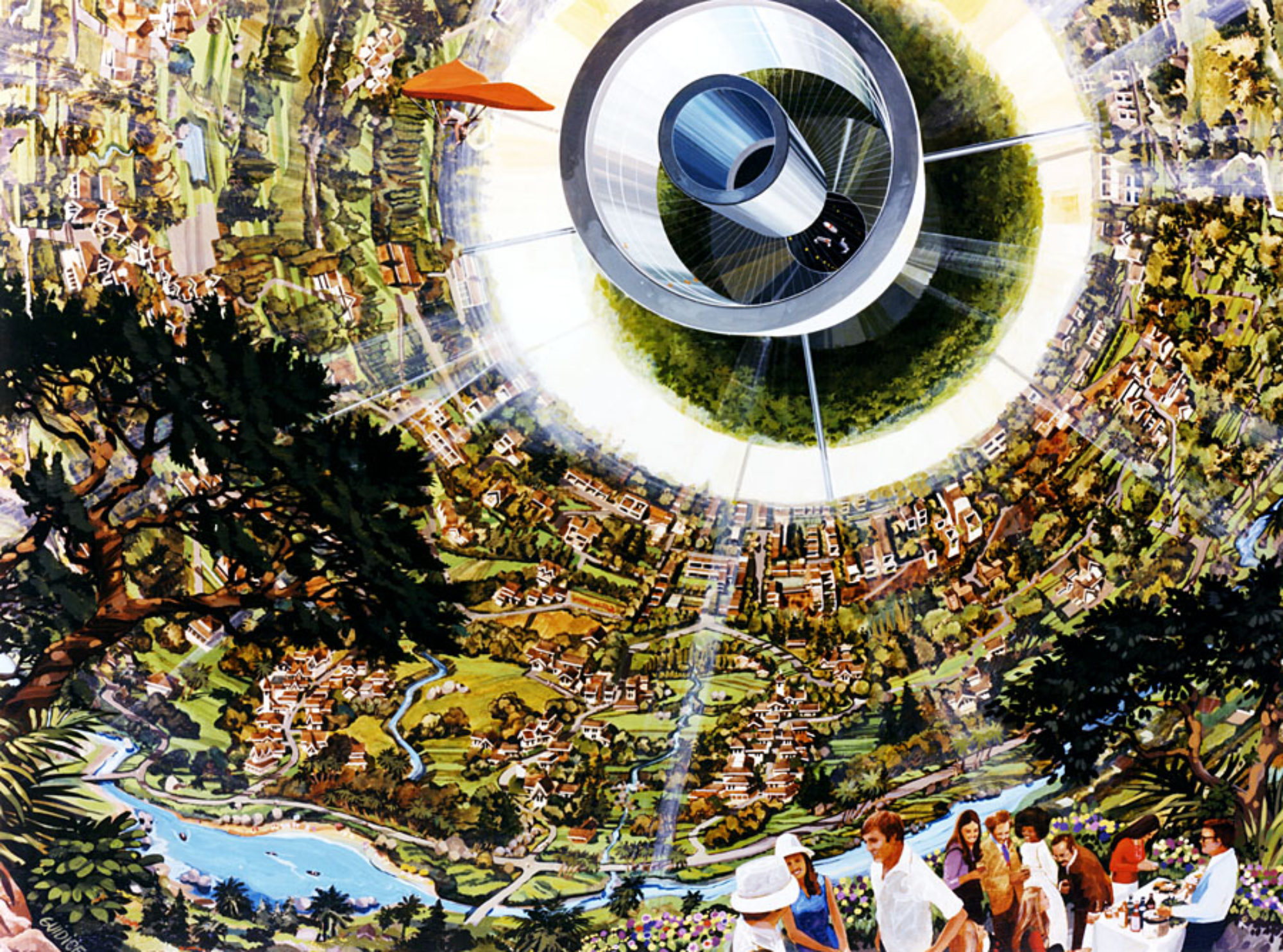


Before O’Neill’s Stanford Torus. Before Stanley Kubrick’s Space Station V in 2001: A Space Odyssey. Before Von Braun’s Space Wheel. There was Hermann Potočnik’s “Wohnrad”, or Habitat Wheel. Writing under the pseudonym Herman Noordung, his 1929 book Das Problem der Befahrung des Weltraums (The Problem of Space Travel) lays out the first serious architectural design of a rotating space station intended to incorporate artificial gravity for human habitation. In the forthcoming issue of Acta Astronautica coming out in April, space architect Sandra Haeuplik-Meusburger examines the early space station architecture via a digital and physical reconstruction. Noordung’s design is considered a milestone in space habitat concepts predating practical spaceflight by many decades.
Noordung’s Wohnrad provided one of the earliest fully developed technical designs for a rotating space station. Unlike speculative ideas before it, his design included three components with specific functions — a rotating Habitat Wheel spinning to create artificial gravity for living spaces at the rim. A free flying lab called the Observatory for scientific discovery. And a much larger sun facing solar power plant (Machine Room), also free flying, which would provide power and life support for the Observatory. Earlier scientists (e.g., Konstantin Tsiolkovsky, Hermann Oberth) suggested early ideas for space stations, but Noordung was the first to produce comprehensive architectural and mechanical drawings of one.
Noordung’s rotating wheel was the first space station intended to provide centrifugal force artificial gravity — a hugely influential idea that foreshadowed decades of later space habitat concepts including Von Braun’s Space Wheel in the 1950s, space station depictions in seminal science fiction movies such as Kubrick’s 2001: A Space Odyssey and of course, O’Neill’s Stanford Torus which didn’t come along until 1975. His design not only addressed physiological needs (countering weightlessness) but architecturally integrated human life support, observation, and workspaces into one cohesive structure — a novel systems-level vision at the time.


Haeuplik-Meusburger’s paper underscores how Noordung’s concept was architecturally rich — detailing spatial organization, functional modules, interior arrangements, including the logic for transitions between rotating and non-rotating sections. Her reconstruction work though modern digital modeling and 3D printed archetypes reveals architectural relationships between modules in more detail than prior historical treatments. Digital reconstruction of the original design provides new insights into proportional relationships, functional layout, and how Noordung envisioned human interactions in space. 3D printing prototypes helped the author reinterpret design logic in ways not possible from 2D archival drawings.
Lets dive in to the details. The author uses a mixed-method architectural and design research approach combining historical analysis with digital and physical reconstruction of Noordung’s original space station concept. She starts by collecting and studying the original material from Noordung’s 1929 book Das Problem der Befahrung des Weltraums — including diagrams, plans, textual descriptions, and images of the Wohnrad (Habitat Wheel) and associated modules (Observatory and Machine Room). The historical review also places the design in the context of other early spaceflight concepts and later influences (e.g., von Braun’s work and science-fiction imagery). This established a baseline understanding of the original design intent and the architectural logic behind the space station.
Next, Haeuplik-Meusburger created a virtual reconstruction taking historical, two-dimensional drawings and texts and translating the original figures into a detailed 3D digital model, probably using CAD or architectural modeling tools (the paper did not specify the software explicitly). This digital reconstruction allowed her to visualize and analyze the spatial layout, proportions, and structural relationships that aren’t obvious in the original flat plans.
After the digital model was created, the author 3D printed a physical prototype enabling tangible exploration of how spaces and modules relate — a method often used in architecture to test and critique design concepts. Moving between digital and physical forms helped identify aspects of the design that might be missed solely through drawing interpretation. Throughout the reconstruction, she provided an architectural interpretation of the design informed by human factors to understand how people would live, move, and interact with spaces under rotational artificial gravity — a layer of analysis beyond mere geometric reconstruction.
The author’s 3D modeling revealed the relationships between modules more clearly than the original drawings. Her findings included unexpected details about occupant circulation in the Habitat Wheel (e.g., access paths, stairs/elevator placement) and how spaces might feel or operate under rotation. This is significant because Noordung’s original descriptive text and flat plans alone could not convey the experience of inhabiting these spaces — a key gap filled by the reconstruction method.
The Habitat Wheel interior is partitioned into activity spaces and individual rooms in the outer rim structure accessed via a central corridor. This is where the crew would spend most of their time close to Earth-like conditions. In the illustration provided above by the author, the layout of the functional areas is shown color coded by the activities envisioned by Noordung.
His original design pegged the radius of the Habitat Wheel at 15 meters with a spin rate of 7.5 rpm resulting in level of artificial gravity of 0.94g. What we know now from many decades of research on human physiology under spin gravity conditions, this arrangement was impractical. The rate of rotation and relatively short radius of the station would likely result in significant Coriolis effects causing vestibule discomfort and disorientation in the occupants. Still, Haeuplik-Meusburger’s analysis places Noordung’s work on firm architectural and design grounds including the practicality of the Habitat Wheel as a concept with enduring lessons for how we might design rotating habitats in the future.
Realizing the issue with the Habitat Wheel’s short radius and high rotation rate, Haeuplik-Meusburger makes use of a Comfort Chart developed by Theodore Hall, a space architect and recognized expert on artificial gravity. The tool is a graph with habitat radius plotted against angular velocity with comfort zones where disorientation is minimized mapped on the plane of the chart. Armed with this information, the author proposes increasing the radius and reducing the rotation rate to a tolerable level, or even considering partial gravity levels of 0.2 to 0.5 g. Incidentally, Hall coauthored a paper on a Mars Cycler with artificial gravity covered by SSP last November.


Haeuplik-Meusburger’s use of physical and virtual models helps us better interpret how Noordung imagined habitability and use. For example, spatial organization suggests how living quarters, laboratories, and circulation were meant to function under artificial gravity conditions. In addition, her research clarified how functional logic (like the location of service spaces versus leisure or observation spaces) reflected deliberate design choices, not just schematic ideas.
The Observatory was intended primarily for scientific observation and microgravity research. It was designed to be free flying tethered to the Machine Room which provided power and breathable air via cables and flexible tubes, respectively. The weightless environment would minimize motion enabling equipment to operate more effectively in the absence of vibration. The facility would be equipped with instruments for astronomical observations, Earth monitoring, and telecommunications. The low-gravity environment made precise pointing of telescopes easier and instrument mounting simpler. In addition, there was a laboratory for performing experiments in microgravity. Noordung envisioned the station not just as a place to live but as a scientific platform in orbit, decades before orbital observatories and research facilities became reality.
One notable aspect of the Observatory was that the facility was intended to be placed in geostationary orbit 35,900 km above the Earth’s surface completing one orbit per day fixing it in the sky above the same location. Noordung suggested it could be used as a telecommunications relay station seventeen years before Arthur C. Clark introduced the concept of a communications satellite in a 1945 article in Wireless World.
The Machine Room was the station’s primary power plant, the earliest know example of a solar thermal-engine for use in space. The system featured a 120 meter concave mirror permanently facing the sun and focusing sunlight on heat pipes, whose working fluid would drive a turbine to generate electricity. The condenser and radiator in the thermal-engine circuit would be located at the back of the facility shielded from sunlight. Noordung chose nitrogen as the working fluid for the system over water as it results in significantly lower condenser temperature, leveraging the extreme cooling of the vacuum of space. The Machine Room was the largest facility of the space station containing the main solar power plant with storage batteries, a large transmission station, and a ventilation system serving the Observatory. Noordung’s design was remarkably forward-thinking, addressing real thermodynamic and space-environment challenges in a way that holds up conceptually even now.
One of the most innovative aspects of the space station was the design of the airlock located at the hub of the Habitat Wheel. In addition to addressing the core functions of maintaining internal atmospheric pressure during ingress/egress, allowing safe transition to vacuum and conserving breathable air, Noordung had a novel solution for resolution of the rotating-to-inertial frame problem created by a spinning space station – a rotating airlock chamber capable of counter-rotation.
Since the station’s rim would be rotating to generate artificial gravity and is mechanically connected to the hub, obviously the airlock would be rigidly attached to this rotating structure and have the same angular momentum as the station. Docking spacecraft or individuals on EVAs would have to synchronize their rotational motion to match the door of the airlock, which complicates entry or exit. Noordung’s solution was a system in which the astronaut would enter the airlock (e.g. when exiting the station) while it is rotating with the the habitat wheel. The chamber would be then mechanically driven to de-spin in the opposite direction of the station’s spin. When its angular velocity cancels out the station’s rotation, the airlock would become inertially stationary relative to space outside of the ship, upon which the outer hatch could be safely opened. Noordung’s design included ball-bearing systems, rotational drive mechanisms and sealed rotational interfaces implying that there would be a structural ring allowing relative motion between rotating and non-rotating sections, a mechanical transmission capable of controlled deceleration and a pressure sealing mechanism across a rotating joint. The latter requirement is mechanically demanding and remains challenging even in modern engineering – but he anticipated the mechanical need even though he did not mathematically model these issues in modern terms.
As an aside, the airlock concept was not the first ever conceived (airlocks were already used in mining, tunneling, and civil engineering projects on Earth in those times), but it is one of the earliest detailed proposals of an airlock in spaceflight literature of that period, specifically designed for a space station and EVA-type operations.
Since the station’s life support system was not intended to be ecologically closed and the facility was not intended to be crewed permanently, Noordung understood that supplies needed to be conserved as resupply from Earth would be expensive, especially prior to the advent of reusable rockets. Thus, his design pumped precious air in the airlock back into the station rather then vent it to space upon exit.

Haeuplik-Meusburger’s modeling and 3D printed physical reproductions reveal clearer spatial and operational insights about how the airlock access points functioned within the overall station layout showing relationships to the hub, circulation paths, and machinery areas. These aspects were not apparent in Noordung’s original 2D drawings as they compressed depth and circulation in ways that are hard to interpret from flat figures. For example, the air lock’s position in the axial hub is not incidental. It sits in a circulation node, not an isolated compartment. Her reconstruction reinforces that the airlock was not an accessory to the station but was embedded in a carefully organized hub as part of a systems cluster including machinery, life-support infrastructure, low-gravity workspace and external access. Seeing that integration clearly in 3-D strengthens the argument that Noordung was thinking in systems-architectural terms, one of the main conclusions of the paper. This systems integration is easier to recognize when viewing the station as a volumetric structure rather than separate diagrams.
Haeuplik-Meusburger’s analysis is innovative in how it reconstructs Noordung’s foundational ideas that deeply influenced both the technical lineage of space habitat design, and the cultural imagery of space stations in science and fiction. Her methods demonstrate how digital/physical reconstruction can deepen understanding of design concepts that were never constructed. Finally, the work reveals architectural details and ergonomic considerations that had previously been obscured in the original diagrams. By re-evaluating Noordung’s work with new modeling techniques, the paper provides both historical clarity and design insight that enriches our understanding of Noordung’s prescient visions for living in space, many of which were ahead of his time.